
U.S. swim fans have been on edge over the past month following the World Championships, questioning the future of Team USA heading into a home Olympics in about three years’ time.
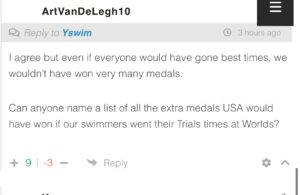
Commenter “ArtVanDeLegh” was one of several commenters over the past few weeks to raise the question: How well would Team USA have performed in Singapore had they been able to replicate their times from Nationals?
Does this information mean anything in the grand scheme of the meet? Absolutely not. But it can provide some outlook into the future as to how things could look over the next few years. This assumes setting aside the illness as well as the double taper issues the team has experienced at the past three major international meets—something Team USA historically excelled at prior to 2022.
This same analysis can be run for any country, as teams such as Great Britain, Australia, and Canada experienced some level of sickness in Singapore. But we’re focusing specifically on the Team USA angle, though we may run through the scenarios for some of these other countries in the coming months.
This is all hypothetical. It’s essentially impossible for every swimmer to replicate their best swims from Trials to Worlds. But given their capabilities, it does provide hard facts as to where Team USA stands at their best, especially given the widespread criticism of the team, specifically the men.
When running the data, the women’s team could have won two additional individual gold medals (50 & 100 free) and a total of seven extra medals. On the men’s side, where most of the fan criticism lies, they would have won only three additional individual medals (400 IM, 200 fly, & 200 back), none of which were gold.
The relays are where the USA team heading into Los Angeles has the best opportunity to target topping the medal table. Their season bests on paper should have easily won them three extra relay gold medals (women’s 4×100 free, men’s 4×100 free, & men’s 4×200 free), with the latter two on track to set new world records.
The biggest problem stems not only from sickness or double taper issues, but from the depth of the Americans in these events that requires them to go “all-in” on a taper for Trials.
Australia has faced this same challenge with their women over previous seasons for both the 4×100 and 4×200. They had to go all-in at their Trials but then handled the transition to major international meets very well. It’s an issue that is very manageable for the Americans over the next few years, especially with an experienced coach like Greg Meehan now at the helm of the U.S. National Team.
Taking into account both individual and relays on paper, the Americans could have walked away with four additional golds and 11 total medals. Things never go perfectly, and if there had been no sickness or any other issues, it’s almost impossible that this outcome would have unfolded anyway, but people have been asking for the data as a point of analysis over the next three years.
See the raw data below.
Women
- 50 Freestyle
- 1. Meg Harris (Australia) — 24.02
- Gretchen Walsh (23.91) and Torri Huske (23.98) both went sub-24 en route to a 1-2 punch at U.S. Nationals
- 2. Wu Qingfeng (China) — 24.26
- 3. Cheng Yujie (China) — 24.28
- 1. Meg Harris (Australia) — 24.02
- 100 Freestyle
- 1. Marrit Steenbergen (Netherlands) — 52.55
- Torri Huske went 52.43 to win U.S. Nationals
- 2. Mollie O’Callaghan (Australia) — 52.67
- 3. Torri Huske (United States) — 52.89
- Gretchen Walsh went 52.78 for runner-up at U.S. Nationals; Rylee Erisman clocked 52.79 to win World Juniors
- 1. Marrit Steenbergen (Netherlands) — 52.55
- 200 Freestyle
- 1. Mollie O’Callaghan (Australia) — 1:53.48
- 2. Li Bingjie (China) — 1:54.52
- 3. Claire Weinstein (United States) — 1:54.67
- 400 Freestyle
- 1. Summer McIntosh (Canada) — 3:56.26
- 2. Li Bingjie (China) — 3:58.21
- 3. Katie Ledecky (United States) — 3:58.49
- Went an even faster 3:56.81 In April
- 800 Freestyle
- 1. Katie Ledecky (United States) — 8:05.62
- Went an even faster 8:04.12 World Record In April
- 2. Lani Pallister (Australia) — 8:05.98
- 3. Summer McIntosh (Canada) — 8:07.29
- 1. Katie Ledecky (United States) — 8:05.62
- 1500 Freestyle
- 1. Katie Ledecky (United States) — 15:26.44
- 2. Simona Quadarella (Italy) — 15:31.79
- 3. Lani Pallister (Australia) — 15:41.18
- 50 Butterfly
- 1. Gretchen Walsh (United States) — 24.83
- 2. Alexandria Perkins (Australia) — 25.31
- 3. Roos Vanotterdijk (Belgium) — 25.43
- Kate Douglass went 25.39 for runner-up at U.S. Nationals
- 100 Butterfly
- 1. Gretchen Walsh (United States) — 54.73
- 2. Roos Vanotterdijk (Belgium) — 55.84
- 3. Alexandria Perkins (Australia) — 56.33
- 200 Butterfly
- 1. Summer McIntosh (Canada) — 2:01.99
- 2. Regan Smith (United States) — 2:04.99
- 3. Elizabeth Dekkers (Australia) — 2:06.12
- Caroline Bricker went 2:05.80 to win U.S. Nationals; Tess Howley clocked 2:05.20 at WUGs
- 50 Backstroke
- 1. Katharine Berkoff (United States) — 27.08
- She went an even faster 26.97 to win U.S. Nationals
- 2. Regan Smith (United States) — 27.25
- She went an even faster 27.20 for runner-up at U.S. Nationals
- 3. Wan Letian (China) — 27.30
- 1. Katharine Berkoff (United States) — 27.08
- 100 Backstroke
- 1. Kaylee McKeown (Australia) — 57.16
- 2. Regan Smith (United States) — 57.35
- 3. Katharine Berkoff (United States) — 58.15
- She went an even faster 58.13 for runner-up at U.S. Nationals
- 200 Backstroke
- 1. Kaylee McKeown (Australia) — 2:03.33
- 2. Regan Smith (United States) — 2:04.29
- 3. Claire Curzan (United States) — 2:06.04
- She was an even faster 2:05.09 to win U.S. Nationals; Leah Shackley notched 2:05.99 during WUGs semifinals
- 50 Breaststroke
- 1. Ruta Meilutyte (Lithuania) — 29.55
- 2. Tang Qianting (China) — 30.03
- 3. Benedetta Pilato (Italy) — 30.14
- McKenzie Siroky clocked 30.05 to win a swim-off at U.S. Nationals
- 100 Breaststroke
- 1. Anna Elendt (Germany) — 1:05.19
- 2. Kate Douglass (United States) — 1:05.27
- 3. Tang Qianting (China) — 1:05.64
- 200 Breaststroke
- 1. Kate Douglass (United States) — 2:18.50
- 2. Evgeniia Chikunova (Neutral Athletes ‘B’) — 2:19.96
- 3. Kaylene Corbett (South Africa) & Alina Zmushka (Neutral Athletes ‘A’) — 2:23.52
- Alex Walsh went 2:22.45 for runner-up at U.S. Nationals
- 200 IM
- 1. Summer McIntosh (Canada) — 2:06.69
- 2. Alex Walsh (United States) — 2:08.58
- She went an even faster 2:08.45 to win U.S. Nationals
- 3. Mary-Sophie Harvey (Canada) — 2:09.15
- 400 IM
- 1. Summer McIntosh (Canada) — 4:25.78
- 2. Jenna Forrester (Australia) & Mio Narita (Japan) — 4:33.26
- 3. N/A
- 4×100 Freestyle Relay
- 1. Australia — 3:30.60
- Fastest U.S. times in 2025 add up to 3:29.33
- 2. United States — 3:31.04
- 3. Netherlands — 3:33.89
- 1. Australia — 3:30.60
- 4×200 Freestyle Relay
- 1. Australia — 7:39.35
- 2. United States — 7:40.01
- Fastest U.S. times in 2025 (-1.5) add up to 7:39.61
- 3. China — 7:42.99
- 4×100 Medley Relay
- 1. United States — 3:49.34
- Fastest U.S. times in 2025 (-1.5) add up to 3:48.15 WR
- 2. Australia — 3:52.67
- 3. China — 3:54.77
- 1. United States — 3:49.34
Men
- 50 Freestyle
- 1. Cameron McEvoy (Australia) — 21.14
- 2. Ben Proud (Great Britain) — 21.26
- 3. Jack Alexy (United States) — 21.46
- Went an even faster 21.32 in semifinals at Worlds
- 100 Freestyle
- 1. David Popovici (Romania) — 46.51
- 2. Jack Alexy (United States) — 46.92
- Went an even faster 46.81 in semifinals at Worlds
- 3. Kyle Chalmers (Australia) — 47.17
- 200 Freestyle
- 1. David Popovici (Romania) — 1:43.53
- 2. Luke Hobson (United States) — 1:43.84
- Went an even faster 1:43.73 to win U.S. Nationals
- 3. Tatsuya Murasa (Japan) — 1:44.54
- 400 Freestyle
- 1. Lukas Martens (Germany) — 3:42.35
- 2. Sam Short (Australia) — 3:42.37
- 3. Kim Woo-min (South Korea) — 3:42.60
- 800 Freestyle
- 1. Ahmed Jaouadi (Tunisia) — 7:36.88
- 2. Sven Schwarz (Germany) — 7:39.96
- 3. Lukas Martens (Germany) — 7:40.19
- 1500 Freestyle
- 1. Ahmed Jaouadi (Tunisia) — 14:34.41
- 2. Sven Schwarz (Germany) — 14:35.69
- 3. Bobby Finke (United States) — 14:36.60
- 50 Butterfly
- 1. Maxime Grousset (France) — 22.48
- 2. Noe Ponti (Switzerland) — 22.51
- 3. Thomas Ceccon (Italy) — 22.67
- 100 Butterfly
- 1. Maxime Grousset (France) — 49.62
- 2. Noe Ponti (Switzerland) — 49.83
- 3. Ilya Kharun (Canada) — 50.07
- 200 Butterfly
- 1. Luca Urlando (United States) — 1:51.87
- 2. Krzysztof Chmielewski (Poland) — 1:52.64
- 3. Harrison Turner (Australia) — 1:54.17
- Carson Foster went 1:53.70 for runner-up at U.S. Nationals; Thomas Heilman logged 1:54.03 for third at the same meet
- 50 Backstroke
- 1. Kliment Kolesnikov (Neutral Athletes ‘B’) — 23.68
- 2. Pieter Coetze (South Africa) & Pavel Samusenko (Neutral Athletes ‘B’) — 24.17
- 3. N/A
- 100 Backstroke
- 1. Pieter Coetze (South Africa) — 51.85
- 2. Thomas Ceccon (Italy) — 51.90
- 3. Yohann Ndoye-Brouard (France) — 51.92
- 200 Backstroke
- 1. Hubert Kos (Hungary) — 1:53.19
- 2. Pieter Coetze (South Africa) — 1:53.36
- 3. Yohann Ndoye-Brouard (France) — 1:54.62
- Jack Aikins went 1:54.25 to win U.S. Nationals
- 50 Breaststroke
- 1. Simone Cerasuolo (Italy) — 26.54
- 2. Kirill Prigoda (Neutral Athletes ‘B’) — 26.62
- 3. Qin Haiyang (China) — 26.67
- 100 Breaststroke
- 1. Qin Haiyang (China) — 58.23
- 2. Nicolo Martinenghi (Italy) — 58.58
- 3. Denis Petrashov (Kyrgyzstan) — 58.88
- 200 Breaststroke
- 1. Qin Haiyang (China) — 2:07.41
- 2. Ippei Watanabe (Japan) — 2:07.70
- 3. Caspar Corbeau (Netherlands) — 2:07.73
- 200 IM
- 1. Leon Marchand (France) — 1:53.68
- 2. Shaine Casas (United States) — 1:54.30
- 3. Hubert Kos (Hungary) — 1:55.34
- 400 IM
- 1. Leon Marchand (France) — 4:04.73
- 2. Tomoyuki Matsushita (Japan) — 4:08.32
- Bobby Finke (4:07.46) & Carson Foster (4:07.92) both went sub-4:08 en route to a 1-2 punch at U.S. Nationals
- 3. Ilia Borodin (Neutral Athletes ‘B’) — 4:09.16
- 4×100 Freestyle Relay
- 1. Australia — 3:08.97
- 2. Italy — 3:09.58
- 3. United States — 3:09.64
- Fastest U.S. times in 2025 (-1.5) add up to 3:08.03 WR
- 4×200 Freestyle Relay
- 1. Great Britain — 6:59.84
- Fastest U.S. times in 2025 (-1.5) add up to 6:57.28 WR
- 2. China — 7:00.91
- 3. Australia — 7:00.98
- 1. Great Britain — 6:59.84
- 4×100 Medley Relay
- 1. Neutral Athletes ‘B’ — 3:26.93
- 2. France — 3:27.96
- 3. United States — 3:28.62
- Fastest U.S. times in 2025 (-1.5) add up to 3:27.51 (3:27.15 when factoring in Alexy’s 45.95 relay split)

The lack of American men across fly, back, and breast is startling
400, 800, 1500 free as well
800 and 1500, yeah. Can’t say 400. Maurer- 3:43.3 and Mijatovic 3:45 and are at the younger side of things
I appreciate that you have a lot of disclaimers at the beginning of the article, but…perhaps it would be more informative looking to 2028 if you used every athlete’a best times this year, not just for the US? I know there’s the swim data section of the website but it’s not limited to the top 2 per country to simulate a world meet.
I just want to see two US swimmers final in the 400, 800, 1500 free that would be a good start…
You mean “two US *male* swimmers”
Got the 4×200 free relay for women has so much potential. I wish they could have Weinstein, Gemmell, Sims, and Ledecky all peak at the right time. Gemmell and Sims go 1:54.2-1:54.7, Weinstein a 1:54.6, and Ledecky 1:53.6, that’s a world title right there
Would’ve been enough for a world title this year but might not be enough at next worlds if Titmus returns to anywhere near her best.
“I wish they could have Weinstein, Gemmell, Sims, and Ledecky all peak at the right time”
It’s meaningless if Pallister + Titmus + MOC + Perkins peak at the right time.
Very soon Rylee Erisman will swim under 1:54, certainly for the 2028 Olympics.
That’s always assuming that whoever got the medals instead wouldn’t have had an answer and gone even faster.
For sure. There’s endless hypotheticals. This is just one specific one that people asked about, so we obliged.
The intention is to try and sniff out the roots of USA Swimming’s performance problem (especially on the men’s side). If it turns out that their best times from Trials would make a significant medals impact at Worlds, then maybe the issues is either with 1) timing of Trials or 2) those final preparations for Trials.
Women’s 4x 200 feels a little misleading because if you just throw gemmel or huske’s flat start pb in there, that relay would have been 7:38
That’s still slower than Australia’s would be if you use the same formula
That’s still slower than Australia add up.
i think the mens relay side is honestly was has stirred up the most disappointment in the comments. Two add ups for a wr time only to get bronze and off the podium blindsided quite a few people.
Taking account the medal tally, the boys at the 2025 World Aquatics Junior Swimming Championships were even worse than the men at the 2025 World Aquatics Championships:
Boys: 0 G, 0 S, 4 B
Men: 1 G, 3 S, 4 B
Edit: Never mind, irrelevant for future meets