2025 World Championships
- July 27 – August 3, 2025 (pool swimming)
- Singapore, Singapore
- World Aquatics Championships Arena
- LCM (50m)
- Meet Central
- Entry Book
- Live Results
- SwimSwam Preview Index
BY THE NUMBERS – Mixed 400 Free Relay
- World Record: 3:18.83 – AUS (J. Cartwright, K. Chalmers, S. Jack, M. O’Callaghan), 2023
- World Junior Record: 3:24.29 – AUS (F. Southam, E. Sommerville, O. Wunsch, M. Jansen) – 2023
- Championship Record: 3:18.83 – AUS (J. Cartwright, K. Chalmers, S. Jack, M. O’Callaghan), 2023
- 2023 World Champion – AUS (J. Cartwright, K. Chalmers, S. Jack, M. O’Callaghan) 3:18.83
- 2024 World Champion – China (Pan Z., Wang H., Li B., Yu Y.) – 3:21.18
The lone holdout in the list of swimming events that are contested at World Championships and not at the Olympics, now that the 50s of stroke have been added to the Olympic program for the 2028 LA Games, the mixed freestyle relay holds a unique position. It’s an event that seemingly should be more popular but often finds itself maligned by swim fans, or perhaps it’s just the comment section. Yet, it’s not just by swim fans as some nations tend not to load the relay with their best swimmers, perhaps due to it not being an Olympic event, or maybe just finding a need to give rest to their stars when they can.
As compared to the mixed medley relay, which gives the opportunity for stroke specialists to shine, giving many of them another opportunity to swim, the mixed free relay is all about which nations have the best freestylers. While the mixed medley has multitudes of line-up permutations, questions about wakes and hard math, the mixed free relay is easy: Fastest two men on the front, so you don’t have to worry about wakes, and then close with your fastest two women. Bish, Bash, Bosh. Bob’s your uncle.
With the relay occurring on the penultimate day of the competition, both the men’s and women’s 4×100 free relay will have occurred, as too will the individual 100 free finals, so coaches will have plenty of time and information to formulate the fastest team. The men’s 50 free final and the women’s 50 free semis, as well as the men’s 100 fly final and the women’s 50 fly final, do occur in the same session, so some swimmers may be pulling double or triple duty.
In 2023, the Australians rolled to a 1.99-second victory in this event as the team of Jack Cartwright, Kyle Chalmers, Shayna Jack, and Mollie O’Callaghan set a new World Record of 3:18.83. The result wasn’t that surprising, as both of the Australians’ men’s and women’s 4×100 free relay topped the podium, with the women doing so in World Record fashion. The United States, which also podiumed in the men’s and women’s relays, took the silver in 3:20.82, while the bronze went to Great Britain, who were DQed in the men’s event and placed 5th in the women’s event. China chose not to load the relay in prelims, leaving their fastest men off, and finished 9th and missed the final, but remedied that the next year in Doha.
While a more sparsely attended meet than past editions, the Chinese team left nothing to chance and set a new Asian Record in the prelims, qualifying first in 3:24.47. In the finals, Pan Zhanle led off in 47.29 and, with his teammates Wang Haoyu, Li Bingjie, and Yu Yiting, stopped the clock in 3:21.18, the 4th fastest performance of all time. With China’s jump up from not making the final to winning, the Australians picked up the silver, and the Americans collected the bronze.
“We Are Family”

PAN Zhanle WANG Haoyu LI Bingjie
YU Yiting
World Aquatics Championships – Doha 2024
02 – 18 Feb 2024
credit Fabio Cetti
The podium in this event, unless a team’s DQ or does not make the final, is generally easy to predict as those teams with both depth in the men’s and women’s sprints are naturally going to do better and as we picked the United States, Australia and China to top the podium in both the men’s and women’s relays, that seems like a good place to start.
In Doha, the Chinese front half of Pan and Wang split 47.29 and 47.41, which was over half a second under World Record pace, but Li (53.11) and Yu (53.37) fell off the pace, as each was over a second slower than the Australians’ last two legs.
All four of the swimmers return to Singapore with Pan, the WR holder in the individual 100, leading the way. Wang appears like a strong candidate to rejoin him, but was out-touched by Chen Juner at the recent Chinese nationals, so it likely would come down to whoever looks better earlier in the week, but Wang does have a better PB.
As for the Women, Li is an unlikely choice as she has likely has the final of the 800 free in the same session, and China does have more sprint-oriented options. National record holder Yang Junxuan is not on the roster, but Wu Qingfeng, Zhang Yufei, and Cheng Yujie are, each of whom was on the women’s bronze medal-winning 4×00 free relay at the Olympics in Paris. Wu and Cheng topped the competition at nationals, stopping the clock with times of 53.27 and 53.35. When their times are summed with the fastest two men, Pan (47.77) and Chen (48.00), the quartet gets a time of 3:22.39, which is just a little more than a second off their national record and does not account for relay splits.
The Australians, who were missing a few key legs in Doha, settled for the silver with a time of 3:21.78. The Australian women are undergoing a bit of a rejuvenation as they are dealing with some key absences, but the return of Mollie O’Callaghan and Kyle Chalmers to this relay (potentially) turns things around. Both were absent in Doha, but each lead the way into Singapore in the individual 100. They do lose Cartwright (48.14 lead-off) and Jack (51.73) from their WR setting relay, but have some strong options to fill in.
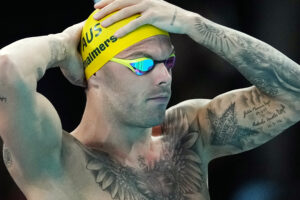
Kyle Chalmers from Australia in action at the 2024 Summer Olympics, Thursday, July 27, 2024, in Paris, France. (Photo by Gian Mattia D’Alberto/LaPresse)
Chalmers won the event at Australian Trials in 47.27, just .02 off his flying start from Fukuoka, so could easily drop time. Flynn Southam took 2nd behind him with a time of 47.69, which, if he leads off, is nearly a half-second improvement on Cartwright. O’Callaghan was a little off at trials, winning in 52.87, but wasn’t under much pressure in the event. Olivia Wunsch took 2nd behind her with a 53.38, but the Australians could also tap Meg Harris, who was the top seed in prelims (53.01), but withdrew from the finals to concentrate on the 50 free. Harris has split under-52, but as the defending silver medalist in the 50 free, she may not wish to potentially jeopardize her chances in the 50 final the following evening.
If we stick to the same format as we did with the Chinese and just used their times from trials, the Australian foursome of Chalmers (47.27), Southam (47.69), O’Callaghan (52.87), and Wunsch (53.38) add up to a time of 3:21.21, which places them just about a second ahead of the Chinese.
Taking the bronze in Doha were the American team of Hunter Armstrong (47.83), Matt King (47.78), Claire Curzan (53.82), and Kate Douglass (52.85); however, it’s entirely possible that not a single one of them makes a reappearance. Armstrong and King are not on the roster, Curzan is, but only made the team in the 200 back, and Douglass placed 4th in the individual event at US Nationals.
Jack Alexy, who led off in Fukuoka with a 47.68, topped the field at Nationals with a swift 47.17 finals time (he was 46.99 in prelims) and looks to return to this relay as a strong counter to Pan and Chalmers. Patrick Sammon took 2nd at Nationals with a 47.47, but was just .02 ahead of Chris Guiliano, who himself was .09 ahead of 4th place finisher Destin Lasco. Of the three, Guiliano has the fastest PB (47.25), but the last spot will likely come down to whomever looks best over the preceding week of competition.
The same can be said for the women’s relay spots. Douglass was part of the relay team in 2023 and 2024, but finished 4th at Nationals, touching in 53.16, behind Torri Huske (52.43), Gretchen Walsh (52.78), and Simone Manuel (52.83). On paper, Huske and Walsh would get the nod, but each is likely to be in the semifinals of the 50 free, and Walsh likely has the 50 fly final, where she could be joined by Douglass. Of the three, only Manuel has no conflicts, but again, it will be up to the coaches to determine the roster.
Using the same formulas as we did for the teams above, the US’s top four combine to hypothetically stop the clock in 3:19.85, a time that clearly puts them ahead of their closest two competitors and with half a second of the American record of 3:19.40 set back in 2019.
| China | Australia | USA | |
| 1st | Pan – 47.77 | Chalmers – 47.27 | Alexy – 47.17 |
| 2nd | Chen – 48.00 | Southam -47.69 | Sammon -47.47 |
| 3rd | Wu – 53.27 | O’Callaghan – 52.87 | Huske – 52.43 |
| 4th | Cheng – 53.35 | Wunsch – 53.38 | Walsh – 52.78 |
| Cumulative Time | 3:22.39 | 3:21.21 | 3:19.85 |
| National Record | 3:21.18 | 3:18.83 | 3:19.40 |
On paper, the US looks to be heavy favorites, but it’s a little misleading. Alexy and Huske’s times are close to their PBs, and Walsh and Sammon’s are their PBs, while all of the times for the Australians save Southam are not PBs. O’Callaghan could easily make up a second of the differential herself, and Pan could as well, and that doesn’t include a flying start.
“Girls Chase Boys”
After the top three nations, there are few countries that have both strong men’s and women’s 100 freestyles, but either not in the depth needed to compete with the top three or they are just slightly slower overall.
NAB
The Neutral Athletes B team, made up of swimmers from Russia, makes its return to the long-course World Championships and could look to shake things up. Egor Kornev posted the 5th fastest time in the World this year with his 47.42 at Russian Nationals, and could be joined by Andrei Minakov (48.16) and Vladislav Grinev (48.16). On the women’s side, Daria Klepikova and Daria Trofimova are both amongst the top 25 in the World this season, with Klepikova’s 53.53 ranking her tied for 14th.
Since it’s been a while since they competed in this event, they finished 5th at the 2019 edition of this meet with a time of 3:22.72. It’ll be interesting to see how the next generation of sprinters performs.
Canada
One spot ahead of them in 2019, and taking 4th in both 2023 and 2024 are the Canadians. The Canadian sprinting corps has fallen upon rough times as of late, with Maggie MacNeil and Rebecca Smith retiring, Kayla Sanchez switching sporting nationalities to the Philippines, and Penny Oleksiak withdrawing from the meet. The women aren’t alone with being hit, as Javier Acevedo, who split 47.58 in Doha, is not competing this summer, and Josh Liendo looked a little off in the event at Trials, placing 3rd with a 48.62. Ruslan Gaziev leads the way, but with a time of 48.37 from Trials, it’s not enough to counter the potential sub-46s from the leading pack to keep the Canadians close.
In the past, this wasn’t a significant issue, as the women would close the gap. However, with Superstar Summer McInstosh likely in the 800 free right before this event, they will need Taylor Ruck to drop a substantial amount of time from her 54.41 100 time from trials.
Italy
credit Giorgio Scala / DBM
The Italian men captured the bronze medal in the men’s 4×100 free relay in Paris, but lost two of their legs from said relay; fortunately for them, though, they only need two men for this relay.
Manuel Frigo split 47.06 in Paris, and looks to be a strong contender for a spot in this event. He likely is joined by Carlos D’Ambrosio who is the only Italian swimmer on the top 25 list in the World this year, coming in at 24th with a 48.14. Thomas Ceccon was 47.44 in Paris, but with the semis of the 50 back in the same session, he may be an unlikely pick, especially is D’Ambrosio throws down some fast times earlier in the week.
The Italian women didn’t fare as well in Paris, placing 8th in the final, but Sara Curtis‘s improvement alone could make up a huge difference. In Paris, with a flying start, she was 54.24, but since then, she has made massive strides, setting a new national record of 53.01 in the event. Tied for 6th fastest in the world this season, Curtis could easily be two seconds faster than the Italians slowest leg in Fukuoka (54.84), when the team finished 5th with a time of 3:24.53.
Hungary
In both the men’s and women’s event previews, we picked the Hungarians as the Dark Horses, and as such, they certainly could be in consideration for a high finish in Singapore. As many nations do not have qualifying swims within the time period, the Hungarians find themselves seeded first, with a time of 3:25.69 from their gold medal-winning performance at the 2024 European Championships.
Hubert Kos led off that relay in 49.39, but he is unlikely to swim as he is also entered in the 50 back and 100 fly, which are in the same session, and the Hungarians return the Olympic 4th place finisher, Nandor Nemeth. Panna Ugrai and Nikolett Padar were the two women on that relay and still could occupy those spots, but like every other team, it likely comes down to who is in good form.
“The Boys of Summer”
Great Britain
The Brits won the bronze medal in Fukuoka, setting a European Record of 3:21.68. Their two front legs, Matt Richard (47.83) and Duncan Scott (47.46), return, but they lose Anna Hopkin (53.30). While Freya Anderson (53.09) won the 100 free at the British Championships, she did so in 54.09, with Eva Okaro taking 2nd place behind her at 54.10.
Scott is by no means a sure pick to be on the relay, as Jacob Mills is the Brit’s second entrant in the individual event and, like a broken record, this relay’s composition likely will come down to who looks best over the course of the meet.
If they do wish to be competitive in the event, the men, the Olympic Champions in the 4×200 free relay, will need to get the team out to a good start and hope that Anderson can rediscover her form.
In a similar position are the French and Germans. Both of their teams have strong front halves but are lacking in the women’s sprints. Maxime Grousset and Josha Salchow were both Olympic finalists in the event in Paris, finishing 5th and 6th respectively.
France
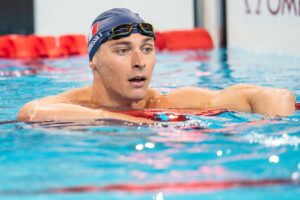
Maxime Grousset (photo: Jack Spitser)
Grousset sits 6th in the individual event this year (47.33) and is joined by compatriot Rafael Fente-Damers, who is 16th (48.02), but Grousset is in a tough position as he likely could have both the 50 free and 100 fly finals in the same session, and the French fall off after him.
Beryl Gastaldello has been having a strong season, as her season best of 53.60 ranks her 19th in the world this season, but there is no clear favorite to join her on the backhalf of the relay, and even if there were it may be moot as the French won’t likely use Grousset in the prelims and may not have the depth to break make the final; as the finished 10th in Fukuoka.
Germany
Despite Salchow’s high finish in Paris, the German finds himself lowered down the World Rankings this year. While Grousset popped a 47.50 at French Nationals and ranks 8th, Salchow has only been as fast as 48.02 and sits tied at 19th. And whereas the French and Brits have a strong second entrant in the individual event, the Germans do not and will need relay-only swimmer Rafael Miroslaw to recapture the 47.66 that he split to help the German men finish 7th in the relay in Paris.
The German women will also need a strong performance from their women as they only have one individual entrant in the 100 free, with Nina Holt‘s 53.90 ranking her outside the top 16 seeds. The Germans finished 3rd at Europeans with a time of 3:27.01, but that likely won’t make the cut in Budapest, and they will need to be likely faster than the 3:26.78 that earned them 8th in the prelims in Fukuoka if they wish to advance.
“Girls Just Want to Have Fun”
Netherlands
On the other end of the spectrum, there are a few teams whose strength derives from their women, and foremost among those teams are the Dutch. The Netherlands topped the podium in the women’s 4×100 free relay in Doha, but failed to make the final in Paris. In this event, they placed 12th in Fukuoka, but advanced to the final and placed 6th in Doha.
On that relay, Marrit Steenbergen split 52.74 and has nearly eclipsed that mark flat-footed, as her 52.77 sits seconds in the world this year. It’s not just Steenbergen, though, leading the Dutch in the event, as Milou Van Wijk crashed into the top of the world rankings this past March with a 53.18 and now sits 9th in the world.
With a backhalf that could conceivably make up more than four seconds on some of their competitors, the Dutch need strong performances from their men to keep them close. Unfortunately, they only have two men entered in freestyle events, so they may need to be creative with their line-ups. Sean Niewold is entered in the 100 free and is tied at 48.14 with D’Ambrosio as the 20th seed and seems very likely to be on the relay. The only male returner from their 2023 and 2024 relays is breaststroker Caspar Corbeau, but they likely will call upon Renzo Tjon A Rose, who is entered in the 50 free.
“Together Forever”
If things stick to form, then the United States looks to be in a tenable position to capture this title for the first time since 2019, but rarely do things stick to form. The US could opt not to use Walsh or Huske and give them rest for the next day, where they likely have the finals of the 50 free and the 400 medley relay. In 2023, Pan did not contest this relay and could again be left off the relay to save his strength for the 400 medley relay, where the Chinese are the defending Olympic Champs and could conceivably be making a run at the World Record.
The Australians, of the top three, seem the least likely to not load the relay as they have fewer potential doubles and look to be in form to reassert themselves atop the field, but much of it comes down to Pan and Walsh/Huske’s involvement.
After those three, it’s quite difficult to predict. The Brits took 3rd in Fukuoka, but a pair of 53 losses on the back half seems unlikely this year, and the NAB team seems poised to potentially jump into 4th, but so too can the Italians, and even the Canadians could, if Ruck and Liendo find their form. The Dutch are an interesting dilemma as they have the backhalf, but the front half woes may be too much to overcome, and the Hungarians, Germans, and/or French could just be too far out in front to run down.
We are going with the US as the top pick based on their versatility, as Manuel and Douglass have strong experience and past performances to anchor this relay, whereas if Pan or Harris don’t swim, then their nations may suffer. That said, it is a toss-up, and while I’m not a betting man, I wouldn’t make any bets on this event, except to put money on the fact that it is bound to be entertaining.
SwimSwam’s Picks
| Place | Nation | Entry Time | National Record | 2023/2024 Worlds Finish |
| 1 | USA | N/A | 3:19.40 | 2nd/3rd |
| 2 | Australia | N/A | 3:18.83 | 1st/2nd |
| 3 | China | N/A | 3:21.18 | 9th/1st |
| 4 | NAB | N/A | 3:22.72 | N/A |
| 5 | Great Britain | 3:27.93 | 3:21.68 | 3rd/N/A |
| 6 | Italy | 3:28.34 | 3:22.64 | 5th/5th |
| 7 | Canada | N/A | 3:20.61 | 4th/4th |
| 8 | Netherlands | N/A | 3:21.81 | 12th/N/A |
Dark Horses: Poland & Japan- It’s very unusual to have the #2 seed, Poland, and the 7th place finisher in Fukoka, Japan, as dark horses, but this event is so uncertain that outside of the top four, the confidence factor starts to deteriorate very quickly. Poland took 2nd behind the Hungarians at the 2024 European championships, winning the silver medal in 3:26.53, and just took 3rd at the U23 LEN meet. Japan was 6th in the prelims in Fukuoka with a 3:26.47 and again could be in amongst the mix to make the final. They don’t have any individual entrants in the men’s 100 free, but Katsuhiro Matsumoto won the event at Japanese Trials in 48.36, and also could have a conflict with the 100 fly.

This would’ve been a three-way tossup if every country had a full-strength delegation, but China and Australia each leaving one of their female legs at home means the USA should be able to win this.
2 hours 20 minutes till prleims day one!!!