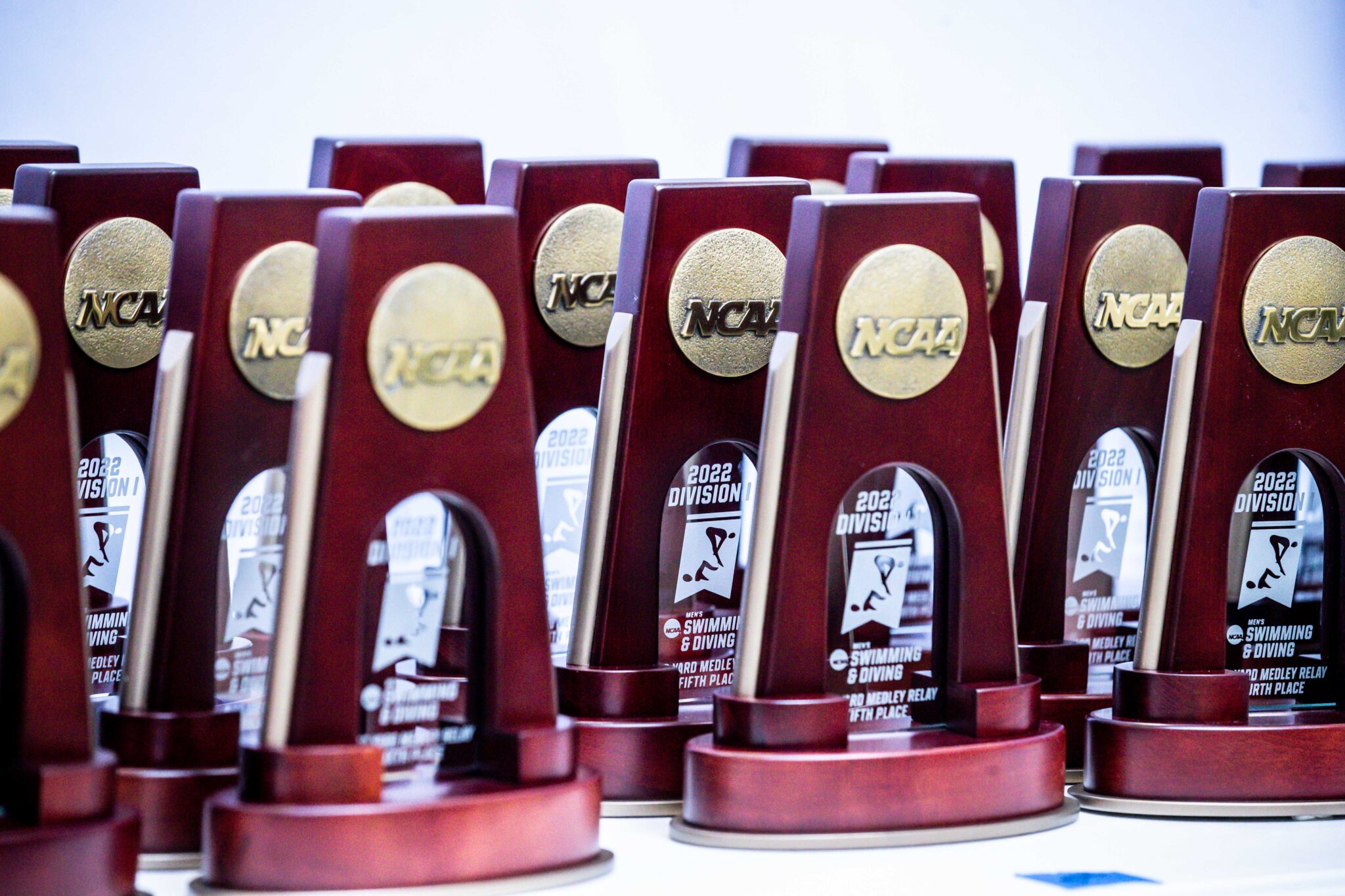
The NCAA Division I Men’s and Women’s Swimming and Diving Oversight Committee has agreed to make changes to the format of the national championship beginning in 2027, accepting most of the recommendations put forth by the College Swimming and Diving Coaches Association of America (CSCAA).
For the 2025-26 swimming and diving season, the NCAA made a number of changes to the Division I championships, including removing ‘B’ finals, rescheduling the competition to optimize broadcasting, shuffling the order of events, and introducing a new qualification model. The new format drew wide criticism, and the CSCAA reacted immediately by creating a Division I NCAA Championship Working Group. After soliciting feedback and meeting twice during the month of April, the working group put together a list of recommendations for both the 2027 NCAA Championships and the future (2028 and beyond).
The Swimming and Diving Oversight Committee has now approved most of those recommendations.
Consolation finals
‘B’ finals are back! The NCAA has approved reinstating the consolation finals for the 2027 championships. While in the past, the finals session for swimming has consisted of a ‘B’ final followed by an ‘A’ final for each event, the 2027 model will have all consolation finals starting at 6 p.m., with all championship finals beginning at at 7 p.m.
Diving consolation finals will begin immediately after the preliminaries, while the championship finals will take place in the evening session. Diving will retain the split format that was introduced in 2026: the first 3 rounds (or first 2 rounds in women’s platform) will take place before the ‘A’ finals begin and the last 3 rounds will take place before the last 2 heats of the relay each evening on Days 2, 3 and 4 of the championships.
Event order
The committee approved a new order of events, with a single-timed finals session in the evening of Day 1, and new event lineups for Days 2, 3, and 4:
Day 1
- 1650 Free
- 200 Medley Relay
- 800 Free Relay
Day 2
- 200 Back
- 100 Free
- 200 Breast
- 200 Fly
- 400 Free Relay
- 1M Diving
Day 3
- 500 Free
- 200 IM
- 50 Free
- 400 Medley Relay
- 3M Diving
Day 4
- 100 Fly
- 400 IM
- 200 Free
- 100 Breast
- 100 Back
- 200 Free Relay
- Platform Diving
Changes to relays
The committee approved swimming all relay heats in the evening sessions. On Days 2, 3 and 4 of the championships, the two fastest heats will be contested during the ‘A’ finals; all the slower heats will be conducted with consolation finals.
Award ceremonies
Awards ceremonies will immediately follow each A-final event during commercial breaks.
Qualification standards
The committee changed the qualification standards to allow only 10% of invited student-athletes to qualify by winning a conference title. The men’s standard is set at the 64th best time from the 2025-26 season, and the women’s standard, on the 88th best time from 2025-26. Moreover, conference qualifiers will be selected only in their top-ranked event.
The NCAA stated that “[the] changes support the goal of presenting the championship for linear broadcast opportunities while enhancing the in-venue and student-athlete experiences.”
“The championship has to work for today’s landscape while also preparing for tomorrow’s opportunities,” said Indiana head coach Ray Looze. “I believe this group found that balance. We made meaningful improvements for 2027, but we also created a pathway to think bigger about how we present our sport, celebrate our athletes, and grow the championship experience.”
“These changes are an important step forward for our sport,” said CSCAA President and Northwestern head coach Rachel Stratton-Mills. “They improve the championship experience for student-athletes today while creating an opportunity to build an even stronger future for collegiate swimming and diving.”
CSCAA Executive Director Samantha Barany said, “These changes represent an important step forward for collegiate swimming and diving. They allow us to provide student-athletes with the championship experience they deserve and create a model that is prepared for the realities and opportunities of today’s landscape. Most importantly, we can begin exploring what the future of the championship can become. By working together, we have created a foundation that addresses today’s needs while opening the door for long-term innovation and continued progress for the sport.”
CSCAA Division I NCAA Championship Working Group:
- Arthur Albiero, University of Louisville
- Herbie Behm, Arizona State University
- Matt Crispino, Princeton University
- Todd DeSorbo, University of Virginia
- Dave Durden, University of California, Berkeley
- Braden Holloway, North Carolina State University
- Matt Kredich, University of Tennessee
- Ray Looze, Indiana University
- Rachel Stratton-Mills, Northwestern University

They should send a free tix to any swimmer who graduated last year and was in the b final
At least they can watch it. It still astonishes me that coaches are so totally out of touch with swimming viewership.
Now they need to figure out how to announce ncaa dates soon too, why do they wait so long!
They announce them years in advance! Here are the dates through 2031 and the sites through 2028:
https://ncaaorg.s3.amazonaws.com/championships/sports/swimdive/d1/2026-31D1XSW_ChampionshipsDatesandSites.pdf
Why?!! Dangit! Remove B Finals and go-ahead and remove A finals as well!! Immediately!!!!
Weird changing up the order of days, but I think I like this????
Maybe not a popular opinion, but seeing as conferences are a bit of an anachronism, why allow anyone not meeting a tougher time standard to swim? We are used to this, as swimmers, after all. I couldn’t go to Trials although I won the 100 breast at that pentathalon meet as a 12 YO, for example….
Crazy to imagine the meet ending with the 2FR instead of the 4FR.
Also: strange that some swimmers will swim their relay and then an individual final, while others swim their final and then a relay.
yeah, kind of wish they would flip the 4 free and 2 free
While the article makes it appear that there is a 10% cap in athletes coming in as conference qualifiers, that wasn’t my read from the actual NCAA release, which introduced the new qualifying standards with this language: “The committee updated the qualification standards for individual events so a targeted 10% of invited student-athletes enter through the conference qualifier pathway.”
To me it sounds like the goal is 10% but it does not mention a hard cap. Implied, but not stated, is that they mean conference qualifiers who would not have otherwise qualified for the championships.
Being that the USA has 3 times the population that it had when the NCAA swimming was started and because there are at least 10 times the swimmers, haven’t a B or even a C finals makes perfect sense. The best of the best has grown exponentially and deserves a spot.
They only had finals with 6 guys when it started
Yes and half of those could barely swim!