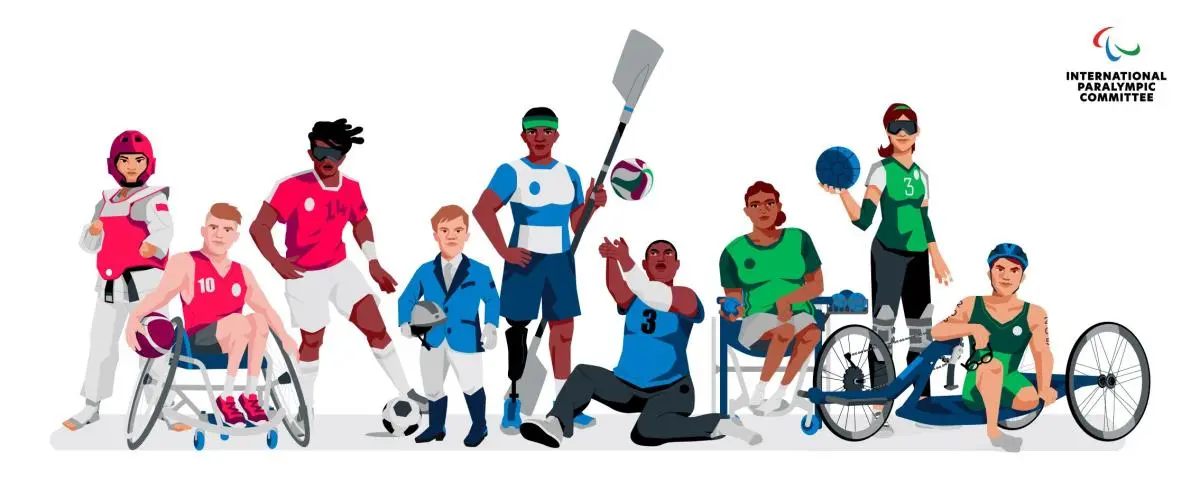
Courtesy: International Paralympic Committee (IPC)
The International Paralympic Committee (IPC) has awarded grants totalling EUR 900,000 to six projects to carry out multi-disciplinary classification research as part of efforts to further enhance the integrity, credibility and fairness of Para sport competitions.
The grants, provided through the IPC’s Sport for Mobility programme and funded thanks to a grant from Toyota Mobility Foundation, have been awarded to projects that cover intellectual, physical and vision impairments classification and range in duration from 12 to 31 months.
Dr. Mike Peters PLY, IPC Chief Executive Officer, said: “As part of our commitment to advance classification systems and processes across the Paralympic Movement, we are delighted to award Classification Research Grants to six outstanding projects as part of our Sport for Mobility programme.
“The standard of applications received for these grants was exceptional. It has been fantastic to witness so many sport federations working hand-in-hand with academic institutions to strengthen the scientific base that supports decision-making processes in classification. Naturally, we are indebted to Toyota Mobility Foundation for their support of classification, which is the cornerstone of Para sport.”
Tea Cisic, IPC Classification Director, said: “Congratulations to the first-ever recipients of IPC Classification Research Grants under this framework, six tremendous projects that will further improve the scientific base behind Para sports’ classification systems across the different eligible impairments.
“We are pleased to see the growing interest in classification research, the spread of member organisations and scientific community applying for the grant as well as the competitiveness in respect to the quality of the research proposals. In addition to assessing the quality of the proposals, we were tasked with balancing it against our priorities and the funding available.”
Intellectual impairment
Two projects received grant funding focusing on intellectual impairment classification, the first with potential application across multiple-sports and the second specifically on cross-country skiing.
Revalidation and extension of the generic sports intelligence test (GSIT) for use with athletes with intellectual impairment
Virtus, the international sport federation for athletes with an intellectual impairment, and KU Leuven have been awarded a grant for the revalidation and extension of the Generic Sports Intelligence Test (GSIT), a key component in the classification of athletes with intellectual impairment. A key objective is to improve the functionality, reliability and validity of the revised GSIT and extend its application to more sports for athletes with intellectual impairment.
X-Pace: Pacing as a key cognitive determinant of performance in cross-country skiing – towards an evidence-based classification system for athletes with intellectual impairment
Virtus, together with Mid Sweden University, will study pacing as a key cognitive determinant of performance in cross-country skiing. Success in endurance sports relies heavily on effective pacing strategy, which depends on cognitive abilities such as planning, anticipation, and real-time adaptation, areas athletes with intellectual impairment may face challenges with. The project aims to develop a cross-country skiing specific evidence-based classification system for athletes with intellectual impairment.
Debbie Van Biesen, Virtus Academy Manager, said: “Virtus is proud to receive this grant, which represents a significant milestone in advancing the science of classification for athletes with intellectual impairments. Through the Virtus Academy, we are leading two groundbreaking research projects in partnership with KU Leuven (Belgium) and Mid Sweden University, focused on validating generic classification measures across sports and developing sport-specific evidence for cross-country skiing.
“Strengthening the quality, credibility and scientific rigour of classification remains a strategic priority for Virtus. While our work continues to support existing Paralympic pathway sports such as athletics, swimming and table tennis, we are equally committed to developing robust evidence-based systems for emerging sports, including winter sports. By strengthening both existing and developing classification systems, we hope to create new opportunities for participation and competition, while supporting the continued growth and inclusion of athletes with intellectual impairments within the Paralympic Games.”
Physical impairments
The relationship between impairment measures and performance determinants across Para rowing sport classes: Towards evidence-based classification in Para rowing
World Rowing and the University of Edinburgh have received a grant to examine how impairment characteristics relate to key performance determinants across the PR1, PR2, and PR3 sport classes. The research aims to identify the optimal sport class structure. This will support the development of clear, objective thresholds for athlete classification and help ensure that the system remains transparent, equitable and based on robust scientific evidence.
To support this work, the research team will collect data throughout 2026 and 2027. Para rowers will take part in physical assessments and ergometer‑based performance testing.
“This grant represents a major step forward for Para rowing. By investing in high‑quality, evidence‑based research, we are strengthening the foundations of our classification system and reinforcing our commitment to fairness and athlete‑centred development. We are grateful to the IPC for their trust and support, and we look forward to the valuable insights this project will bring to our sport,” said World Rowing Executive Director Vincent Gaillard.
Trunk-arm dynamics: Sensor-based assessment of impairments for evidence-informed classification in wheelchair basketball and other sports
The International Wheelchair Basketball Federation (IWBF) and The Hague University of Applied Sciences will use their grant to investigate trunk-arm dynamics: sensor-based assessment of impairments for evidence-informed classification in wheelchair basketball and other wheelchair sports. The project aims to pilot a wearable sensor–based system to objectively measure and visualise how impairments in trunk–arm interaction affect performance in wheelchair basketball. The pilot will develop a prototype dashboard to support classifier decision-making, demonstrate the feasibility of sensor-based assessments, and lay the foundation for a transparent, scalable assessment of activities framework across wheelchair sports.
Ulf Mehrens, IWBF President, said: “Classification is the cornerstone of Para sport, and research is essential to ensuring our classification systems remain fair and fit for the future. Without funding opportunities such as the IPC Classification Grant, projects like this are extremely challenging to deliver. We are delighted to be among the first recipients of this new grant, which enables IWBF to partner with The Hague University of Applied Sciences to undertake further research into trunk–arm dynamics in wheelchair basketball. The more we can invest in research, the stronger our classification system becomes, giving players confidence in the integrity of our sport.”
Vision impairment
The Vrije Universiteit Amsterdam has received two grants for projects focussed on vision impairment classification covering multiple sports.
Next-generation visual field assessment for classification:
The first project aims to substantially strengthen visual field measurements during classification, with practical strategies and innovative methods to measure visual field as one of the core visual functions assessed in classification.
The VAI project: AI-enhanced visual acuity testing for accurate and reliable VI classification
The focus of the second project is to enhance the accuracy and reliability of visual acuity testing during classification, through the creation of a computerised test.
David Mann, Associate Professor Department of Human Movement Sciences from Vrije Universiteit Amsterdam, said: “We are thrilled to have received funding from the Sport for Mobility programme. The projects will innovate the way that we test vision during classification, making classification fairer and more accessible globally for athletes with vision impairment.”
The first call for applications for the IPC Classification Research Grants initiative closed in September 2025. It made grants of up to EUR 65,000, up to EUR 90,000, up to EUR 125,000, and up to EUR 250,000 available to International Federations, International Organisations of Sport for the Disabled and Recognised International Federations, in collaboration with the scientific community, to support the development and improvement of best practice and evidence-based classification systems in Para sports. Projects must be 12-36 months in length and be delivered before October 2028.
A second call for applications was announced by the IPC in April 2026. Recipients will be announced later this year.
For more information please visit: www.paralympic.org/classification
