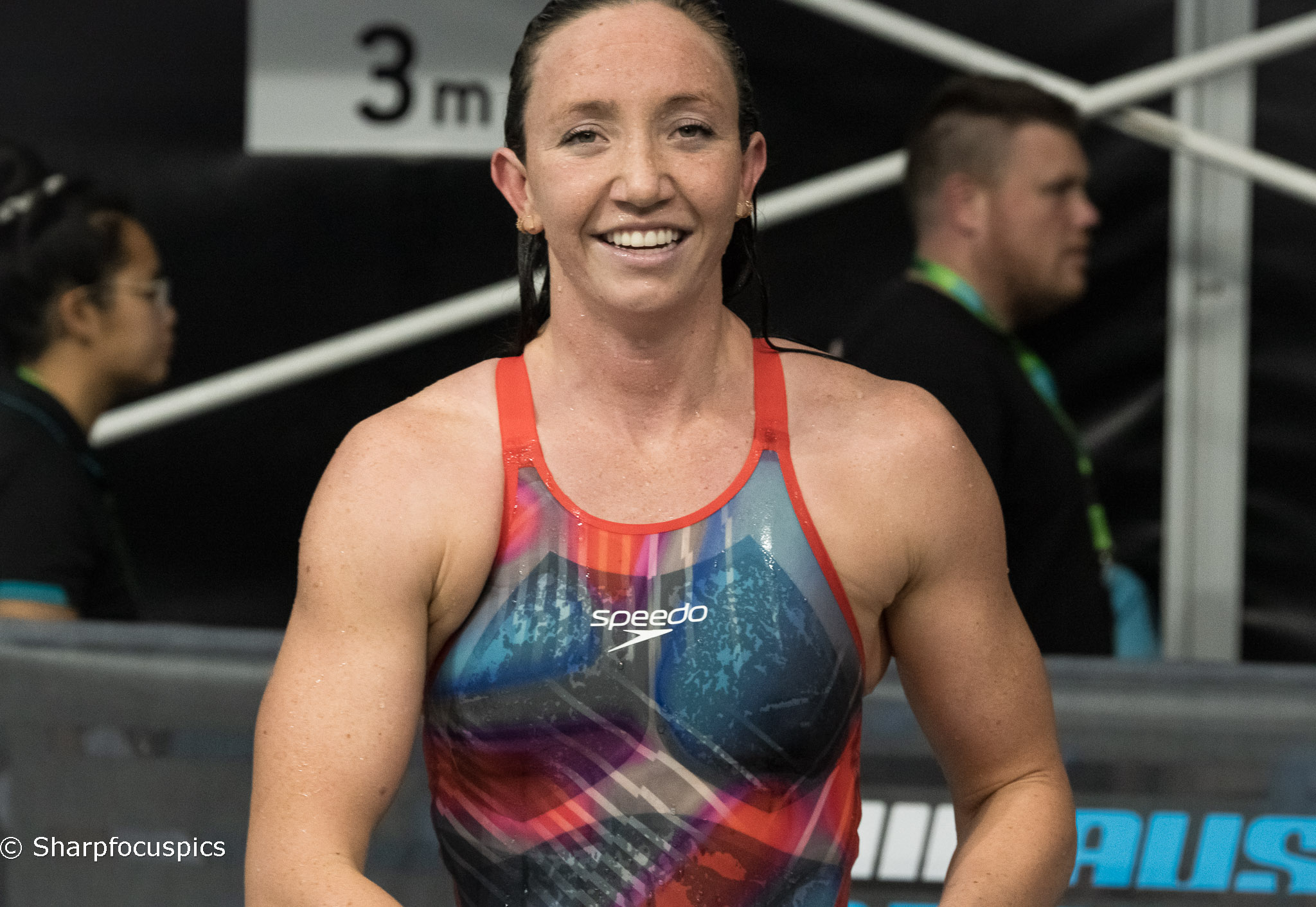
2024 Paris Olympic gold medalist Lani Pallister of Australia had committed to arrive at the University of Florida last fall as a member of the class of 2028, according to an interview on the Unfiltered Waters podcast. Pallister committed to the Gators in 2023 but received an email from the NCAA during the 2024 Paris Olympics learning that she was not eligible.
The 23 year old represents Australia the international level and was set to swim the 1500 free as the #4 seed and a medal contender in Paris. Pallister had to scratch the 1500 free after testing positive for COVID-19.
Despite testing positive, Pallister got her redemption later in the meet, helping Australia win gold in the women‘s 4×200 free relay. That relay also swam to a new Olympic Record. Pallister also went on to swim the 800 free, finishing 6th overall.
The day after testing positive for COVID-19, Pallister received an email from the NCAA stating that she was not eligible. Pallister appealed the decision and heard from the appeal in November 2024. Pallister stated that “they wanted me to pay back all of the prize money I have ever accepted.” She quickly followed that statement with her reply “no.”
Pallister has instead remained training in Australia. She most recently competed at last month’s Australian Trials where she swam best times in all four of her events. She won the 400 free (3:59.72), 800 free (8:10.94), and 1500 free (15:39.14) and was 2nd in the 200 free (1:54.89). Her 1500 free time made her the 3rd fastest performer all-time and #2 in the world this year only behind Katie Ledecky.
If Pallister had joined Florida, she would have had the chance to train alongside the Olympic gold medalists in the 1500 free as Katie Ledecky and Bobby Finke both train in Gainesville. Finke is a Florida alum.

Here’s a thought: She could swim at Florida but not for Florida.
In the NIL era how is accepting prize money still a no no? Doesn’t seem real consistent.
The NCAA has drawn a distinction between accepting endorsement money on one side, and prize money/professional league salaries on the other. NIL is not the same as prize and salary, though with essentially a “pay to play” model in place for NIL, it’s getting blurrier.
A group of tennis players are currently suing over the prize money piece: https://swimswam.com/brantmeier-v-ncaa-prize-money-case-scaled-back-to-just-tennis/
It will be interesting to see how the tennis case shakes out. The whole “color of money” distinction seems a bit weak at this point.
Different things make sense in different sports.
If the “color of money” doesn’t matter, then you’re going to see NBA rookies bomb out and return to the NCAA, where they might make more in NIL money than they would going to play in Europe or Asia.
In which case, it’s just an unmitigated minor league. Which might be legally the correct outcome, but will actually torpedo collegiate sports.
So, again, congress needs to step in and legislate. They won’t, but they should.
There are about a dozen or so European basketball pros who’ve been cleared by the NCAA this spring/summer to play college basketball, but with more limited eligibility.
Not sure why there’s a difference sport-to-sport. Pallister’s timing certainly played a role here.
If their salary didn’t exceed actual or necessary expenses, they were fine. There have been a few case where they’ve been able to repay small salaries or prize money and retain some eligibility, but I’m not sure what the status of that pathway is. In theory, an ISL swimmer who declined their money or were never paid or were paid a very small amount could qualify, so it’s not actually different across sports in that regard. Tomac is an example of that. It’s more in the sense of ‘the way swimmers and tennis players are paid is different than the way basketball and football players are paid.’
Pallister has, on paper, earned well over actual and necessary expenses. I don’t… Read more »
If Congress does not have the stones to step in to resolve this murky topic, the President of the United States could sign an Executive Order
It sounds more like a White House to prevent foreign swimmers from competing in the states against homegrown swimmers. We will have to see if Summer MacIntosh gets to attend any classes while training in Texas
how does an NCAA swimmer like Gretchen Walsh accept $200k in prize money at World SCM Champs
in december and remain eligible?
can the money go into a trust fund and be deferred to later??
I would seriously love to know the answer to this because it seems so murky.
1) We don’t know that she accepted it (unless she said it in an interview that I missed?)
2) The big loophole is the Operation Gold/similar exception. If you funnel all of your money through your national Olympic committee, it doesn’t count. In America, everyone knows to do that. In Australia, they’re not thinking about it (or are intentionally not bringing it up, because they don’t actually want their swimmers to go train in the NCAA).
That’s why Schooling was able to take his million dollars (minus taxes), for example, long before House.
Go Lani 🔥
Unsure what posting about this now really accomplishes. But regardless, why aren’t we crediting the podcast that she talked about it on? Unfiltered Waters deserves some mention.
The podcast is credited and linked to in the first paragraph . Maybe it got edited to add this?
Can’t link to the competition!
The entire podcast is linked to above.
The NCAA is ridiculous. Just let the girl swim!
Yeah because every US school needs a bunch of 23-year old freshmen!
Why not?
Better a 23 year old freshman than a 17 year old NBA player
Guessing you went to Cal?
Lani shared this story and more recently on the Unfiltered Waters podcast.
I didn’t think NCAA had any rules anymore?!?
Seems she is doing fine where she is – those times are spectacular.