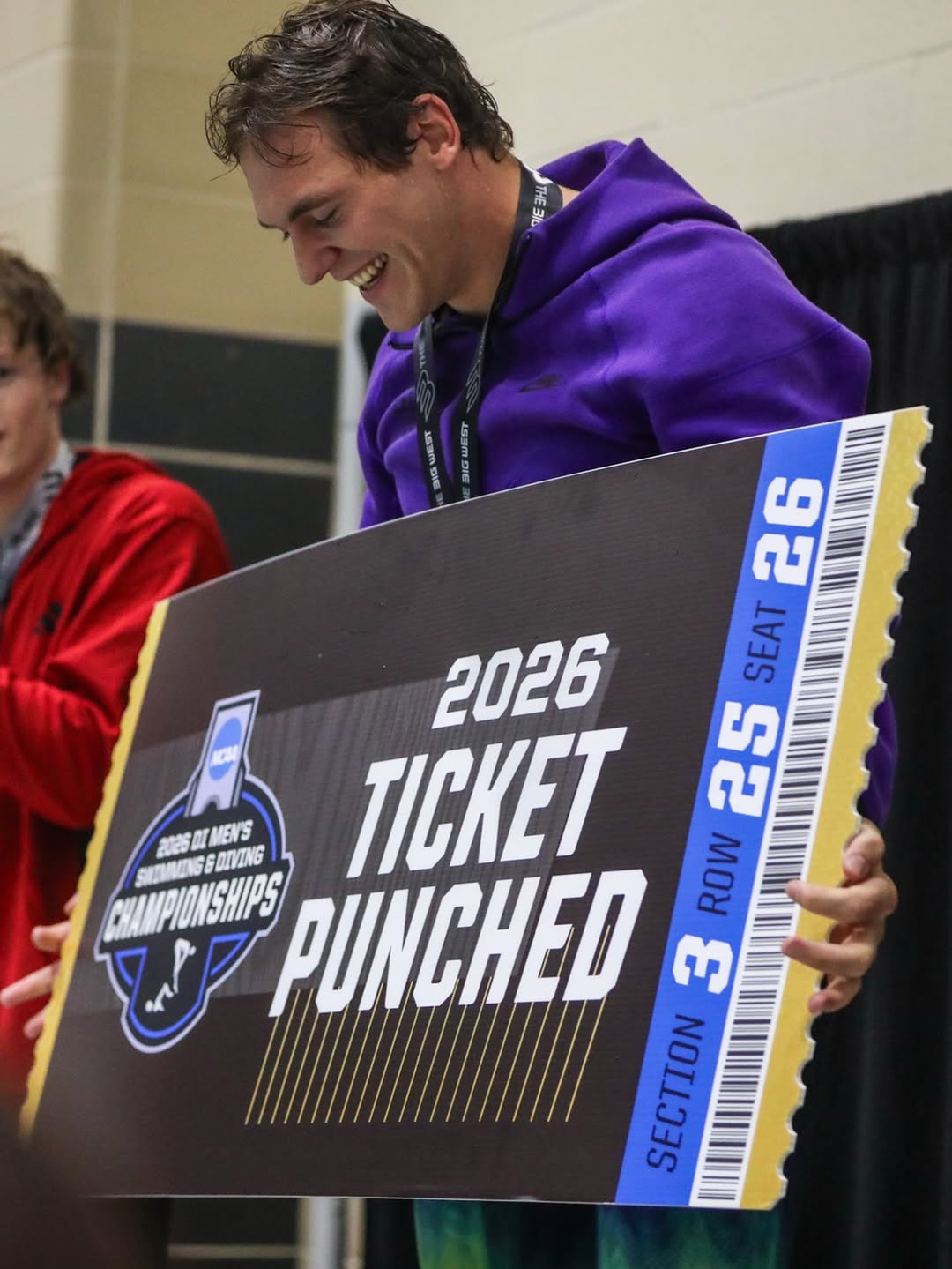
We have made it to the end of the 1st week of NCAA Division I conference meets, and after the two meets this weekend, there are nine swimmers qualified for the NCAA Championships, 5 women and 4 men.
The final night of the meets saw two Big West swimmers earn qualifications. In the men’s 200 breaststroke, Grand Canyon’s Carter Dooling swam 1:54.56 to take more than a second off his pre-meet best of 1:55.92. This swim came in four tenths under the NCAA AQ standard of 1:54.95.
On the women’s side, UCSB’s Samantha Banos earned her own NCAA qualifying swim with her 200 fly winning time of 1:56.44. This time was more than six tenths under the standard of 1:57.11, but was just off her lifetime best of 1:56.14 from November.
There were also a few swimmers who swam AQ times but have already earned invites. Hawaii’s Karol Ostrowski picked up a 3rd NCAA event with his win in the 100 freestyle with a time of 42.41. This swim was a tenth under the standard of 42.44.
Vili Sivec from CSUB also swam an AQ time in the 200 fly, touching in 1:42.37 to come in more than a second under the NCAA standard of 1:43.79. This was also a new best time by about a second, beating the 1:43.13 mark Sivec set at this meet last year.
Since Ostrowski and Sivec already earned NCAA qualifications earlier in the meet, they are only counted as one swimmer, and will only appear on the list with the first event they qualified in.
There were no NCAA qualifiers from the MAAC Championships which was the only other Division I meet this weekend.
New Women’s Qualifiers
| Swimmer Name | School | Conference | Event | Time | 2025 Invite Time |
| Samantha Banos | UCSB | Big West | 200 Fly | 1:56.44 | 1:55.82 |
New Men’s Qualifiers
| Swimmer Name | School | Conference | Event | Time | 2025 Invite Time |
| Carter Dooling | Grand Canyon | Big West | 200 Breast | 1:54.56 | 1:52.89 |
All Women’s Qualifiers After Week One
| Swimmer Name | School | Conference | Event | Time | 2025 Invite Time | |
| 1 | Eva Boehlke | UC San Diego | Big West | 200 IM | 1:57.43 | 1:56.69 |
| 2 | Holly Nelson | Hawaii | Big West | 50 Free | 22.28 | 22.01 |
| 3 | Asia Kozan | UC San Diego | Big West | 200 Free | 1:45.52 | 1:44.74 |
| 4 | Chloe Braun | UC San Diego | Big West | 100 Breast | 58.95 | 59.51 |
| 5 | Samantha Banos | UCSB | Big West | 200 Fly | 1:56.44 | 1:55.82 |
All Men’s Qualifiers After Week One
| Swimmer Name | School | Conference | Event | Time | 2025 Invite Time | |
| 1 | Tom Thalau | Hawaii | Big West | 200 IM | 1:43.93 | 1:42.65 |
| 2 | Karol Ostrowski | Hawaii | Big West | 50 Free | 19.13 | 19.02 |
| 3 | Vili Sivec | CSUB | Big West | 100 Fly | 45.91 | 45.12 |
| 4 | Carter Dooling | Grand Canyon | Big West | 200 Breast | 1:54.56 | 1:52.89 |

For entry purposes, would Samantha Banos (and all others in the AQ category) be entered with her winning time or her season best time?
I love the automatic qualifiers thing.
But don’t take spots away from faster swimmers. Just let them go in addition to the top 30/ish.
People keep bringing this up. “Expand the meet expand the meet expand the meet.”
Expanding the meet is never going to be the answer.
1) They’re already doing things to shorten the meet
2) That costs more money
3) Nobody’s going to ask the NCAA to revise the number of invitees because there were a lot more D1 swim teams when the numbers were set, and the NCAA would be well within reason to contract the meet.
The “faster swimmers” we are talking about are ranked 28th, 29th in the country, not All-american favorites. For the last few spots in the meet, I would much rather see the “cinderella story”.
This is why the NCAA basketball tournament has such lasting popularity even compared to the rest of that sport (CBB is not overwhelmingly popular until March). Fans of the smaller schools and casuals as well would usually rather tune in to see a “small” conference champion take a swing at the “big time” teams for the tiny chance they make magic happen, rather than see the 11th placed SEC team with a 6-10 record take up space.
I’m actually more surprised that there weren’t more qualifiers from the Big West meet. Only 9 winners under the NCAA cut is less than I would have expected.
Remember that the new q-time is based on 72 time and before this year the b-cut times were based on the average 125 place ranking from the prior 3 years.
So much for all the handwringing.
(This is just week 1).
Mountain West, MAC, and the American about to take some spots on the women’s side for sure
I wonder if any swimmer will make the choice to go to a school from a non power conference to increase their chances of making NCAAs. I’d guess no because that seems like a fairly small needle to thread but if you’re choosing between being the 20th guy in the TX roster and maybe not going to NCAAs even if you make the times or being a superstar at Hawaii maybe that’s a harder decision than it was. Seeing where this is in 5-10 years will be fun.
I think a bunch of swimmers are going to choose smaller schools
I think this is great. The times are much closer to the “2025 invite times” than what I originally expected when this system was published in the fall. Should be fun to see if these athletes pop off a prelims swim to make top 16 at ncaas. Adds a bit more suspense ncaas for me.
I think it’s much more likely they’ll end up at the bottom of the prelim results but you’re right, we’ll see how it goes.
Isn’t that always going to be the most likely outcome for the last qualifer (to finish near the bottom) whether they are a 30th ranked “at large” or a 45th ranked Big West champ?
*Nine spots taken from the fastest swimmers and given to others because it could hypothetically have some influence on some university presidents to cut a different sport instead.
Sour.
For argument’s sake, let’s say that is 100% true. So what? Swimming needs to figure out how to stay relevant for spectators, training opportunities, and sponsorship money.
So if it positively affects a school/swimmer and keeps a line of swimming open, then so be it. Swimming acts like it won’t have to make hard choices. And I’m not sure that places 20+ are that big of a sacrifice.
Is it fair? Probably not. But at least it is a try for something.
>So what?
The issue is that it fundamentally changes the nature of the competition. In swimming, faster times have always beaten slower times. Not anymore. And for every positive effect this change has on a swimmer/school it has a negative effect on another such pair.
I absolutely understand the reason why somebody thought this change would be beneficial to the college sport. It just sucks that it’s come down to this gimmick.
I’ll respectfully suggest an alternative viewpoint.
In swimming competition, faster times beat the slower times performed at the competition. This is how Huske can have 100 fly gold despite the world record holder also being in her heat. Competition, particularly in swimming, has always included rising to the occasion at the right time.
Yes, the new automatic qualifier element changes the nature of the competition’s qualification. But in my opinion, a qualification system acknowledging the ability to rise to the occasion at the right time seems more aligned with the nature of competition than a system that rigidly ranks everyone based on their times throughout the year. Neither system is perfect, but I don’t see this as a gimmick.
Rising to the occasion has to include a consideration of exactly how significant that occasion is.
How would college football fans feel if a MAC or Mountain West team got an automatic qualification to the College Football Playoff by winning their conference?
I have a lot of issues with this change, not the least of which is how will anyone measure its success or failure. If one fewer school drops its swimming program compared to the year before, will we consider these changes a success? If one more school drops it, will it be a failure?
People talk about the need for change in our sport. Perhaps they’re right. But I don’t see much merit to throwing… Read more »
This new rule is conference agnostic, while acknowledging that conference championships (regardless which league) are extremely significant to a college swim team’s season. If your point is that there must be competitive standards, a conference champion still needs to achieve a qualifying time to make the meet.
To me, success would look like more representation at the NCAA Championship from more schools who choose to sponsor Swimming and Diving. Even more success would look like a surprise performance from those who have proven they are capable of rising to the occasion – similar to the automatic qualifier Cinderellas in college basketball that make their Championship so popular. Failure might look like a substantial decrease in the quality of the competition.
I like the AQs. I think they should (and probably will) slide the number down a bit, from 75th last year to maybe 65th. Especially on the men’s side – 75 seems to deep to me when only 30 go per event.
I don’t think they did a great job ‘using the moment’ like we hoped they would. Zero acknowledgement of it from the Big West social media – which generally does a pretty nice job, but social media team clearly weren’t clued in to this new process. Hawaii’s swimming account did an okay job of promoting. But it wasn’t HUGE whizbang fireworks ya know?
Someone at the NCAA or CSCAA needs to package this up and distribute to… Read more »
Not true at the international level (Olympics, world championships) where countries can only send 2 per event max and some swimmers get to compete even if they don’t have qual times. Expanding participation has value.
I hear your point but this just isn’t true that “faster” always qualifies over “slower” in our sport. There have always been carveouts in swimming to guarantee wider representation, at least at other levels. For high school many state championships will have “auto” qualifiers who won their less populated regions/districts, that wouldn’t have made the meet as an at large.
Everyone: SAVE OUR SPORT!
Also, Everyone: Whatever you do, don’t change ANYTHING. I’ll fight you on any change to our meets or rules. But if you could please change the rest of world.
Anyone who can’t see the gain in this new opportunity is part of the problem.
This isn’t saving many programs, even if we say having an ncaa qualifier saves your program. UCLA men showed us it doesn’t matter how you perform years ago. It has always and will always be money driven. Once private equity firms who buy stake in programs and conferences start to see the ROI is negative, goodbye non revenue sport
UCLA? Seriously! That was 50 years ago. Maybe make a relevant/recent argument
This is the SwimSwam ethos.
Do you get mad that basketball gives automatic spots to conference tourney winners rather than just the best 64 teams?
NCAA basketball started AQs in 1939. Wonder if there are any contemporary news articles about how that was received.
Things were substantially more *chill* in 1939 than they are now, so maybe people are just used to it…
I think the 1939 comparison is a bit misleading. The first NCAA Tournament had only 8 teams representing different regions. Only 6 conferences were represented at the first tournament with 2 independents.
The bigger issue in the early history of the NCAA Tournament is that conferences were limited to a single representative, which for most conferences was the regular season champion. Not all conferences received bids. Postseason conference tournaments were not yet common, though one specific exception was the ACC which named as champion the winner of its conference tournament since 1961. In the ACC, that tournament champion would be the ACC’s sole representative in the NCAA Tournament (with exceptions like 1973 when NC State was on probation). Then… Read more »
For the fans – can we get a link to the invite times?
https://ncaaorg.s3.amazonaws.com/championships/sports/swimdive/d1/2025-26D1XSW_QUALSTANDARDS.pdf
https://swimswam.com/what-will-it-take-to-qualify-for-the-2026-di-ncaa-swimming-championships/