
2025 World Championships
- July 27 – August 3, 2025 (pool swimming)
- Singapore, Singapore
- World Aquatics Championships Arena
- LCM (50m)
- Meet Central
- How To Watch
- SwimSwam Preview Index
- Entry Book
- Live Results
- Euro Recap, Day 1: Lukas Märtens Earns First World Title, Completes Epic Year In 400 Free
- Euro Recap, Day 2: Roos Vanotterdijk Wins Belgium’s First World Championship Medal Since 1998
- Euro Recap, Day 3: Simona Quadarella Swims First 1500 Free PB In Six Years, Sets European Record
- Euro Recap, Day 4: Sven Schwarz and Lukas Märtens’ 800 Free Medals Keep Germany Riding High
- Euro Recap, Day 5: David Popovici Completes 100/200 Free Double Gold After Nearly Not Swimming
- Euro Recap, Day 6: Duncan Scott Comes In Clutch Again, Team GB Extends Its Men’s 4×200 Free Relay Reign
- Euro Recap, Day 7: Grousset and Ponti Join The 49-Second Club In 100 Butterfly A Year After Olympic Disappointment
Ruta Meilutyte is unstoppable in the women’s 50 breaststroke.
The 28-year-old Lithuania tore to a fourth-consecutive world title in the event on Sunday in Singapore during the final session of the 2025 World Aquatic Championships. The event’s world record holder, Meilutytė tore down the pool, pulling away from the field and stopping the clock in 29.55.
It capped a dominant run through the rounds for Meilutytė. She swam 29.82 in the heats before dropping down to 29.54 in the semifinals and 29.55 in the medal round. No other swimmer broke 30-seconds in the individual 50 breaststroke this week, though silver medalist Tang Qianting did open her 100 breaststroke final under 30 seconds. Tang earned silver in the final, with Benedetta Pilato getting bronze. Meilutytė became the second swimmer to defend their 2024 World Championship title this week and this entire podium is the same as it was in Doha.
Meilutytė’s 50 breaststroke dominance is not a new phenomenon. The 2012 Olympic champion in the 100 breaststroke, Meilutytė has taken over this event in the last four years. When told that she’d won her fourth-consecutive world title in the 50 breaststroke, Meilutytė laughed “that’s eight years right? That’s crazy.”
Like many swim fans, Meilutytė still hasn’t wrapped her mind around the fact there’s been a long-course World Championships every year since 2022. So instead of eight years, it’s only taken her three years to win four titles. It’s not the same type of longevity that hearing “four-straight world titles” would suggest. Instead, it’s a display of how quickly she’s taken over the event.
Meilutytė now owns nine of the top 15 fastest swims in the event. Only one of those times isn’t from the last three years–a 29.48 she swam in 2013.
All-Time Top Performances, Women’s 50 Breaststroke (LCM)
- Ruta Meilutytė, Lithuania — 29.16 (2023)
- Ruta Meilutytė, Lithuania/Benedetta Pilato, Italy — 29.30 (2023/2021)
- —
- Benedetta Pilato, Italy — 29.35 (2021)
- Ruta Meilutytė/Lilly King, United States — 29.40 (2024/2017)
- —
- Ruta Meilutytė, Lithuania — 29.42 (2024)
- Ruta Meilutytė, Lithuania — 29.44 (2022)
- Ruta Meilutytė, Lithuania — 29.48 (2013)
- Benedetta Pilato, Italy — 29.50 (2021)
- Tang Qianting, China — 29.51 (2024)
- Yulia Efimova, Russia — 29.52 (2013)
- Ruta Meilutytė, Lithuania — 29.54 (2025)
- Ruta Meilutytė, Lithuania — 29.55 (2025)
- Ruta Meilutytė, Lithuania — 29.56 (2023)
By 2013, Meilutytė had already achieved what many swimmers spend their whole life dreaming about — Olympic gold. After winning the 100 breaststroke at the 2012 Olympics as a 15-year-old. She went on a tear after that breakout swim, winning at the World Short Course Championship, World Long Course Championships, European Championships, Youth Olympic Games, and World Junior Championships in an intense two-year period. She set three world record in 2013 alone, at just 16-years-old.
In parallel with that success, Meilutytė was starting to struggle. She was battling depression, an eating disorder, and along with others, has recently shared about how a “toxic environment” training with coach Jon Rudd contributed to her mental health challenges. She has said that she considered retiring after the 2016 Olympics. In a 2018 interview, she said, “Sometimes I wondered what I was doing with my life, because everything seemed meaningless. It was a loss of the perception of things, that made me discard the positive side of my life and focus only on the negative. And then I did not want to train or see people.”
Shortly after that interview, she was given a two-year doping suspension by FINA (now World Aquatics) for missing three doping control tests in a year, which she said was the result of her depression, and announced her retirement from competitive swimming at age 22.
The suspension gave Meilutytė the chance to work on her mental health and discover herself outside of the pool. When the suspension expired, it seemed that she was not done with the water after all. She returned to racing at a small domestic meet in Lithuania. Every meet she did was without commitment to the next one. She was convinced to attend Lithuania’s National Team camp without pressure to go to Worlds. But she did go to the 2022 World Championships, where she won gold in the 50 breaststroke (and bronze in the 100 breaststroke). It was her first long-course world title in the event and kicked off the world title run she extended tonight.
Her title tonight extended another long run of success for Meilutytė, which feels reminiscent of the run she went on after her Olympic breakout. But Meilutytė is not the same person as she was then and has found what seems to be a healthier training environment for her. Many swimmers at these World Championships have repeated the old adage that “happy swimmers are fast swimmers” and Meilutytė is another example of that.
After her win tonight, Meilutytė’s prevailing emotion was gratitude. “I’m just really thankful for this opportunity to do what I’m doing, to be where I’m at,” she said. “Just to share this experience in this pool with great people, and the girls. It was really cool, to do it with Lilly [King] on her last race today. Cheers to Lilly.”
“I got emotional singing the national anthem,” she continued. “It means a lot to me, as well as for my country, and I love my country, and I’m just really grateful to do it at this level.”
Meilutytė still prefers not to publicly commit herself to competitions too far in the future. A holiday is the first thing on her mind. “It’s hard to say,” she said when asked about her future. “But I enjoy this very much, and so long as I enjoy it, as long as it’s meaningful, I can continue.”
“I’ll just have a holiday now, nothing on my mind now, just holiday, then we’ll pick up from there.”
When SwimSwam awarded her the 2022 Comeback of the Year Swammy, we wrote that now, every meet with Meilutytė feels like a bonus. That still feels true. And however long she finds meaning in racing, it will be a thrill to watch her compete.
Quick Hits
NAB Relay Strength Shines Again, Kolesnikov Wins First Long-Course World Title
The Neutral Athletes – B team of Miron Lifintsev, Kirill Prigoda, and Egor Kornev closed out an excellent session for the team with a championship and European record in the men’s 4×100 medley relay. This is the same quartet that ended the 2024 Short Course World Championships with a gold and world record in this race.
Minakov reflected that it was a “very special moment” to win win the same quartet that won at the 2024 Short Course World Championships seven months ago. “We knew it’s going to be a great rivalry. But you know, it’s always good to come out on top,” he said, sharing that it’s an important step forward for the team with the 2028 Olympics on the horizon.
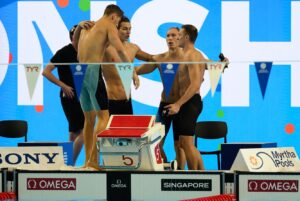
Neutral Athletes -B 4×100 medley relay (Credit: Nardia Mulkerrins)
The team was third after the backstroke leg with a 52.44 lead-off from Lifintsev. The team moved into second off Prigoda’s 57.92 split and held the position with 100 meters to go after Minakov’s 50.17 butterfly effort. Kornev, who finished 4th in the 50 freestyle, dug in for a 46.40 anchor leg that powered the quartet past the French team.
Kornev stopped the clock at 3:26.93, breaking the U.S’s championship record from the 2023 World Championships (3:27.20) and Italy’s European record (3:27.51) from the 2022 World Championships.
The relay win closed out an excellent session for the Neutral Athletes – B team. The evening opened with Kliment Kolesnikov winning gold in the men’s 50 backstroke with a championship record of 23.68, tying the second-fastest performance all-time. The other top two swims belong to him, and he now owns eight of the top 10 all-time performances.
It’s a special moment for Kolesnikov, as the two-time Olympic medalist earned his first long-course world title. “It was a tough seven years since my first world championships in Budapest. I collected all medals from each championship, but just from short course,” said Kolesnikov.
“Before the final tonight, I didn’t think that I could go so fast. When I touched the wall, I saw under 24 seconds, it’s pretty fast for today–still, after eight days of championships. Some good feelings by the end, I’m happy. When I saw the result, I thought, ‘come just off my world record, why not faster?'”
Kolesnikov got to share the medal ceremony for his first long-course world title with teammate Pavel Samusenko, who tied for silver with Pieter Coetze. “I’m glad to be second, not fourth like I was at previous championships. I’m very happy. [It gives] confidence, for sure. I know myself that I can, and now I’m going to be better and better.”
Finally, Ilia Borodin earned his first long-course Worlds medal in the final event of the meet, the men’s 400 IM. Borodin swam 4:09.16, earning bronze behind Marchand and Tomoyuki Matsushita. “I missed a lot of competitions – three world championships in long course, and this is my first time. It’s good for the first time. It’s not pressure for me. I just have fun for every race every day,” Borodin said.
France Cracks National 4×100 Medley Relay Record, Marchand Pulls Tough Double
Behind the Neutral Athletes’ Championship and European record, the French squad of Yohann Ndoye-Brouard, Leon Marchand, Maxime Grousset, and Yann le Goff earned silver with a national record 3:27.96. The time bettered the French record that Ndoye-Brouard, Marchand, and Grousset helped set along with Florent Manaudou as part of a storybook ending to a home Games.
Last summer’s Paris Olympics were an excellent outing for the home team, powered by Marchand’s four gold medals. During the last session, the men’s 4×100 medley relay added more magic, earning a surprise bronze medal for the nation’s first relay medal of the week. The quartet got to step onto the podium together as a thousands-strong French crowd cheered for them, led by Manaudou.
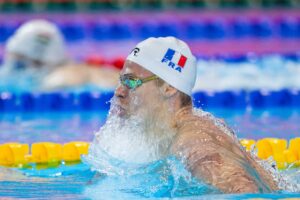
Leon Marchand (photo: Jack Spitser)
But now, it’s clear that culminating moment of the Paris Olympics–exactly a year ago–was just a starting point for the French.
Each member of this year’s medley relay final walked out to lane one in a very different place than they were a year ago. Despite the lane assignment, they were no longer a surprise but a serious medal contender. Individually, they were different too. Ndoye-Brouard earned his first long-course World Championship medals this week, taking over both the 100 and 200 backstroke French records and clearing 52-seconds in the 100 backstroke for the first time. After being disappointed in his individual events in Paris, Grousset swept the 50 and 100 butterfly, swimming a European record in the latter.
Marchand, like many, had an up-and-down post-Olympic year and battled injuries. He took on a lighter event load in Singapore, but smashed the men’s 200 IM world record and confirmed his men’s IM sweep less than 30 minutes before walking out to the blocks. Le Goff was not even on this relay, replacing Manaudou who skipped these Worlds, and had dealt with injuries of his own.
Ndoye-Brouard got the team started with a 52.26, putting them in second. After swimming the fourth-fastest 400 IM of his career, Marchand put together a 58.44 breaststroke split. At the halfway point, the team was still third.
Grousset put France into the lead with a 49.27 butterfly split, tying his performance from Paris as the second-fastest in history. Only Caeleb Dressel has split faster. Le Goff finished the race off with a 47.99 split, stopping the clock at 3:27.96 for silver, .42 seconds under their former national record.
“The silver medal was amazing,” said Marchand, who was later named Male Swimmer of the World Championships. “And the time we did was really fast, so that’s exciting for what’s to come. I think we can do even better.”
It seems like the final session of the Paris Olympics wasn’t just a starting point for the relay, but for the French team. Manaudou was not at these championships and Marchand took on a reduced schedule, but the French still earned one more medal than they did at the Paris Olympics, topping the European medal table as they did in Paris.
Sven Schwarz Wins Second Worlds Silver With PB, Helps German Men Medal In 400/800/1500 Free
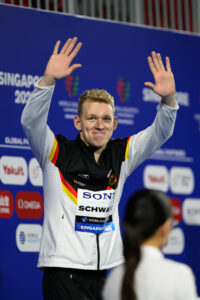
Sven Schwarz (credit: Nardia Mulkerrins)
Sven Schwarz, 23, put the world on notice earlier this season, swimming an 800 freestyle European record.
He delivered on that early season promise in Singapore, establishing himself firmly as part of the next generation of the men’s distance swimming renaissance and the next go-t0 German distance swimmer. Schwarz earned silver in the 800 freestyle and matched that in the 1500 freestyle with a 14:35.69, finishing second to Ahmed Jaouadi in both races.
“It’s absolutely amazing,” Schwarz said. “I can’t believe I was able to do this and I’m really proud of myself to get two medals here. I need some time to process this and we’ll see what will be next.”
These two medals are Schwarz’s first at the Olympic/World Championship level. Further, this swim moves him into the top 10 performers all-time in the event. Now, eight of the top ten performers have swum their best in the last three years.
All-Time Performers, Men’s 1500 Freestyle (LCM)
- Bobby Finke, United States — 14:30.67 (2024)
- Sun Yang, China — 14:31.02 (2012)
- Ahmed Hafnaoui, Tunisia — 14:31.54 (2023)
- Gregorio Paltrinieri, Italy — 14:32.80 (2022)
- Daniel Wiffen, Ireland — 14:34.07 (2024)
- Ahmed Jaouadi, Tunisia — 14:34.41 (2025) *NEW*
- Grant Hackett, Australia — 14:34.56 (2001)
- Florian Wellbrock, Germany — 14:34.89 (2023)
- Sven Schwarz, Germany — 14:35.69 (2025) *NEW*
- Mykhailo Romanchuk, Ukraine — 14:36.10 (2022)
As Schwarz rose to prominence this season in tandem, his presence, along with Lukas Märtens, Oliver Klemet, and Florian Wellbrock shined a light on Germany’s depth in the mid- and distance freestyle races. Germany is the only nation to put two men into the final in the 400, 800, and 1500 freestyle. The nation put at least one swimmer onto the podium in all three events. Märtens won the 400 freestyle, then took bronze in the 800 freestyle with Schwarz winning silver. Now, Schwarz has finished the job with silver in the 1500 freestyle.
“Now we’re back, and the next years we hope to be the same like this one and improve, Schwarz said, before deadpanning “you can see that we’re not the worst nation in long-distance swimming, so we’ll see.”
National Records
Men’s 4×100 Medley Relay
- The Dutch men lowered their record in the men’s 4×100 medley relay to qualify for the final. Kai Van Westering (53.89), Caspar Corbeau (58.60), Nyls Korstanje (51.11), and Sean Niewold (47.47) swam 3:31.07, improving on the 3:21.23 swum at the 2024 World Championships. Only Korstanje was on that Doha relay.
- Rémi Fabiani (55.91), Joao Carneiro (1:01.63), Julien Henx 954.57), and Ralph Daleiden brought their national record under 3:41 for the first time in the men’s 4×100 medley relay. The team broke the Luxembourgish record from the 2024 European Championships (3:41.40) with a 3:40.99 during the Singapore heats.
Women’s 4×100 Medley Relay
- Hungary’s quartet of Dora Molnar (1:02.04), Henrietta Fangli (1:06.63), Panna Ugrai (58.21), and Minna Abraham (54.34), took .28 seconds off their national record in the women’s 4×100 medley relay. They swam 4:01.22, bettering the 4:01.50 the nation swam at the 2024 European Championships. Three of the four relay legs are different than that relay, with only Ugrai returning.
Final Continental Medal Table
| Nation | Gold | Silver | Bronze | Total |
| France | 4 | 1 | 3 | 8 |
| Germany | 2 | 2 | 1 | 5 |
| Romania | 2 | 0 | 0 | 2 |
| Italy | 1 | 4 | 2 | 7 |
| Great Britain | 1 | 1 | 0 | 2 |
| Netherlands | 1 | 0 | 2 | 3 |
| Hungary | 1 | 0 | 1 | 2 |
| Lithuania | 1 | 0 | 0 | 1 |
| Switzerland | 0 | 2 | 0 | 2 |
| Belgium | 0 | 1 | 1 | 2 |
| Poland | 0 | 1 | 0 | 1 |
