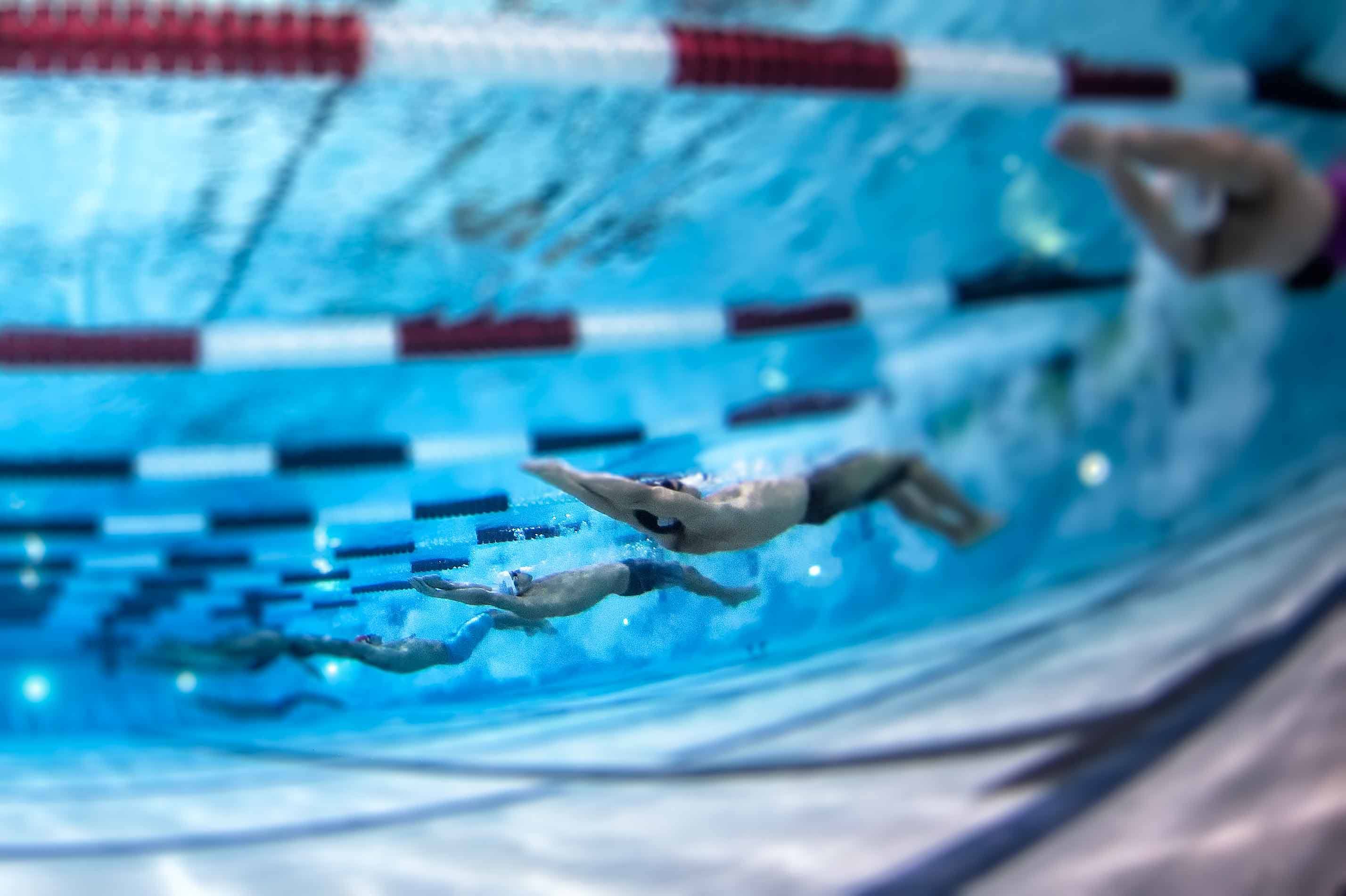
What happens when you extend your underwater breakouts? Here’s a look at the metabolic implications for training and racing.
Thundering underwaters are essential for a quick start and fast turns.
So we kick our little hearts out at practice with:
- Kick counts
- Resisted kicking
- Vertical kicking
- Kicking on our front, back, and side to side
All so we can improve our dolphin kick and max out the speed advantage of kicking faster underwater than surface swimming.
But what happens when you push your underwaters further than usual?
(Besides getting a little more out of breath, obviously…)
The Effects of Longer Underwaters
A study (Venckunas & Achramavicius., 2024) tested this out with a group of junior swimmers, national to international level, cranking out solid volume per week (40-70k).
Swimmers were tasked with swimming a pair of 200 freestyles at threshold pace:
- Once with their usual 4-5m underwaters off every wall.
- And then once extending all their underwaters out to 12.5m.
Result?
The longer breakouts resulted in much higher post-swim lactate levels:
- Short underwaters: 3.3 mmol/L.
- Long underwaters: 7.9 mmol/L.
Staying under for longer pushed swimmers much deeper into anaerobic territory, even though they weren’t swimming faster. When you restrict breathing, your body ends up relying more on anaerobic energy to keep the pace.
So what does this tell us?
A couple of key things.
Race Day Underwaters
If you’ve been training with ~5m underwaters all season long, and it’s time to step up on the block to compete, it’s not a great idea to double up kickout distance.
Especially in events with a heavy aerobic component.
Which, admittedly, is all races outside of the splash and dash. Rodriguez and Mader, (2011) analyzed the contribution of energy systems across different events, and even the 100m free had a chunky aerobic contribution of ~41%. And it only goes up from there.
If you’re working hard aerobically, cutting off oxygen delivery for another 5-7m per lap is going to dig you into a deep metabolic hole that you’re going to have a hard time clawing out of.
Extended Underwaters in Practice
But in practice? Experimenting and deliberately extending underwaters can be used as a training tool.
When done at controlled speed with proper rest, extended underwaters:
- Build lactate tolerance
- Improve lactate clearance
- Strengthen the anaerobic system
- Develop the mental resilience to tolerate CO2 buildup
All without having to swim faster or “harder.”
The cool part is that being more intentional with your underwater kick outs reduces lactate production over time in response to the same effort. Like most things in the water, your body gets better at handling it with progressive exposure.
Over time, the same underwater distance produces less lactate—or the same lactate with more powerful kicks.
How to Get Started with Longer Underwaters in Training
If this is tickling your chlorinated fancy, here are a few practical guidelines to help you get started:
- Keep the intensity submaximal. It doesn’t need to be done all-out. The stress comes from the breath-hold, not the speed.
- Give yourself real rest between reps. Adaptation happens when you recover, not when you’re gasping through sloppy reps.
- Progress gradually. Start simple and doable with kick counts. 1-2 dolphin kicks if that is what it takes.
Used randomly—or at the last minute on race day—extended underwaters will drain you quickly.
But used deliberately, with progression, structure, and recovery, they will build a faster swimmer for race day.
The Bottom Line
The underwater dolphin kick is one of the sneaky and misunderstood parts of fast swimming on race day.
But to have the smooth, powerful UDK when you arrive at a meet you need to have done the work in training to make it cheap to use and won’t wreck you mid-race.
Build the kick in practice. And then when it’s time to race, cash it in.
Happy kicking!
ABOUT OLIVIER POIRIER-LEROY
Olivier Poirier-Leroy is a former national-level swimmer, 2x Olympic Trials qualifier, and author of several books for swimmers, including The Dolphin Kick Manual: The Swimmer’s Ultimate Guide to a Fast Underwater Dolphin Kick.
 The book is a beastly 240+ pages of actionable insights and research into elite dolphin kicking technique and performance. It details everything from mastering undulation to vortex recapturing to structuring a dryland program for dolphin kicking success.
The Dolphin Kick Manual combines evidence-based insights with a collection of 20 ready-to-go sets and a 6-week Action Plan to help swimmers set a course for dolphin kicking success.
Train smarter and kick faster.
👉👉👉 Learn more about The Dolphin Kick Manual

Great stuff. How underwaters impact the ability to execute the desired race strategy is critical.
I can’t wait to see the next generation who grow up through the sport knowing how important underwaters are and having that be reflected in their development/training.
The more we adapt training philosophies that allow swimmers to build endurance around optimal technique – technical endurance – the faster this sport will get.
Thank you Olivier! Excellent article.
If anyone remembers how Maya Dorado won the 200 backstroke in the 2016 Olympics against katinka hosszu, IMO it was because on the last 50 KH stayed underwater too long and her dolphin kicks cost her. MD popped up and got air off her third wall. In the last 10 meters Dorado had a lot more power.
Or how Molly hannis made the Olympic team by foregoing her last pull out in the 200 breaststroke in the trials. Unheard of! But it was her ticket to the Olympics. I know this is not related to dolphin kicks as much as it is to getting enough oxygen.
The old standby of not breathing out of… Read more »
When Ye Shiwen ran down Beisel in the 400IM in 2012, she did very few dolphin kicks throughout the race. Critics seldom looked at what she did the first 300 to make that last 100 possible.
Yes, I think in situations like Lani’s during that short course swim there was a trade-off between underwater speed, and grabbing as much oxygen as possible. Ultimately, getting that extra oxygen did the business for her. Ledecky usually economical with her underwater in the 800/1500, saving something so she can do a bigger underwater after her last turn. You’re suffering enough in these long events…why add to it with lots of uw kicks when you need that oxygen nectar!
I’m not sure that’s exactly the takeaway here. There’s nothing in this study to indicate you can’t breathe the 2nd to last stroke in and 2nd stroke out of walls and get enough oxygen.
This isn’t evidence that disrupting speed like breathing the 1st stroke results in a better finish to the race. That may have happened, like in your examples, but there hasn’t been any determination of cause and effect.
Thanks for sharing.
This was a thoughtful (and informative) article.
I think introducing underwater dolphin kicking very gradually and in various ways to young age group swimmers will, over time, derive multiple benefits as they grow older. Being patient and thinking long-term is very helpful.
Teaching kids how to undulate effectively is important and can be challenging. Again, variety is good – barefoot, with fins, on and off kick boards, dolphin kicking on back, kicking w hands at side, kicking while streamlining, alternating sides, vertical kicking, dolphin kicking off the bottom in 7 to 9 feet of water, etc.
Remind kids that we call it dolphin kicking for a reason!
It seems like there’s kind of a movement to actually teach underwater kick technique, which I love. In the late 90s/early 2000s, the teaching was “do more of them.”
I was chatting with Tom Shields the other day and he told me he’s doing some underwater kicking clinics/consulting, and I think if I were a coach I would pay for that. I mean, I’d pay to learn from Tom myself, in addition to the kids.
So true. In my turn-of-the-century heyday I was terrible at dolphin kicks, but put a lot of that energy into a long breaststroke pullout, a great tool to have for 200Br and 400IM when the grim reaper is hanging over you.
I think I struggled a lot more than I needed to as a swimmer 20-30 years ago because we were consistently encouraged to UW dolphin kick as far as possible off the walls and not to breathe every stroke on free and fly. I think I could have swum faster in events 100y or meters and above if I wasn’t anaerobic much of the time