
Swim meets are a chlorinated bouquet of emotions and experiences.
The long stretches of waiting between events. The excitement of a close race. The quiet frustration of an underwhelming result. The wrestling match that is getting into a tech suit.
And what makes swim meets mentally unique from our usual back-and-forth swimming at practice is the sometimes all-consuming pressure that comes with racing.
Swimmers who don’t have a great relationship with pressure—or don’t prepare for it—often end up choking or swimming below what their training suggested they were capable of. (Not fun.)
And one of the proven ways to get better at swimming when it counts is with pressure training.
Here’s how.
Training for Competition Pressure
Choking on race day typically happens for one of several reasons (Christensen et al., 2015):
- Distraction – We get caught up in what’s happening around us, from the bright lights to the fast competitors to the splits we are putting up on the clock.
- Overthinking– Instead of letting our body do what it’s been trained to do, we overthink and over-monitor every little thing, from our technique to our start to our turn approach. Skills that should be largely automatic are back-seat-driven into sub-par swimming.
- Emotional reactions – Fear, doubt, and frustration cloud our thoughts and focus. Instead of sticking to things we need to do to prepare, emotions take over and we react according to them instead of following our race-day plan.
These things are common responses to pressure. And fortunately, improving on them is totally doable, and one of the best ways to do just that is with pressure training.
We train to be ready for the pressure. That simple.
By engaging with pressure more often in practice, it removes the novelty when we get to competition. That way, when you step up on the blocks, the Big Meet pressure is on, the pool falls silent, and it’s just you and your thoughts, you can smile and tell yourself…
Been here, done this.
How to Increase Pressure in Practice
There are several different ways to do this.
A study (Stoker et al., 2016) surveyed a group of elite coaches on how they add pressure in practice. There were two main dials—increasing training demands and introducing consequences.
Training demands
By changing the physical demands of a set, pressure naturally increases:
- Difficulty goes up. The intervals get shorter, stroke rate gets harder, target times are set.
- Perform under adversity. Challenging an athlete to perform under difficult circumstances. For example: after a hard main set, get up on the blocks and race.
- Adjusting the environment. Doing a time trial in a slow pool. Adding noise. Racing eight swimmers in a line in a pool with no lane ropes.
Consequences
This is where get closer to the emotional stakes of competition:
- Forfeit – Something to lose. If you don’t hit a target time, you have to redo the set. Something bad is on the line.
- Reward – Get out swims (everyone’s favorite). Choosing tomorrow’s main set. Something good is on the line.
- Judgment – Doing a main set in front of the whole team. Being watched and evaluated. Leaderboards. Peer reviews.
And if you are wondering which of the two crank up the pressure higher—training demands or consequences—a follow up study by some of the same researchers (Stoker et al., 2017) tested this out.
Based on how athletes self-reported pressure, anxiety, and confidence—researchers also measured heart rate to get a metric that wasn’t self-reported—consequences created the most pressure, and did so consistently.
Making it matter moves the needle harder than making it hard.
This aligns with what we experience on race day. The race or event itself isn’t that tough. We’ve swum countless more meters compared to the race distance of our big race.
But it’s what it means to us that causes pressure.
Learning How Pressure Makes an Impact
A key part of making this work is understanding that pressure is highly individual.
What gets one athlete fired up to compete well under pressure doesn’t always move the needle for another. One kid might thrive under the consequences of a forfeit while for another it might actually demoralize them.
Which makes it important to know what gets the stakes moving for you:
- Is it competing against other swimmers?
- Swimming as part of a relay squad?
- Is it the clock?
- Swim to win or swim to not lose?
One of the big benefits of pressure training—beyond the fact that it tends to work quite well (Low et al., 2020)—is that it represents an opportunity to show us how we respond to different types of pressure in a safe setting.
We can then take the lessons and apply them to our race-day preparation.
The good news is that you don’t need to perfectly mirror the pressure and stakes of competition.
We can’t do that anyway, unless you have a few hundred people you can bus to your next morning workout to fill out the stands, a bunch of volunteer officials ready to line the pool deck and starter’s podium, or have a trophy-maker on speed dial to rack up ribbons, medals, and high-point winner plaques.
All you have to do is make the stakes meaningful in training, even though they don’t look anything like a swim meet.
The brain doesn’t seem to care that the stakes don’t perfectly match. It cares that they felt real.
A Couple of Caution Flags Before You Dive into the Pressure Cooker
This stuff can work, but it is important to use it properly. It can also be counter-productive when not used smartly.
Timing matters – Pressure training can backfire if used at the wrong time. Getting humbled in practice the day before a big swim meet is not useful. Pressure training should be done in the meat of the training cycle so that it’s developed as a true skill and not in the hours before the big race, when you are already tense and anxious.
Don’t overcook the consequences – Forfeits and punishments are the easiest dials to misuse. Leaning too hard on negative stakes can easily backfire and damage trust (“If I don’t succeed on this main set I have to quit swimming!”). The goal isn’t to make practice miserable, but to make it matter, reduce the scariness/novelty of pressure, and to not take your sights off why you are doing it—to swim well in competition.
The Bottom Line
Swimmers can struggle with pressure because a majority of the swimming they do all season has no resemblance to the experience of racing.
Swimmers don’t shave down for training, wear a fancy tech suit during morning practice, or take long stretches of time between their warm-up and the main set. There’s also little on the line—if you have a bad practice today, there’s always tomorrow’s workout to turn things around.
Incrementally add some stakes to your practices. Get up and swim fast when you are tired. Don’t be afraid to compete against the clock, your teammates, your in-practice best times.
Do it enough, and pressure stops becoming a surprise or a threat, and simply a sign that this matters to you and that you are ready to swim fast.
ABOUT OLIVIER POIRIER-LEROY
Olivier Poirier-Leroy is a former national-level swimmer, 2x Olympic Trials qualifier, and publisher of YourSwimBook, a ten-month logbook for competitive swimmers.
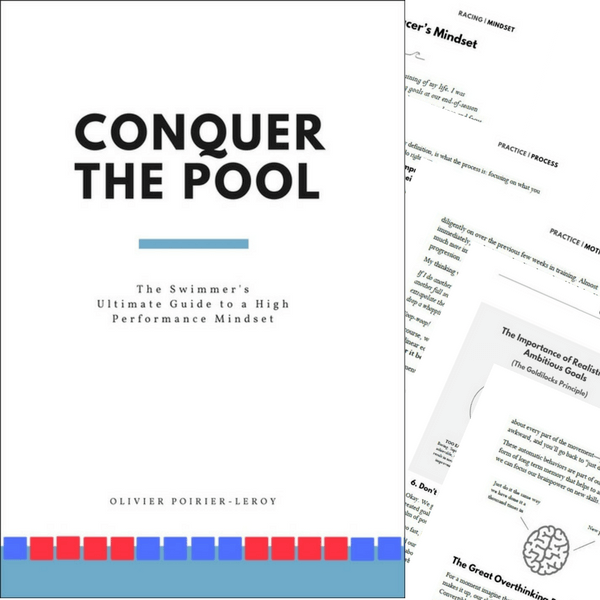 He’s also the author of the recently published mental training workbook for competitive swimmers, Conquer the Pool: The Swimmer’s Ultimate Guide to a High-Performance Mindset.
It combines sport psychology research, worksheets, anecdotes, and examples of Olympians past and present to give swimmers everything they need to conquer the mental side of the sport.
Ready to take your mindset to the next level?
👉👉👉 Click here to learn more about Conquer the Pool.
