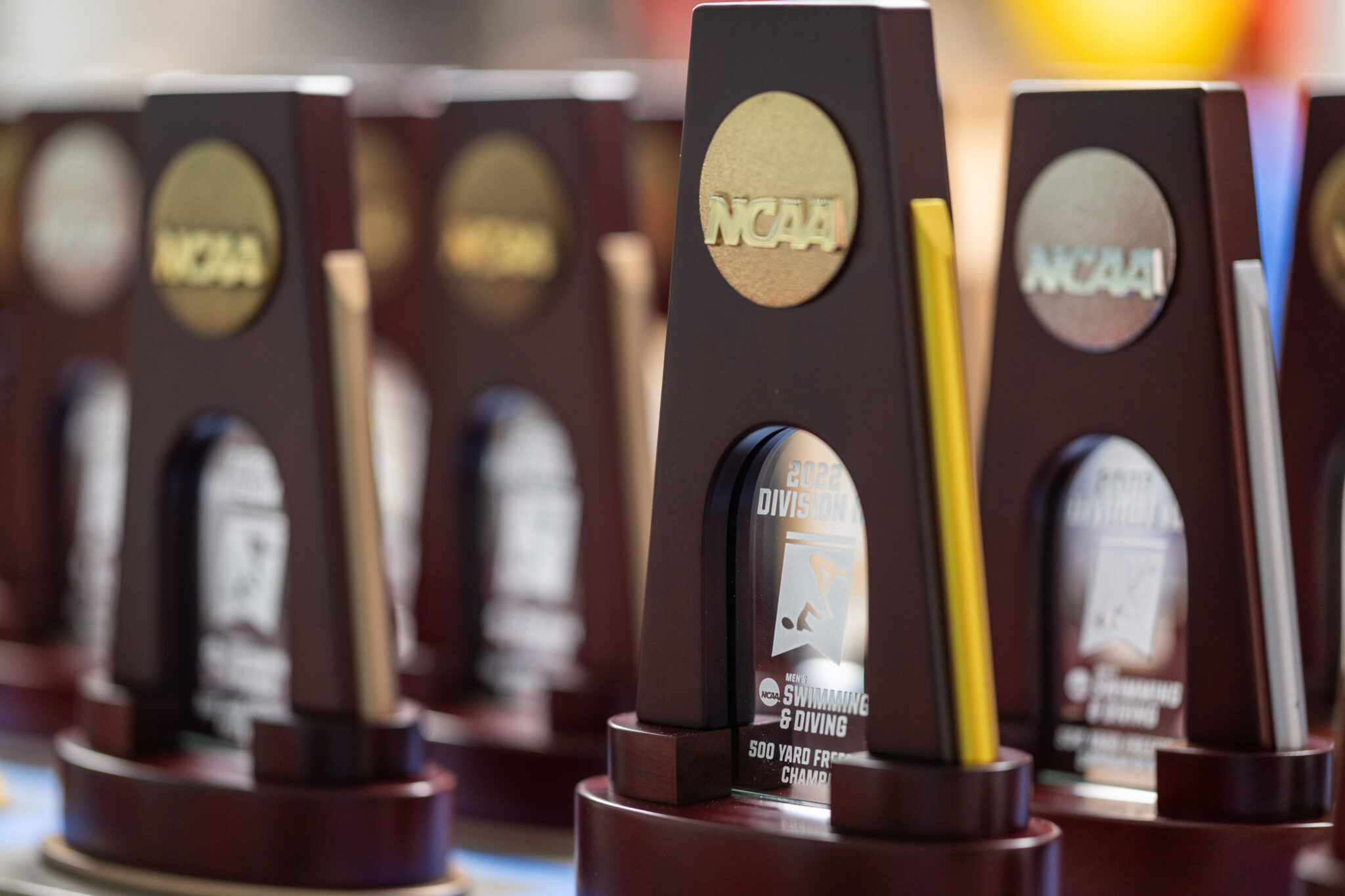
The 2025 NCAA Men’s NCAA Swimming & Diving Division II Championship will remain vacant after Drury was stripped of its title, the NCAA confirmed to SwimSwam on Monday morning.
The Tampa men finished 2nd at the meet, 74 points behind Drury. Their record will continue to reflect a 2nd place finish.
The original champions from Drury announced on Friday that their title was vacated after a member of the team violated NCAA anti-doping rules by testing positive for an elevated level of caffeine. Caffeine, while no longer outlawed by the World Anti-Doping Code, has a certain threshold in NCAA competition that makes it an anti-doping rules violation.
The threshold is set very high, with a limit of 15 micrograms per milliliter to trigger a positive drug test. WADA previously had a limit of 12 micrograms per milliliter. The NCAA says this equates to about 500 milligrams of caffeine within an hour in a normal adult male (though it would require larger quantities in a larger person). That’s equivalent to about 6-8 cups of brewed coffee in a short period of time.
Caffeine also has a relatively-short half life, meaning that it leaves the system at a high rate. Depending on how long after consumption the test was taken, that implies an even higher level of consumption likely from either highly-concentrated energy drinks, caffeine pills, or caffeine powders.
The amount of caffeine that would have to be consumed to trigger a positive test could be unsafe for some individuals. The FDA has cited 400 milligrams per day as “an amount not generally associated negative effects.” The FDA estimates that toxic effects, like seizures, can be observed with “rapid consumption of around 1,200 milligrams of caffeine.”
After the news broke on Sunday, one NCAA Division II coach told SwimSwam that this was the first time in “at least a decade” that he remembered there being drug testing at the D2 National Championships, and that the program was announced ahead of time. He speculated that it may have been prompted by the high profile suspension by WADA, the global anti-doping authority, of three-time NCAA Division II Champion Rafaela Raurich earlier this year.
The NCAA’s approach to Drury’s title is in line with its policies and past practices. Even in cases of regular season events, a team that has to vacate a win remains on the opponent’s record as a loss.
In spite of losing the 2025 title, Drury still has 12 NCAA Division II men’s championships in program history, which is easily the most among active D2 programs (Tampa and UIndy are the only other current D2 swim programs that have won titles, 1 each, in the last two years). That does bump them out of a tie with Cal State Bakersfield, which has since moved to Division I, for the most ever.

Hi there, Clinical Sports Pharmacist here who was a D1 NCAA swimmer.
So Caffeine actually has a very significant amount of genetic variability that could have caused this in this athlete. Contrary to this article, the science of caffeine in the body, called pharmacokinetics, is actually much more complex than what is described. The half-life of how long something stays in the body, which you described as “relatively-short half life” is actually incorrect. There are also drug-drug interactions that impact caffeine effect and levels/elimination as well. For the healthy adult male, the half-life ranges from 3 to 7 hours taking into account no drug-interactions and only genetics. This means that within 7 hours, the athlete could have had 50%… Read more »
Foot Toucher Top 3 reccommendiations for who deserves this title now:
Which list should i rank next?
Exactly why should the team that got 24th “deserves” the National Championships?
He’s doing a bit.
The Golden Eagles of Carson Newman are on par with the Los Angeles Mad Drops of Major League Pickleball, amongst other perennial powerhouses of sport and athletics. Team culture sometimes outperforms speed in the pool
I think we need to re-evaluate whether caffeine is “performance enhancing” because this is so dumb
If it isn’t performance-enhancing, why is every swimmer ripping it before their races?
Doping doesn’t outlaw everything that is performance-enhancing. Creatine is a great example of this. What it tries to do is outlaw everything that is performance-enhancing and either 1) not safe, or 2) not equitably accessible/requires an extreme level of medical intervention (like blood doping). That’s my interpretation, not WADA’s or the NCAA’s. (Plus, of course, things that could mask the other things that aren’t allowed).
Caffeine at this level can be unsafe, and at higher levels is definitely unsafe. So a threshold feels like the appropriate rule, given the goals, so that nobody feels they have to take an unsafe amount of substance just to ‘keep up.’… Read more »
Ya i mean i get the safety thing but this punishment just seems so excessive
It’s really not that excessive when you break it down, it’s just kind of a domino effect because the one swimmer seems to have scored enough to be the difference between first and second.
If I’m understanding it correctly, the title wouldn’t have been vacated if they were still in first after the offending athlete’s points were removed. So, while the vacated title seems excessive, it’s also fair given that the person in violation was a significant contributor to that title.
Also if “every swimmer” is ripping it before races than why are we taking away a national title from an entire team because of it?
Idk i understand rules are rules, and he broke the rules. This just feels wrong
“If it isn’t performance-enhancing, why is every swimmer ripping it before their races?”
Is that really going on??! Wow, I was really naive in my swimming days (last NCAA championship in 1994). I was super-vigilant about what I consumed, and I don’t remember ever having a cup of coffee or tea with breakfast before prelims. We also didn’t have caffeinated energy drinks back then. However, I did attend and swim at “Coca-Cola University,” and I had a few cans of that stuff here and there around (academic) finals or at lunch before practice.
My swimmer and a few of his teammates don’t drink coffee and don’t take caffeine tablets or satchets. They swam at nationals in Australia.
There have been many people who I know across summer and club teams who would drink an energy drink before races with the specific purpose of it helping them swim faster (and they claimed it worked). I watched it trickle down to even 13- and 14-year-olds, and across levels of competitiveness and success
At the NCAA level the vast majority of sprinters take a pre workout before their races at big meets. Most of them have somewhere between 150 and 250 milligrams of caffeine per scoop. There was one year in the early 2010s where Cal upset Texas at NCAAs and the rumor was they were taking NO Xplode before their races, it has been very common since then.
You are exactly right in your understanding for Caffeine, Braden. Weight-based dosing for cognitive benefits in someone who is intermediate metabolizer is 1-3mg/kg and max physiological performance benefits are seen as doses 3-6mg/kg.
Let’s say the average swimmer is between 130-190lbs (59kg – 86kg). That means the max dose therapeutic “safe” dose range for someone who doesn’t have any other genetic issues with caffeine (there are several genes that were involved with caffeine metabolism such as CYP1A2, ADORA2A, AHR, POR, ABCG2, CYP2A6, PDSS2 and HECTD4 rs2074356), the dose range max is about 500mg.
59kg x 6mg = 354mg max dose
86kg x 6mg = 516mg max dose
There is literally no safe reason to go over 500mg, but the… Read more »
Straight off of the NCAA Banned Substances List:
Category of Medication = Stimulant
Amphetamine (Adderall), Caffeine and sources of caffeine*, Cocaine, Dimethylbutylamine (DMBA; AMP), Dimethylhexylamine (DMHA; Octodrine), Ephedrine, Heptaminol, Hordenine, Lisdexamfetamine (Vyvanse), Methamphetamine, Methylhexanamine (DMAA; Forthane), Methylphenidate (Ritalin), Mephedrone (bath salts), Modafinil, Octopamine, Phenethylamine (PEA) and its derivatives, Phentermine, Synephrine (bitter orange).
* Sources of caffeine (e.g., Green tea extract, Guarana, Yerba Mate, etc.)
Exceptions: Phenylephrine and Pseudoephedrine are not banned.
https://www.ncaa.org/sports/2015/6/10/ncaa-banned-substances.aspx
_______________________________________________________________________________________
Now for my Pharmacist expertise on why Caffeine seems benign, but is actually on this list for several other reasons outside of safety:
1.Caffeine can make the person feel less pain when you take it with OTC… Read more »
Also, this is extremely important for the NCAA Banned Substance List and why every athlete should have a Clinical Sports Pharmacist to be able to pay to consult if they want consume anything that isn’t food. Dietary supplement isn’t food, protein powder isn’t food.
“Some Examples of NCAA Banned Substances in Each Drug Class
THERE IS NO COMPLETE LIST OF BANNED SUBSTANCES. DO NOT RELY ON THIS LIST TO RULE OUT ANY LABEL INGREDIENT.
Many nutritional/dietary supplements are contaminated with banned substances not listed on the label. It is the student-athlete’s responsibility to check with the appropriate athletics staff before using any substance.
“Any substance that is chemically/pharmacologically related to one of the above drug classes, even if it is… Read more »
And for the women’s team title ???
While colloquially, swimming folks often refer to programs as “one team,” in most technical senses in the NCAA, at a competition, they are separate teams.
The women are unimpacted by this, because their swimmers did not test positive.
So if this was an actual PED (Testosterone, Tren, etc.) how bad would the punishment have been? Way too excessive for just caffeine.
They treat it equally
My coaches at University of Houston took caffeine probably MORE seriously and monitored our intake than probably alcohol. This was irresponsible on the coaches as well for not educating and enforcing these very established and well known rules.
My question to the NCAA swimming committee is that a fair ruling?
I do not think so. Re-score the meet and if Tampa wins then they should be the natty champs.
The NCAA, generally, tries to keep its rules consistent across all sports, which is probably why the context for this rule makes sense.
Think about basketball. A team cheats its way to an NCAA title (which has happened, Louisville vacated the 2013 title). Why does the team that lost to them in the championship game get declared a champion, when the team that lost to them in the Final Four not?
I think the rules could be tailored for certain sports. They do it, for example, with recruiting rules. But…that’s my best guess as to why this is the policy.
I wonder if the NCAA policy is also in line to protect the identity of the individual who tested positive. If someone’s individual and possible relay points are stripped, I would imagine you could figure out pretty easy who it is. Not sure if they publicize who did the 5-hr energy shots anyway, but if this is considered protected information (and my guess is yes for the NCAA), a policy to out them could be problematic…