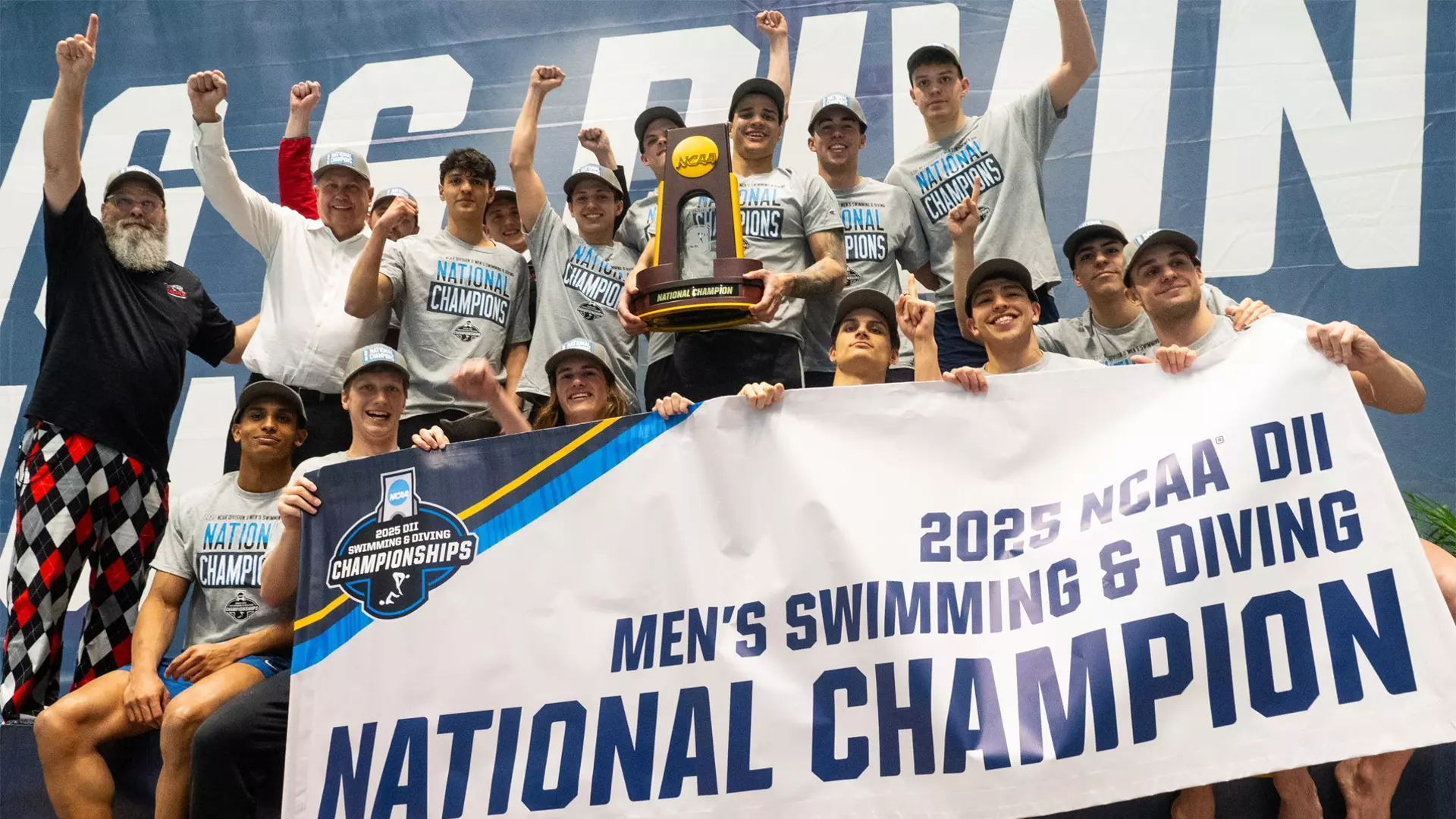
Drury University will vacate its 2025 Men’s Division II NCAA swimming and diving team title after a single positive test of caffeine was above the NCAA’s allowable limit during the meet this past March. Drury’s points total now drops them out of first place. Tampa was originally 2nd in the team standings but as of publishing, Tampa has not been notified of the violation and it is unclear if they will be elevated to national champions or if the title remains vacated.
“While I’m disappointed for our team, I am still very proud of what we accomplished this year, both in the pool and the classroom,” said head coach Brian Reynolds. Reynolds just finished his 45th year as head coach.
The one athlete that tested positive will also serve a one year suspension during the upcoming 2025-2026 season, losing a season of eligibility in the process. The individual athlete has not been named.
According to Drury’s press release, Drury’s adjusted point total dropped them from the top spot in the team standings. Because of the size of the gap, that implies several relay results were impacted too in addition to individual results.
The Drury men captured the 2025 NCAA Division II team title with 525 points, 74 more than 2nd place Tampa. It marked the first team title for Drury since 2014. Sophomore Ivan Adamchuk led the way for the team with 61 individual points, including NCAA titles in the 100 back, 200 back, and 200 IM. Senior Israel Zavaleta won the 1 meter and 3 meter diving events while senior Davi Mourao was the final individual title winner with a 1st place finish in the 200 breast. The team’s 400 medley relay also swam to an NCAA title.
The team runners-up from Tampa say that they were not notified of the decision, and it is unclear whether the title will be re-awarded or left vacant. That team was led by Jacob Hamlin who swept all four of his individual events, winning NCAA titles in the 200 free, 500 free, 1000 free, and 1650 free. He also swam to Division II NCAA records in the 500 free, 1000 free, and 1650 free in the process. The team’s 800 free relay, which included Hamlin, swam to an NCAA record as well. Tibor Tistan won the other NCAA title as he earned the win in the 50 free.
One NCAA Division II coach told SwimSwam that this was the first time in “at least a decade” that he remembered there being drug testing at the D2 National Championships, and that the program was announced ahead of time. He speculated that it may have been prompted by the high profile suspension by WADA, the global anti-doping authority, of three-time NCAA Division II Champion Rafaela Raurich earlier this year.
This is not the first time the Panthers have lost a high NCAA finish. In 2023, they were found to have committed recruiting violations that forced them to vacate their 2021 runner-up finish.
In spite of losing the 2025 title, Drury still has 12 NCAA Division II men’s championships in program history, which is easily the most among active D2 programs (Tampa and UIndy are the only other current D2 swim programs that have won titles, 1 each, in the last two years). That does bump them out of a tie with Cal State Bakersfield, which has since moved to Division I, for the most ever, however.
The current World Anti-Doping Code does not limit caffeine concentrations, but the NCAA has a limit of 15 micrograms per milliliter to trigger a positive drug test. WADA previously had a limit of 12 micrograms per milliliter. The NCAA says this equates to about 500 milligrams of caffeine within an hour in a normal adult male (though it would require larger quantities in a larger person). That’s equivalent to about 6-8 cups of brewed coffee.
A 12-ounce can of Celsius Original, a popular energy drink, contains 200 milligrams of caffeine, while Celsius Heat contains 300 milligrams per 16 ounce can. A can of Red Bull contains less caffeine, about 1oo milligrams.
The Mayo Clinic says that up to 400 milligrams of caffeine intake per day “seems safe for most adults.”

Is it normal to learn this news 5-6 months after the competition?
There are processes and hearings and all that stuff to go through.
The swimmer’s Starbucks rewards balance exceeded the NCAA’s allowable limit.
For caffeine?! Seems a bit extreme, especially since it’s over the counter and no one is excluded from drinking it. Prescribed medicine and PEDs I get, that is not readily available. Nor should it be. But caffeine is everywhere. I dont care how much coffee people drink. I never needed it to swim or lift weights.
It’s not coffee. Lots of these athletes (at least D2 and D3) use C4 at meets. 200mg of caffeine in each little scoop. I had a swimmer who had never used it before but did at the conference championships. She was half a lap ahead of the field at the 100 of the 200 fly. Finished 8th.
I had a high school teammate that took 3 or 4 scoops and set a PB in the 100 free. The problem was it was a 500. It ended the same as your story.
My guess is this guy pounded caffeinated drinks or took too many caffeine pills. It takes a lot more than a couple cups of coffee to exceed this limit. A typical cup of coffee is 100-125 mg. And dissipates from the body fairly rapidly.
I am stunned he got caught. NCAA dont seem to test much or care much really.
My daughter got tested twice at swim nationals and once at track nationals this year. They were definitely testing and apparently the coaches were aware, so this kid and his coach had an opportunity to make a different choice. Whether caffeine should be “banned at this level” is a different discussion, but following the rules isn’t optional.
Congratulations on your victory by disqualification
To me it appears the win is being vacated because with the disqualification of the swimmer who tested positive, the points the swimmer scored are removed from the team’s total, and the total drops below that of Tampa’s. Not that the team as a whole is being directly penalized for the positive test. Is that correct? (Not that it really makes a difference…)
.
The ncaa and international doping rules are different with regard to caffeine. The rules should be updated to be consistent with each other.