2025 Men’s NCAA Swimming and Diving Championships
- March 26-29, 2025
- Weyerhaeuser King County Aquatics Center, Federal Way, Washington
- Short Course Yards (25 yards)
- Live Results
- Final Results
- Live Recaps
With the new event schedule having just three heats on the first evening, one each of the 1650 free, 200 medley relay, and 800 free relay. That has results in a considerable amount of ‘dead’ time within the session, especially given that there is no diving on the first day.
ESPN filled out a fair amount of this time at the women’s championships with replays of races from previous years, and this week the stream seems to have dropped entirely after the 200 medley relay – to keep you entertained, we have decided to do a little throwback of our own to last year.
A Record-Setting Series Of Events In The 400 Free Relay
The 400 freestyle relay has seen an explosion of times since Florida and Cal broke NC State’s NCAA record of 2:44.31 in 2023, in a race decided by one-hundredth of a second. That has come to a head this year, and on Day 4 of NCAAs gave us a fantastic end to a blockbuster championships.
Seven of the top 12 teams in 2025 set a new school record: six of them outright and Texas matching the 2:45.12 they swam back in 2019.
| School | Old Record | New Record |
| Tennessee | 2:42.41 | 2:42.30 (NCAA Record, SEC Record) |
| ASU | 2:43.40 | 2:43.22 (Big 12 Record) |
| Indiana | 2:45.62 | 2:45.08 (Big Ten record) |
| Texas | 2:45.12 | 2:45.12 |
| Alabama | 2:47.67 | 2:46.40 |
| Georgia | 2:48.22 | 2:47.15 |
| Arizona | 2:47.86 | 2:47.64 |
Arizona’s record was a big one. They took over 1.5 seconds off their time from Big 12s and were 0.22 under the previous record from way back in 2007, a team that included short-course World Champions Albert Subirats and Darian Townsend.
The 400 freestyle relay as a whole has gotten much quicker since 2021. That year the winning time at NCAAs was 2:46.60, which would have slotted into 10th place this year just behind Alabama.
That was a drop off from the winning time in 2019, 2:45.12 from Texas, but the Crimson Tide’s time this year would have won the title at all bar six previous championships (2017-2019, 2022-2024). Just for reference, that’s the team that just finished 9th.
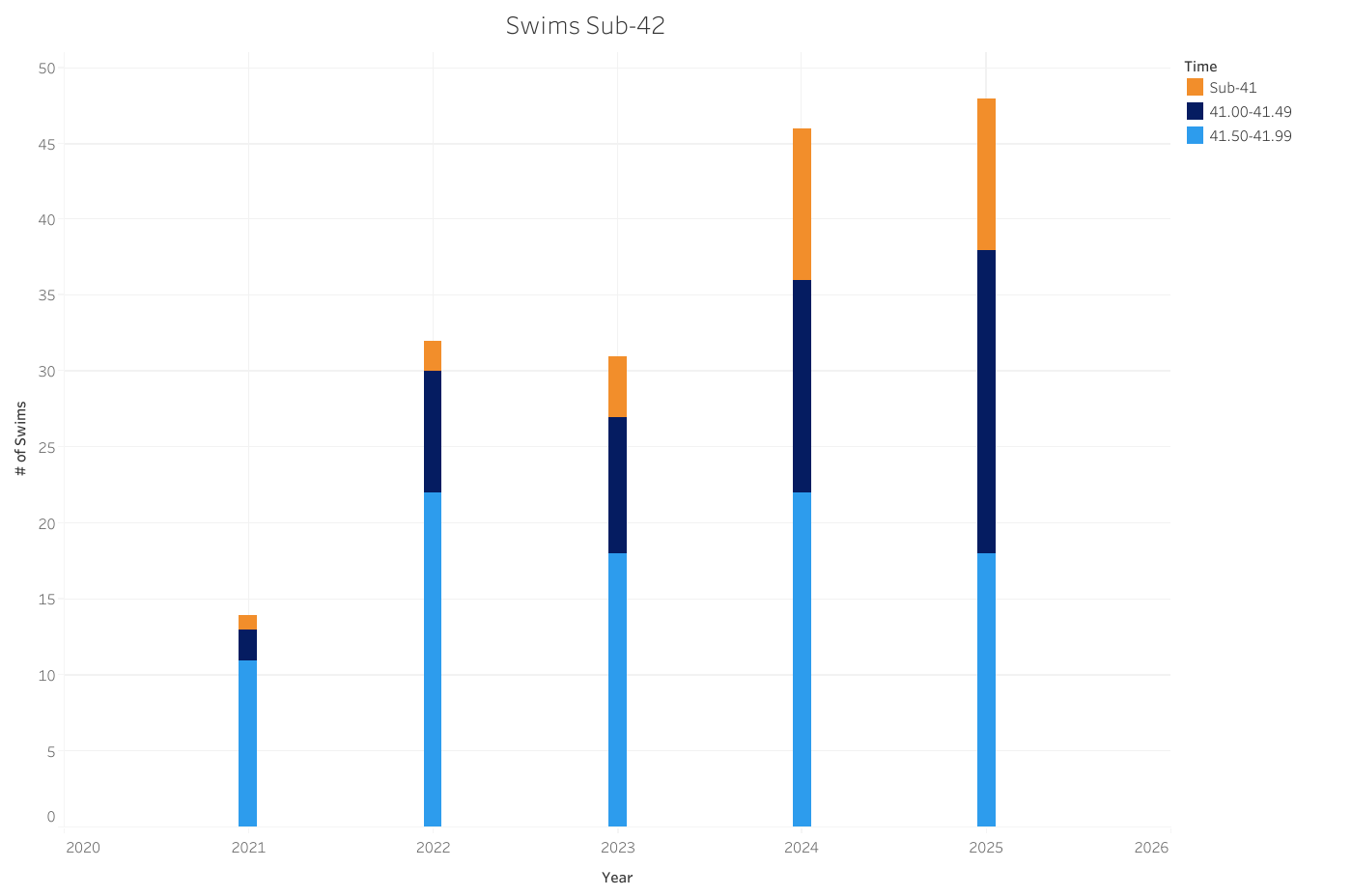
It has been a concerted team effort driving this. Three-quarters of relay legs (including leadoffs) this year from the top 16 teams were under 42 seconds, after only 14 were in 2021. This season also saw the first ever sub-40 split back in November, and in the final event of Day 4 we saw two: Jordan Crooks (39.36) and Jonny Kulow (39.93).
| 2021 | 2022 | 2023 | 2024 | 2025 | |
| Sub-42 | 14 | 32 | 31 | 46 | 48 |
| Sub-41.5 | 3 | 10 | 13 | 24 | 30 |
| Sub-41 | 1 | 2 | 4 | 10 | 10 |
Looking at the splits from the All-American relays, there’s been a significant downward trend since 2021. On average they’ve been getting quicker by 0.23 seconds a year, or 0.91 seconds in total over this timespan.
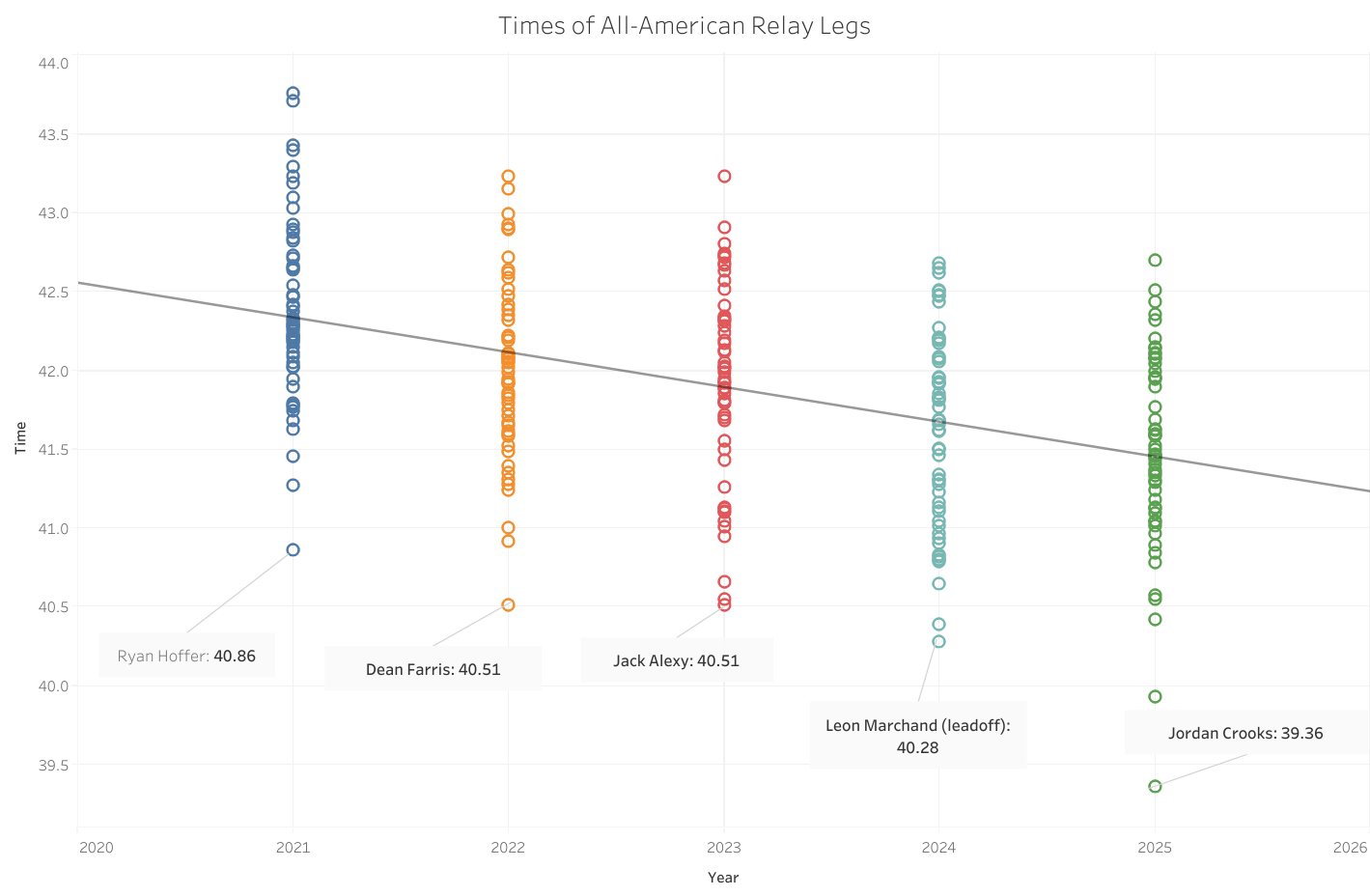
Median swimmer’s time from All-American relay teams
| 2021 | 2022 | 2023 | 2024 | 2025 |
| 42.40 | 42.02 | 41.92 | 41.64 | 41.49 |
This trend is not likely to continue next season as the Covid-era fifth year of eligibility comes to an end. A whopping 28 of the 64 All-American relay legs will not return next year, including the entirety of Cal’s team.
However, it would be a shock to see the time needed to make the top eight jump up above 2:48 next year. A year of turnover is likely in 2026 but it certainly will not be slow.
