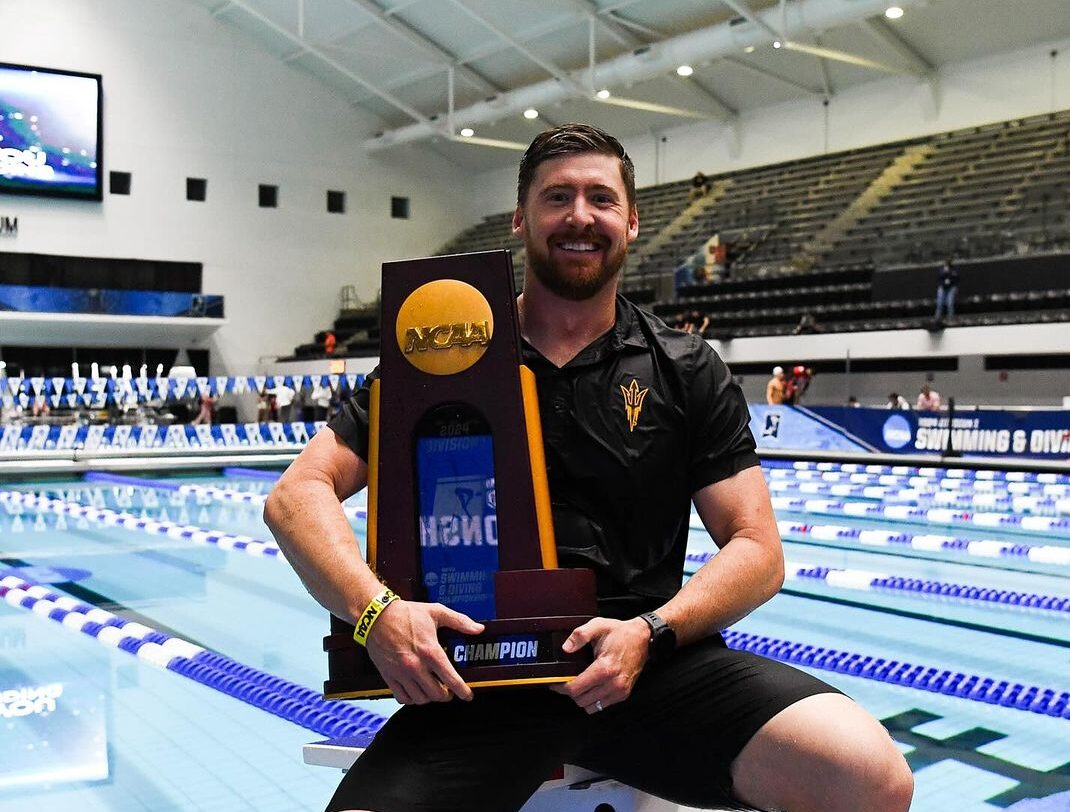
Arizona State head coach Herbie Behm proposed a new idea on NCAA Championship qualifications, with dual meet wins giving teams three individual spots. Only the fastest 270 men and 322 women would still make the meet though.
A more detailed breakdown on Behm’s idea would have all Division I schools compete in six dual meets during the “regular season.” Under the current model, some schools compete in as little as two “dual” meets where others compete in upwards of ten. After the dual meet season would be a conference championship and NCAA championship.
NCAA rosters would be built off of dual meet wins, with a dual meet win giving a team three individual athletes added to an NCAA roster. Loses do not add any NCAA roster spots. This would allow an undefeated team to build a roster of up to 18 athletes, which is the current NCAA limit. With this idea, Behm also emphasizes the importance of still taking the top 270 men and 322 women, meaning the overall number of athletes would stay the same.
Behm addressed some questions in the comment section. One comment asked “Would this lessen the importance of conference championship meets? Would there be qualifying opportunities at conference champ meets? Also, would qualifying times still be in place?” but Behm replied, “Same qualifying procedures as currently in place (must hit time & be in top 270/322) but roster limited by dual meet record. Times at conference championship will count so current importance will not be lowered.”
Another commenter asked, “Like the idea. However, won’t top teams be discouraged from racing other top teams in season? Losing to a NCAA rival at a dual meet would mean certain loss at nationals (being down three roster spots), so teams wouldn’t risk having exciting schedules.” Behm replied, “I think we should require 3 in-conference meet and 3 “equally ranked opponents.” So team within 5 places of last year’s finish. NCAA should dictate the schedule and require head-to-head competition all season long.”
As far as mid-majors vs Power 4 goes, one person asked, “Is this Just Power 4 teams? What about Mid Majors?” Behm replied, “I think 3 in-conference meets and 3 out of conference meets with some type of strength of schedule requirement but yes, all D1 teams having the same season requirements.”
With dual meets giving NCAA roster spots in this idea, Behm also addressed the fact that some dual meets end in a tie which means a tiebreaker would need to be addressed.

Two questions on this: First, a school with strong diving but maybe less strong swimming (Maybe a Purdue for example) could win only one or zero meets due to the number of swim events and keep divers from advancing.
Second, especially at mid-majors, you could have one stud athlete but not the team depth to win meets. This could keep out someone like Brian Benzing from Towson (silver in breast at NCAAs) a few years ago. [Yes, I know they did win dual meets that year, but you get the point.]
Personally, I would rather see more “big” dual meets like the ASU vs. Cal we saw a few years ago. That was epic. To have implications of NCAA qualifiers on the line would be too high stakes, in my opinion. I’d like to see more matchups between the top 20 teams, for sure. While I don’t care for this idea, I do like outside the box thinking. Keep ’em coming!
Why are more women than men invited to the championships? I assumed it was due to equalizing opportunities due to large football rosters, but I am not sure of that.
Can someone clarify for us?
Thx
It is about that.
This is a great starting point for a discussion on how to make swimming more attractive to fans. Making dual meets relevant is a good idea. We have to stop having dual meets where swimmers show up in training suits and that held at times that are inconvenient for most fans (eg, Fridays at 1 pm), for example.
Yes, there seems to be an uptick of dual meets on Thursday and Friday during the day. I live close enough to go to UVA meets, but there’s only one home meet this season held outside of business hours. If you want to build a fan base, this isn’t how you do it.
First reaction: this doesn’t seem like a good idea. It obviously favors the way Behm likes to approach the season, and discourages the way other coaches like to approach it.
I have no vote in the matter, but I’d rather just see an approach that lets each team bring a consistent/equal # of athletes, rather than relying on esoteric qualifying procedures. I think there are some obvious questions/problems with that, as well, but just seems more reasonable (e.g. what’s the roster limit? Does every school get the same # of athletes regardless of speed? Isn’t that too expensive? Wouldn’t the meet take too long?).
This might also encourage less concentration of power at just a few schools. I think… Read more »
Sounds like Herbie and some of the other stake holders should be running for election for the committee that made the changes.
these “stakeholders” won’t run for committees…they don’t even attend annual meetings where decisions are being made
Ah, no!
I appreciate the thought, hopefully it will inspire something with more detail. I like what NCAA basketball did. $1 million dollar purse for the team that wins a tournament. Incentives impact behavior.
Mainstream sports are far less predictable with meaningful games every week. I always thought an all star meet would be cool. Let the 4 best swimmers on a relay together and see how fast they can go.
Meets with unorthodox events or altered DQ rules.
Hill Taylor’s 50 Meter Back Underwater – Intentional DQ is one of my all time favorite videos. Would be cool to see the top athletes see how fast they could go without a 15M mark.
Also outdoor meets with… Read more »