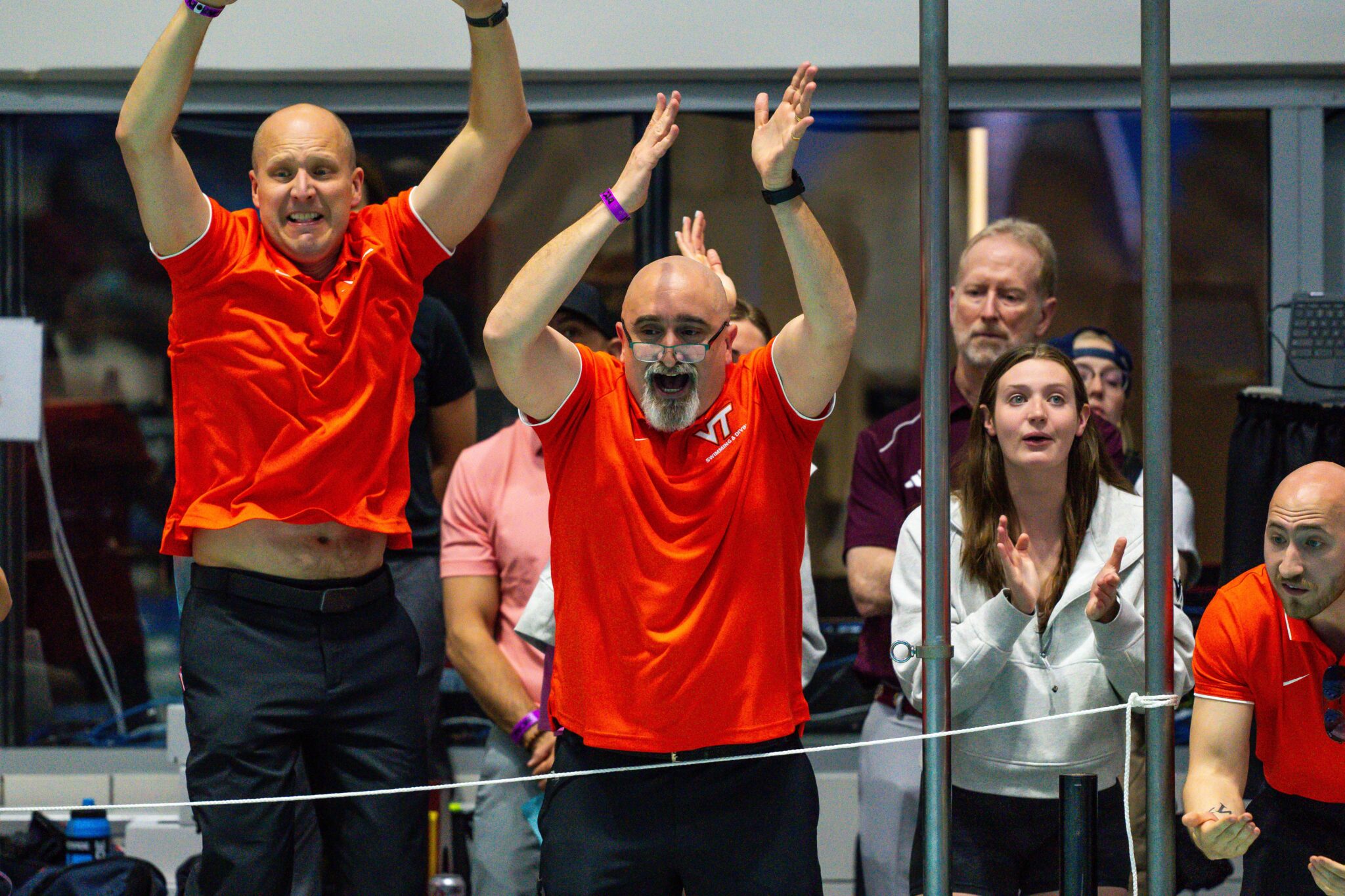
It’s that time of the year again. SwimSwam will be previewing the top 12 men’s and women’s teams (and then some) from the 2025 NCAA Championships. Follow along with the College Swimming Preview Channel. Want to read even more? Check out the latest edition of the SwimSwam magazine.
#10 Virginia Tech Hokies
Key Losses: Carles Coll Marti (35 NCAA points, 4 NCAA relays), Youssef Ramadan (23 NCAA Points, 4 NCAA relays), Mario Molla Yanes (4 NCAA relays), Luis Dominguez Calonge (2 NCAA relays)
Key Additions: Connor Johnson (NJ-backstroke), Andy Roose (VA- backstroke), Oscar Bilbao (Arizona State transfer-breaststroke)
GRADING CRITERIA
Over the years, we’ve gone back and forth on how to project points, ranging from largely subjective rankings to more data-based grading criteria based on ‘projected returning points.’ We like being as objective as possible, but we’re going to stick with the approach we’ve adopted post-COVID. The “stars” will rely heavily on what swimmers actually did last year, but we’ll also give credit to returning swimmers or freshmen who have posted times that would have scored last year.
Since we only profile the top 12 teams in this format, our grades are designed with that range in mind. In the grand scheme of college swimming and compared to all other college programs, top 12 NCAA programs would pretty much all grade well across the board. But in the interest of making these previews informative, our grading scale is tough – designed to show the tiers between the good stroke groups, the great ones, and the 2015 Texas fly group types.
- 5 star (★★★★★) – a rare, elite NCAA group projected to score 25+ points per event
- 4 star (★★★★) – a very, very good NCAA group projected to score 15-24 points per event
- 3 star (★★★) – a good NCAA group projected to score 5-14 points per event
- 2 star (★★) – a solid NCAA group projected to score 1-4 points per event
- 1 star (★) – an NCAA group that is projected to score no points per event, though that doesn’t mean it’s without potential scorers – they’ll just need to leapfrog some swimmers ahead of them to do it
We’ll grade each event discipline: sprint free (which we define to include all the relay-distance freestyle events, so 50, 100 and 200), distance free, IM, breaststroke, backstroke, butterfly and diving. Use these grades as a jumping-off point for discussion, rather than a reason to be angry.
Also, keep in mind that we are publishing many of these previews before teams have posted finalized rosters. We’re making our assessments based on the best information we have available at the time of publication, but we reserve the right to make changes after publication based on any new information that may emerge regarding rosters. If that does happen, we’ll make certain to note the change.
2024-2025 Lookback
Virginia Tech survived a relay DQ and still held onto 10th at NCAAs, extending its streak of top-10 finishes to three straight under Sergio Lopez Miro.
- 2025- 10th (107.5)
- 2024 – 9th (172)
- 2023 – 9th (133)
- 2022 – 11th (143)
- 2021 – 11th (135)
- 2020- Canceled due to COVID-19
- 2019 – 35th (11)
Over half of the points that the Hokie men scored at last season’s NCAAs came at the hands of Carles Coll Marti and Youssef Ramadan, combining for 58 of the 107.5 points. Coll Marti racked up a pair of finals appearances in both the 200 breaststroke (3rd) and 200 IM (4th), earning a bulk of his individual points there (31 of his 35 individual points). He added a consolation final in the 100 breast, where his 13th-place finish earned him another four points.
Ramadan wrapped up his decorated collegiate career with the Hokies with just a single championship final at last season’s NCAAs, finishing 8th overall in the 100butterfly (44.15), an event he won back in 2023. Ramadan added another set of second swims to his meet in both the 100 backstroke (10th) and 100 freestyle (12th).
The only other individual scorer for VT came at the hands of rising junior Brendan Whitfield, who ended up with a 15th-place finish in the 100 free (41.69).
The rest of the points came from the relay performers. The Hokies’ highest finish came at the very end of the competition, in the 400 free relay (Ramadan, Witfield, Coll Marti, Mario Molla Yanes), they touched 8th overall (22 points). No other relays managed to crack the top 8 leading up to that point. The 400 medley was 11th, they touched 13th in the 200 free, and 14th in the 800 free.
Sprint Free: ★★
Youssef Ramadan held the fastest times in two of the three sprint free events for the Hokies last season. His opening leg of the 200 free relay of 18.80 stands as the fastest flat start time for the Hokies last season, while his 100 free at NCAAs of 41.44 also tops last season’s VT top times list.
Sprint free is one of the few areas where VT retains top-level firepower, led by Brendan Whitfield. The rising junior followed closely behind in both distances, his 18.89 from prelims at ACCs ranked him as the second fastest Hokie, and the only other one under 19 seconds on the season. Whitfield finished 4th in the final at ACCs, along with his bronze medal finish in the 100, where he swam the second fastest time for the program last year in 41.60. His 50 free was fast enough to score this past season at NCAAs (T12 in prelims,13th at finals); he just wasn’t able to get it put together in prelims. That echoes into his 100 free as well, although he did make the consolation final, his time from a few weeks prior would have scored two spots higher.
Whitfield will undoubtedly be the backbone of this sprint group with the departure of Ramadan, we mentioned last year that Ramadan could be a threat to make multiple ‘A’ finals, this year that role has been passed to Whitfield, who will not only have the task of higher point scoring, but also will likely be a member of every relay that he can fit in (as he was this past season where he represented VT on all five relays).
Virginia Tech will be without the services of Luis Dominguez Calonge, who led the team in the 200 free with his 1:32.37 from the Tennessee Last Chance Invite, over 1.3 seconds faster than Whitfield, who was second (1:33.69).
Returning for his sophomore year in Blacksburg will be Jakub Poliacik, who showed plenty of promise in the 200 free last season. Between November and March, he managed to shave nearly 1.4 seconds off of his 200 free, knocking him down to his current best of 1:34.09, well over a second faster than his 1:35.25 from the ACC Championships.
One more key returner for this group is Will Hayon, who was on that disqualified 200 medley relay, but also swam a trio of individual races at NCAAs, including both the 50 and 100 free. His NCAA experience is crucial with the loss of four big veterans.
Distance Free: ★
This is an area where Virginia Tech is in need of some serious depth. Luis Dominguez Calonge did not swim his 500 at NCAAs, and his 4:16.46 from ACCs was still nearly over three seconds off from putting him into NCAA scoring position.
Behind him were only three men within the 4:20 to 4:21 threshold: returning senior Lee Naber (4:20.00) and Jakub Poliacik (4:20.83) return in the 500, but neither was near NCAA scoring range.
Poliacik has raced the 500 only six times, dropping at least two seconds each swim — a strong trajectory for a sophomore.
The Hokies will bring in Lucas Humling of Sweden, whose converted time in the 400 free in short-course meters sits at 4:23.87 for the 500 free, providing a slight bit more depth in the event.
Naber led the team last season in the 1650 free with his 15:03.59, a time that earned him a 12th-place finish at ACCs. Yet he was the only swimmer who was under 5:18 for Virginia Tech last season.
Backstroke: ★
Ramadan (44.61), Molla Yanes (45.59), and Gabriel Yuk (46.79) will be heavily missed in the 100 back for the Hokies. With the top three times from last season gone, that leaves a lot to be desired from a team that put three swimmers in the top 32 in this event at ACCs. Molla Yanes also held the top 200 back time in 1:39.80, the only Hokie under 1:40 last season.
They brought back Levente Balogh for his sophomore season, who was the second quickest in the 200 back last season with his 1:40.55.
Fortunately, the Hokies recruited backstroke. Incoming freshman Connor Johnson holds lifetime bests of 46.88 and 1:42.95 in the 100 and 200 back, immediately throwing him into the conversation for relay placement. Along with Johnson is Andy Roose, whose lifetime bests sit at 47.44 and 1:42.43, respectively. Both Johnson and Roose hold 100 back bests that were faster than any returning VT man from last season.
They may not top Balogh in the 200 back, but collectively, they make up the top two in the 100 back and 2nd and 3rd from last season in the 200 back.
Brit Matt Cairns committed to transfer to Virginia Tech in the spring and would have added depth to this group, but ultimately decided to stay at Florida.
Breaststroke: ★
Losing Carles Coll Marti carries a little extra weight here. As we mentioned before, he made finals in both breaststroke events at NCAAs, and now the closest to a sub-51 performer that is returning is Ethan Maloney at 52.56, when he finished 20th at ACCs. Maloney was the only other sub-53 performer on the season.
Returning sophomore Eli Martin dropped a second and a half from his pre-VT best in the 100 breast in his freshman campaign (currently at a 53.12). He also took off over two and a half seconds in his 200 breast (1:54.67), showing some signs of a potential role filler going forward within the program with the loss of Coll Marti’s 1:48.89 200 breast.
Incoming freshman Jack Mainville comes into Blacksburg sitting at 54.07. If his first-year trajectory is similar to that of Martin last season, there is the potential for another sub-52 performer in the event for the Hokies, which could have an outside chance to make NCAAs (considering the 5th year/senior-heavy nature of the 2025 season at NCAAs).
The big addition here is British sophomore transfer Oscar Bilbao from Arizona State. He didn’t score at NCAAs last year, but finished 33rd in the 100 breaststroke with a best time of 51.99 at the big meet in March.
He may or may not score individual points, but he’ll be a key piece for the Sun Devil relays. He also went his first best times in two years in the 100 breaststroke (1:01.52) and 200 breaststroke (2:15.10) at the British Championships in April, so the Arizona State training was paying off, in spite of the transfer.
Butterfly: ★★
Ramadan and Molla Yanes leave an NCAA champion-sized hole in the 100 fly. Luckily, Will Hayon returns, on the back of a 28th-place finish at NCAAs in 2025 (45.33), his best individual finish of the meet.
Hayon swam faster at the Tennessee Last Chance Invite with his 45.12, a time that would have been 21st (eight swimmers above 21st place at NCAAs were either seniors or 5th years for reference for 2026).
Along with Hayon, the Hokies return Landon Gentry, who was right behind Hayon at 45.15 (21st last season at NCAAs), equally putting him firmly in the conversation for a potential NCAA finals berth.
Gentry also held the top Hokie time in the 200 fly at 1:40.99, a time that slotted him just off of a second swim at NCAAs. Carl Bloebaum has been as fast as 1:42.16 back in 2024. If he can find that form this season, breaking 1:41 may be what gets him into NCAAs.
With Hayon and Gentry near scoring range and Bloebaum seeking a rebound year, fly could be one of VT’s steadier events.
IM: ★
With Coll Marti gone, VT loses its only NCAA-level IMer. The next best returner, Landon Gentry (1:44.70), was well outside scoring range.
Daniil Pancerevas turned in a respectable 1:45.34 at the Virginia Tech Invite, just .03 off of his lifetime best from ACCs in 2024. Both Pancerecas and Gentry will have to pick up for lost points at the departure of Coll Marti
There is not much firepower in either IM. The 400 IM has a similar story. Nico Garcia is gone, taking his 4:46.82 with him, leaving Eli Martin (3:51.24) as the only returner who swam faster than a 3:55 on the season.
Incoming freshman Clem Camacho, of Wilmington, NC, boasts a best time of 3:50.86, along with Andy Roose at 3:51.22, and Connor Johnson at 3:54.80, all of which add needed depth to a rebuilding IM department.
Diving: ★
The Hokies sent a pair of divers to the NCAA Championships last season, upcoming sophomore Nathan Cox and rising junior Rocky Ramsland, each competing in all three diving events.
Cox finished up 33rd in the 1-meter, 49th on 3-meter, and 39th on the platform. Ramsland finished in 46th on 1-meter, 47th on 3-meter, and 41st on the platform. They didn’t score at NCAAs, but Cox and Ramsland showed progress as underclassmen.
Diving was not the strongest part of the VT men’s team last season, but with the amount of returners for Head Diving Coach Ryan Hawkins’ group (including junior Zachary Shaddy and senior Jacob Fisher), the Hokies could see a positive bump up in the diving department.
Relays: ★★
Note that the grading system doesn’t align perfectly for relays as double points.
Relay grading system:
- 5 star (★★★★★) – 31+ points per relay event
- 4 star (★★★★) – 22-30 relay points per event
- 3 star (★★★) – 12-21 relay points per event
- 2 star (★★) – 5-11 relay points per event
- 1 star (★) – 0-4 relay points per event
After three years of rare stability on relays, VT now faces a complete rebuild.
With the medley backstroke leg and sprint free ace-ability of Youssef Ramadan gone, and a valuable breaststroke and sprint free leg in Carles Coll Marti also out of the program. There will be a lot of flipping around to do. All four of our key departures we listed at the top of the article swam on at least two NCAA relays, with three of them as members of four.
Brendan Whitfield is likely to be called upon for a repeat of the relay quintet. He was the lone Hokie to represent VT on all five of the NCAA relays last season, showing his dominant sprint free prowess. Whitfield constructed a handful of notable performances in those relays as well, splitting a pair of 18.58s as the 2nd leg of the 200 free and anchor on the 200 medley (that eventually got disqualified). He put together a tandem of solid 100 free legs, anchoring the 400 medley in 40.92, and a second leg 41.04 on the 400 free (the fastest split of all VT men in that relay). Even his 200 free second leg was more than respectable in 1:33.90.
Whitfield was arguably VT’s most reliable relay piece last season, delivering strong legs across all five races. He’ll again be the foundation as the team works to replace Ramadan and Coll Marti
The biggest question marks will be the replacement of Ramadan’s backstroke (very possibly a freshman like Roose or Johnson), Coll Marti’s breaststroke (Maloney and Martin seem like the preseason frontrunners), and Molla Yanes’ 400 medley butterfly (shifting Will Hayon up seems like the easy choice, considering he swam on the 200 medley).
Some new questions have arisen within the free relays, along with Whitfield, who surrounds him?
Hayon, in theory, is an obvious choice, having NCAA racing experience and relay experience with Whitfield. Hanyon was the only other non-senior/5th-year last season to swim on a Hokie NCAA relay (Whitfield being the other).
Tanish George Matthew holds the third fastest time among returners in the 100 free at 43.19, which seems to be a logical replacement in the 400 free relay, along with Poliacik in the 800 free with his quickly moving progression.
Total Stars: 11/40
2025/2026 Outlook:
Virginia Tech enters this season at an inflection point: three straight top-10 finishes have firmly established the Hokies as a consistent NCAA contender, but the loss of program cornerstones Carles Coll Marti and Youssef Ramadan will test their staying power at that national level. The roster still has firepower, led by Brendan Whitfield, who now takes over as the centerpiece sprinter, but the path to another top-10 finish looks narrower than in recent seasons.
The team’s outlook hinges on two factors: whether returning swimmers like Whitfield, Will Hayon, Landon Gentry, and Jakub Poliacik can elevate to primary point scorers, and how quickly newcomers such as backstrokers Connor Johnson and Andy Roose adapt to the NCAA stage. Sprint free and butterfly look stable enough to deliver points, but the gaps in breaststroke and IM left by Coll Marti are significant, and rebuilding relays without Ramadan’s versatility will be a season-long project.
Realistically, Virginia Tech should remain competitive in the 8–12 range nationally. If their younger core develops on schedule and at least one freshman produces NCAA-level times right away, a fourth straight top-10 finish is within reach. But without that progression, the Hokies may find themselves closer to the edge of the top 12 than the top 8.
Men’s College Preview Index:
| Rank (2024) | Team | Sprint Free | Distance Free | Backstroke | Breaststroke | Butterfly | IM | Diving | Relays | Total Stars |
| 1 | Texas Longhorns | |||||||||
| 2 | California Golden Bears | |||||||||
| 3 | Indiana Hoosiers | |||||||||
| 4 | Florida Gators | |||||||||
| 5 | Tennessee Volunteers | |||||||||
| 6 | Arizona State Sun Devils | |||||||||
| 7 | Georgia Bulldogs | |||||||||
| 8 | Stanford Cardinal | |||||||||
| 9 | NC State Wolfpack | |||||||||
| 10 | Virginia Tech Hokies | ★★ | ★ | ★ | ★ | ★★ | ★ | ★ | ★★ | 11/40 |
| 11 | Michigan Wolverines | ★★★½ | ★★½ | ★★★ | ★★★ | ★★★ | ★★★ | ★ | ★★★★ | 23/40 |
| 12 | Texas A&M Aggies | ★★★ | ★ | ★ | ★ | ★★ | ★ | ★★★ | ★★★ | 15/40 |

Daniil Pancerevas is transferring to Texas A&M. And what a turn of events for Matt Cairns to stay in Florida after committing to Virginia Tech.
While he is not (yet) Coll Marti, you may have understated the potential of Bilbao.
As freshman:
Big 12s – 200 Breast 1:52.31
200 IM 1:43.47
NCAA 100 Breast :51.99
Man, Hokies are absolutely cooked
Mmmm fettuccine Alfredooooo yum yum yum
I see no mentions of Javier Nuñez, FR, coming in. I see opportunity both in Sprint Free and Fly.