The conversation around the substance-fueled Enhanced Games has centered around the money.
And of course it’s the money. The athletes can talk about the curiosity all they want, but at the end of the day, it’s the rumored $250,000+ baseline salary, the $1 million World Record bonus, the share of the $800 million World Aquatics lawsuit, and the proximity to one of the world’s richest men.
And it’s hard to blame them. That kind of money could set up athletes, who by-and-large have to go out and get jobs when their bodies are no longer able to keep up with the new talent coming in, with a few years less experience than many of their peers (though the value to an employer of an Olympic medal is a different wormhole for a different article).
So then the conversation turns to “how can the traditional Olympic track reward its swimmers in a way that doesn’t tip the scales as far in favor of the Enhanced Games.”
And let’s be clear: it can’t. The Enhanced Games only needs about 25 athletes, racing 8 events, to race once or twice a year as a spectacle, to sell the protocols to the general public and recoup their investment.
But in that one sentence, there are so many valuable lessons for the Olympic track of the sport. One is the power of marketability of swimming, when enhanced with a true marketing/PR power.
The other is the scale.
At the end of the day, swimming as a sport has a huge number of athletes, and writing them all a check takes a huge amount of money, because there are a lot of events – and every quad, the momentum comes to add more (see: stroke 50s at the Los Angeles Olympics).
This got me thinking about the numbers it would take to “pay the athletes,” and if that’s realistic.
A few data points:
- World Aquatics reported $191.5 million in assets on their 2023 financials with $64.41 million in revenue.
- Swimming Australia generated just over $17.4 million USD in revenue in 2024.
- USA Swimming generated a record $51.0 million in revenue in 2024.
- Aquatics GB produced about $18 million in revenue in 2024.
- Many federations are funded by government or lottery schemes.
- Those are Olympic year numbers.
- That money has to support not only elite international-level swimmers, but age groupers (who pay much of that revenue), staff (for better or worse), and in World Aquatics’ case, other aquatic sports. Someone is going to say “cut the other aquatic sports,” but trust me when I say that this would not benefit the economics as much as you think it would.
So put together the four biggest ‘brands’ of governing bodies in the western world (because we’ll never get any data out of China or Russia), and you’re looking at around $150 million in revenue in a year.
Let’s keep that number in mind as we run through some math.
Paying all the Medalists
- There were 140 medalists in swimming at the 2025 World Aquatics Championships (including swimmers). Giving them all $100,000 (which is more prize money than the leader Summer McIntosh got). That would mean $14 million in base salary per year.
- Matching the Enhanced Games’ rumored $250,000 offers, that would be $35 million.
Paying all the Finalists
- About 312 swimmers finaled at the World Championships, including relays. Take out the 140 medalists above and you get about 172 additional finalists. Let’s take out a handful of prelims-only relay swimmers from that (we’ve gotta make sacrifices to make the numbers work) and call it 155 additional finalists.
- Let’s say we give them each $50,000. That’s another $7.75 million.
Paying the National Team
- Now let’s say the wealthier nations like the U.S. and Australia expect to be able to pay a basic salary to their entire World Championship team (40-50). Or even their entire National Team.
- $50,000 to a 50 swimmer World Championship Team is another $2.5 million annually.
- The rest of the U.S. National Team is 71 swimmers. If you give them each $35,000, that’s another $2.5 million.
- Then what do you do for the coaches? At the end of the day, coaches more-often-than-not have final says on who shows up for which meets. Gotta make sure they’re paid too.
I think the point is, that this all starts to add up to a lot of money very quickly. Plus you need to administer this program across 50 countries across the world, which would cost another million+ dollars.
The Rub
The rub of the game, and this is what I think is the single unifying problem of “how to fix swimming” is right now, from the Kyle Sockwells to the Mel Stewarts to the Braden Keiths to the Enhanced Games and everyone in between, is that a select few athletes are doing the lift for everyone, and we rely too much on money circulating within the sport, and not enough on bringing outside money into the sport.
David Popovici is a media-marketing machine in Romania. He’s giving a new interview almost every week, saying something interesting, making an appearance somewhere. Federica Pellegrini has mainstream starpower in Italy. Caeleb Dressel was doing it for a while, though that’s subsided. Phelps carried that torch. Lochte made a television show.
But so many others run from the spotlight. Their federations protect them from exposure for fear that they can’t handle it (or will begin to realize their value if they do). About 75% of conversations I have on the topics of marketing the sport with coaches and athletes wind up at a point singularity: “I’m not paid for all that, I’m paid to swim fast and win conference titles and win medals and stand on a podium.” And so they don’t do the marketing, they don’t do the promotion, and they use “I’m paid to go fast” or “I’m paid to make sure my athlete goes fast” as an excuse to not do the other part.
Yes, putting yourself out there as an athlete does risk criticism, but ultimately criticism is part of the marketing of sports. It is true in every profitable sport in the world. If we want to be like them, we’ve got to be like them.
The age groupers’ fees pay National Team stipends, but the marketing of the National Team athletes is built around selling to age groupers. See how twisted the economics are?
I think Learn to Swim, and returning it from private corporate and private equity pockets to money being reinvested into the sport, is a key to making this all go. I’m still fleshing out that idea, and will hit it in a latter review.
Ultimately, there are some athletes doing well, but to bring more stability to the whole thing, and fend off operations like the Enhanced Games, the net needs to be cast broader. But as the net gets bigger, it can get really big, really fast. And so this is the challenge: getting everyone to pitch in. This is where leagues and federations are supposed to get involved. Every WNBA team has a massive marketing operation. Every Premier League player has required media appearances. Very few of them do the heavy lift of the promotion themselves, but they allow themselves to be a part of the machine, because it means the pot of gold at the end of the rainbow stays full.
That’s what the Enhanced Games is. The athletes are fed into the machine, and now the money will be turned out the other end.
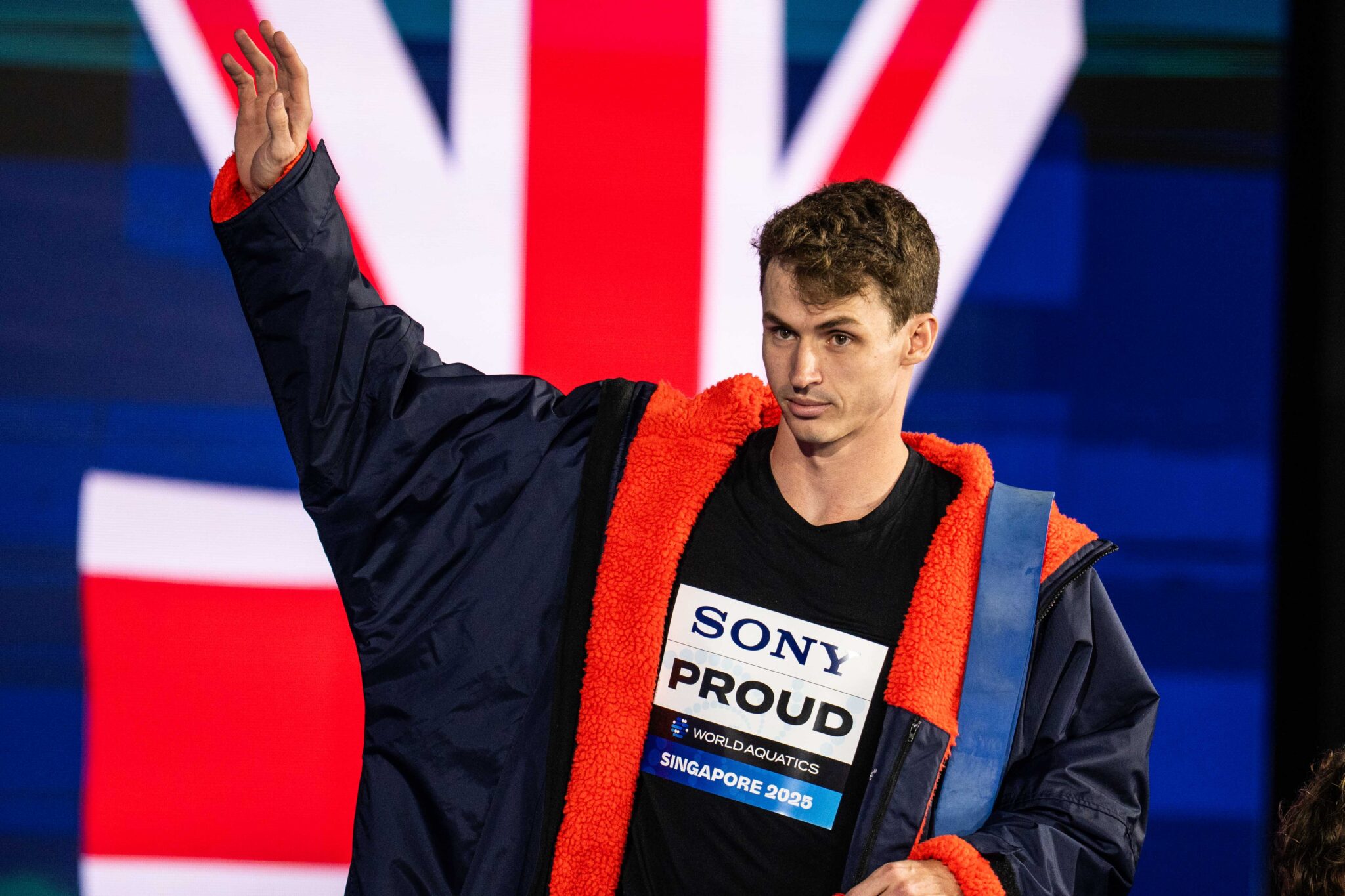
Ben Proud didn’t post on Instagram from October 29, 2024 until September 7, 2025, and virtually every post before that was an ad co-posted to his account.
We need all 312 swimmers pitching in, plus another 200. If 512 elite swimmers haven’t posted on Instagram this week, haven’t shared a story, haven’t signed an autograph or filmed a TikTok with their teammates, then they’re not doing their part.
Rather than paying the athletes $50 million/year directly starting now, I’d rather the powers that be create a marketing machine that generates $150 million/year and pays the athletes $100 million/year directly. But the federations haven’t been capable of that either so far.
If the Enhanced Games are doing anything positive for the sport, it’s that they’re forcing us to have better conversations about the future. Do I want a world where kids have to dope to succeed? Absolutely not. But I do want a world where success means they can pay their own bills and build a life around the sport.

“We need all 312 swimmers pitching in, plus another 200. If 512 elite swimmers haven’t posted on Instagram this week, haven’t shared a story, haven’t signed an autograph or filmed a TikTok with their teammates, then they’re not doing their part.”
That’s sounds like Personal brand development.
There is one elite swimmer, who took unconventional path, turned pro at age of 14, thus skipping traditional college track. He was building his own personal brand, attempting to earn any endorsement available. Reaction at social media was positive in general, thanks for him fully embracing little swimmers support at all the meets, and endless requests for a photo, especially during and after pandemic, when he was coming to local meets. Reaction at… Read more »
I’ll say it again…
USA Swimming has a PR/Marketing problem.
They’d do more good by investing in a fabulous PR team. One that can bring attention to the sport (and outside money) but also help athletes with their own social media.
What does the “marketing machine” look like? Honest question, clearly that’s the best idea but where’s the investment coming from
The federations need to have a team that helps the athletes produce social content. The federation needs to help them set up interviews not hide them from interviews.
USA Swimming needs to transform into a marketing firm. But a good one.
Maybe we could put a tariff on swimsuits, goggles, and gear bags. The proceeds could, partially, go to the elite swimmers.
Great article. Another point, closely related to what you are saying but I don’t think quite the same is that the recent saga shows how valuable swimming actually is/can be. The Enhanced Games is a well-funded organization whose purpose is to make money, and they’ve chosen to put swimming (and track) at the center of their showcase. It’s true that doping is antithetical to how most of us see sport (although at least they’re being honest about it…), and also true that the way they’re making money (selling doping products to the mass public) isn’t a good business model for World Aquatics. But the Enhanced Games could have showcased weightlifting, they could have showcased tiddlywinks, they could have showcased average… Read more »
The key is the point of interest, “the pinnacle of human physical performance”. At some point, we stop being human. There is an eternity of enhancements before us and the feat will be carried out in no time. What do we have then? And what human would want to challenge? You kill the gladiators to save the coliseum.
I think it’s a good point that marketing the sport is currently neglected, however I also think the bulk of the responsibility for that rests with organisations. In the Premier League, the clubs are the ones who place marketing obligations on the players, and they aren’t required to have personal social media. The latter is more a choice of the player who might want to boost their own personal brand. Rodri, for example, who is one of Man City’s star players, doesn’t have Instagram. In boxing, it’s the promotion company who develop the narrative of the fight – the stakes, the undefeated records, the beef between the fighters etc
Two or three years ago I gave to the US Swimming numbers on the Russian Swimming. In UK, depending on the World LC RAnking, the National Lotery funding (paying money) only 20-25 best swimmers, another 25-30 payed for medicals massage, entry fees, travel… Here in the University of Bath our students are paying around 250 pounds a year for pool training and 150 pounds for gym. We still do British National finals and winning medals at the SC and LC Nationals, foreign students represent their countries at the Olympics ( 3 at the Paris Games 2024), World SC and LC Champs. And they pay full tution fees 3 x 3000 pounds a year… They do love the great sport of… Read more »
Australia does it well.
What do you mean?
You think? Some Aussie swimmers do pretty well thanks in part to Gina Reinhardt but there is a great many multi National Medallists with zero income (albeit good academy support for physio, doctors and mental health type things) . Mum’s and Dad’s are still paying for swim squad fees, food, fuel, accommodation ECT with their “kids” out of their teens but well and truely just 1 good swim or lucky break away from an international Dolphins team. This is not sustainable for many, very promising, athletes and their families and I feel there has to be a better way for those well and truely on the cusp.