This editorial is courtesy of Jaimie Fuller, a swim-data entrepreneur and the chairman and founder of EO SwimBetter.
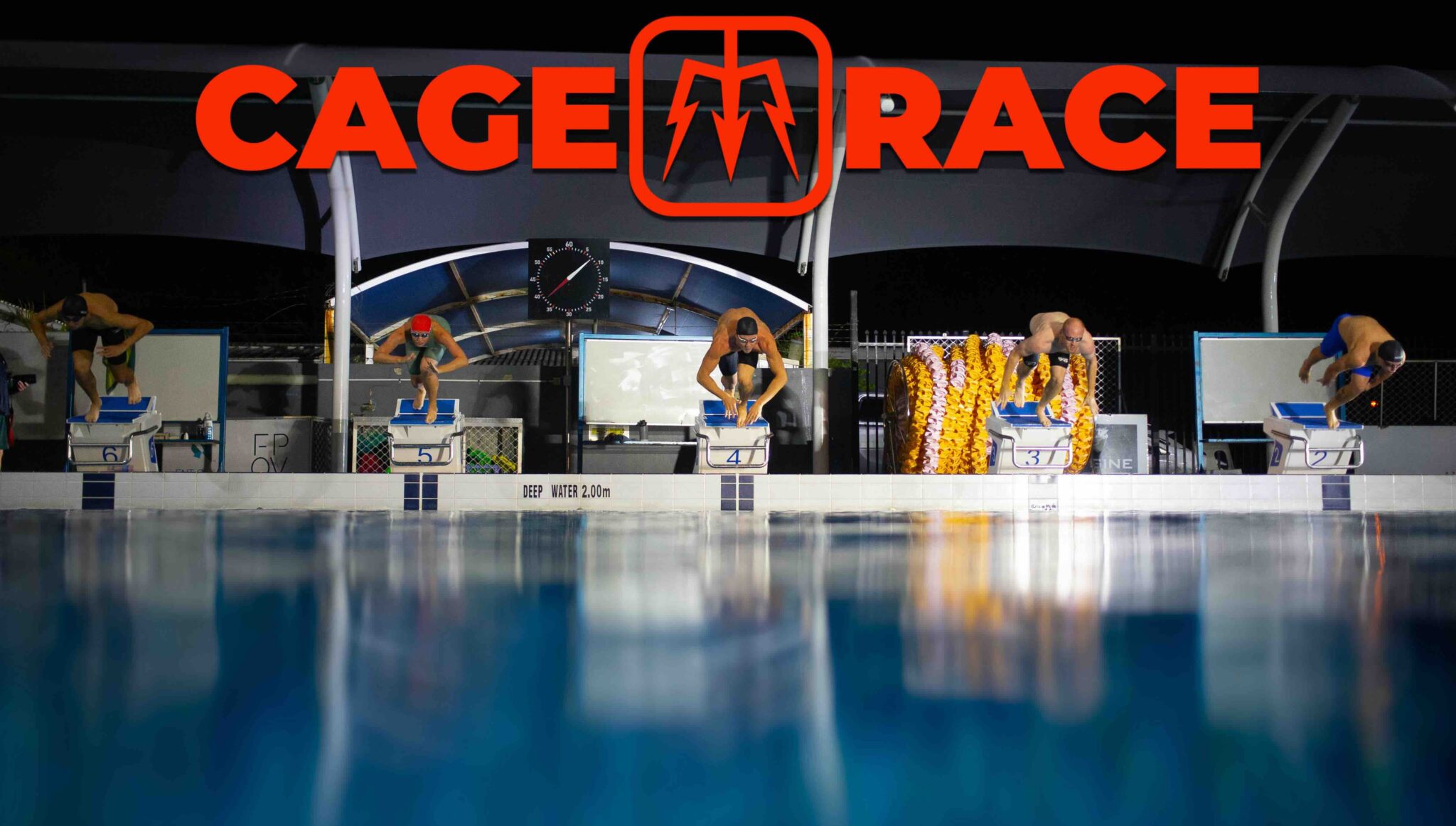
Picture ten swimmers in a single pool. Five men, five women. Each one has a number, a colour, a single primary sponsor on their cap. They will race ten 50s on a descending recovery, but the rest interval is not really theirs to control — at any point, any swimmer in the field can “step up” and kill the rest break for everyone. There are no lanes. Drafting off another swimmer is allowed; holding or aggressive contact draws a time penalty, or a disqualification. Walkbacks happen with goggles off, on camera, while the body is still screaming. Penalties are imposed in real time instead of disqualifications being handed down later. And at the end of the night, the field is ranked on aggregated time — with two official winners, one male and one female, and equal prize money down to the cent. The full result is not announced in the arena. It is held back and revealed the next day, on camera, after debriefs and tribunals.
That is CageRace.
It is being built as three things at once: a six-part reality series, a new competition format, and a grassroots participation sport — with the longer-term ambition of an elite international league. It is not another exhibition meet bolted onto an existing calendar. It is an attempt to design a piece of professional swimming from scratch, around the way modern audiences actually consume sport.
And that is why it matters.
Swimming has a problem it has spent far too long refusing to confront. It is one of the biggest Olympic sports on earth, full of extraordinary athletes, extraordinary bodies, extraordinary suffering, and extraordinary performances — and yet, outside the Games, it routinely struggles to convert any of that into sustained public attention, meaningful commercial energy, or life-changing earning power for the athletes themselves, other than a very few. CageRace attacks that problem head-on. It does not treat swimming’s invisibility between Olympic cycles as unfortunate but inevitable. It treats it as a failure of imagination.
Not every traditionalist has to love every element of it. Sanctioned pool swimming does not have to disappear. The sport does not need novelty for novelty’s sake. CageRace matters because it is one of the rare projects in swimming willing to admit that the old model is not doing enough for the athletes, the audience, or the future of the sport. Its underlying premise is simple: stop hiding swimmers inside a conservative format designed mainly to control variables, and start building a format designed to reveal pressure, personality, decision-making, and consequence.
That premise matters even more in the light of what just happened with Cameron McEvoy. McEvoy broke the men’s 50m freestyle world record at the China Open — a swim that, as ABC noted, beat the last surviving long-course men’s world mark from the super-suit era. But because the meet was not organised by World Aquatics, there was no world-record bonus attached. McEvoy himself called the contrast “ludicrous,” given that the Enhanced Games are dangling US$1 million for a world record in their drug-permissive environment. And it would not stop there. An athlete of McEvoy’s profile would, almost by definition, be heavily targeted by the Enhanced Games — a sign-on bonus likely measured in the millions, on top of the world-record purse, on top of whatever else they could attach to him as a marketing asset.
That should be a flashing red warning light for everyone in the sport.
When a clean athlete can produce a historic performance and walk away with no world-record bonus, while a chemically permissive exhibition can offer life-changing money and call it progress, swimming has a commercial credibility problem. If legitimate swimming does not build bolder, higher-paying, more watchable platforms for its own athletes, it should not be surprised when outside actors try to fill the vacuum. CageRace is, at its core, an attempt to stop that vacuum from swallowing the sport.
It is not trying to be a lazy sideshow. It is trying to become an athlete-centred commercial system. The series model is designed so that most revenue flows back to athletes through appearance fees and prize money, while the wider build includes pilots, crowdfunding, distributed media, grassroots adoption through schools and clubs, and the eventual ambition of an elite international league. That is a far more serious proposition than “let’s make swimming more dramatic.” It is really saying: let’s build swimmers a platform modern sport should have built for them years ago.
It also delivers something swimming has talked about for decades without fully delivering: structural equality. CageRace’s mixed-field format puts five men and five women in the same pool, on the same clock, with two official winners by aggregated time. It is a format in which a woman can, on her day, beat a man outright on time in the same race. Just as importantly, male and female prize pools are equal at every level — per round, per night, and in the season champion bonus — “not a courtesy,” but part of the architecture. That is not a slogan. It is a design choice.
The athlete branding is another piece of that architecture. Each swimmer carries a distinct number, colour, and single primary sponsor, with sponsor value tied to performance, exposure, and continued presence in the main-event field. That is clever, because it turns swimmers from interchangeable entries into identifiable sporting properties. Swimming has spent years wondering how to make athletes more marketable. CageRace’s answer is the obvious one: brand them properly, film them properly, and stop presenting them as anonymous bodies moving up and down black lines.
Just as important, the format is engineered around choices under fatigue rather than straight-line speed. The repeated 10 x 50m structure, descending recovery, the ability of any athlete to “step up” and kill the rest break for everyone, the absence of lanes, the freedom to draft off another swimmer at the cost of a penalty if it tips into holding or aggressive contact, walkbacks with goggles off, live penalties instead of automatic disqualifications, and a next-day winner reveal turn swimming from a fixed test into a strategic contest. The point is not merely that it is different. The point is that it exposes elements of elite swimming that ordinary meet formats bury: nerve, opportunism, emotional control, fatigue management, and the ability to think when the body is screaming.
That exposure is central to the whole idea. CageRace, in its own words, “doesn’t protect swimmers. It exposes them.” Cameras are not passive observers but part of the competitive load. The walkback is treated as “where the race is actually won and lost,” because it forces athletes into visible, unguarded moments under fatigue. The debriefs, tribunals, and next-day result reveals are all built to turn effort into narrative, rather than letting the sport vanish the instant the touchpad is hit. Whether people love that language or hate it, it is at least based on a real understanding of modern media: fans no longer just want the result. They want the cost.
In light of the Enhanced Games comparison, the anti-doping section matters enormously. Compliance with CageRace’s anti-doping policy is mandatory and aligned with the WADA prohibited list. It allows random urine and blood testing in and out of competition, requires anti-doping education, provides a TUE process, and sets out sanctions ranging from two-to-four-year ineligibility to lifetime bans for trafficking or complicity. That is a critical distinction. CageRace is arguing for a more commercial, more dramatic, more modern form of swimming — not a pharmacological arms race.
It is worth being honest about what the Enhanced Games actually is. Strip away the rhetoric about “human potential” and the headline prize money, and what is left is a project whose primary commercial purpose is selling snake oil to the public — supplements, performance compounds, and the broader fantasy that the limits of the human body are a marketing problem rather than a biological one. The athletes are not really the customers. They are the shopfront. The risks they are being invited to absorb — to their long-term health, to their reputations, to their post-career lives — are not paid for by a sign-on cheque, no matter how large. CageRace is the opposite proposition: build a platform that pays athletes properly without asking them to mortgage their bodies to do it.
That distinction is the heart of the opportunity.
Swimming does not need to choose between being morally serious and commercially ambitious. It can be both. In fact, it must be both. World Aquatics has, to its credit, increased athlete prize money in recent years, with the organisation reporting a record US$11.1 million paid across aquatics events in 2024 and US$4.38 million to swimming athletes at World Aquatics events in 2025. But the McEvoy example shows the central problem has not been solved: there is still too much distance between swimming’s cultural value and what too many swimmers can actually earn.
That is why the community should support projects like CageRace rather than reflexively sneering at them.
Athletes should support it because they need more leverage, more visibility, and more ways to be paid. Sponsors should support it because swimming is full of underexposed talent and visual drama that has been badly packaged for decades. Fans should support it because swimmers deserve to be seen as characters and competitors, not just lane assignments and reaction times. And the establishment should support it because an industry that refuses to innovate eventually loses control of its own future.
Will CageRace make some people uncomfortable? Of course. Good. Swimming has been too comfortable for too long inside formats that are safe, respectable, and commercially underpowered. CageRace is valuable not because every idea inside it is perfect, but because it proves that someone is finally willing to build a system around the athlete, the camera, the sponsor, and the audience at the same time.
That is what this moment demands.
Because the lesson from McEvoy is not simply that one swimmer missed out on one bonus. The lesson is that clean, legitimate swimming cannot afford to keep acting as though prestige alone is enough. Prestige does not pay rent. Tradition does not fund careers. Reverence does not beat a million-dollar cheque.
If swimming wants to protect its integrity, it has to increase its ambition.
That is why CageRace deserves support. Not because it is polite. Not because it is familiar. But because it understands something the sport’s conservatives still seem reluctant to admit: if swimming is not prepared to drag itself into the 21st century, someone else will drag its athletes somewhere far worse.
More information on the format, the series, and the wider build is at cagerace.com. Athletes who want to be considered for competition can register their interest there.

looks like a training set to me
Oh wait…it’s not the April Fools edition….
can’t get past reading the first paragraph
sounds about the same interest level as the enhanced games
ZERO
Is it just me or is this completely AI written?
It is. Extremely disappointing
Underwaters are going to be even more important to stay under the chop
Paul Biedermann also still holds a world record in the 200 free from the super-suit era.
Aaron Peirsol would disagree that McEvoy “beat the last surviving long-course men’s world mark from the super-suit era”. Peirsol still holds the 200 backstroke record from the super-suit era.
Isn’t the men’s 800 free also still pretty much untouchable?
Spice things up and add (reasonably-sized) sharks or piranhas in the cage with the swimmers!
Some sharks with freaking laser beams attached to their heads! Or at least some ill tempered sea bass.