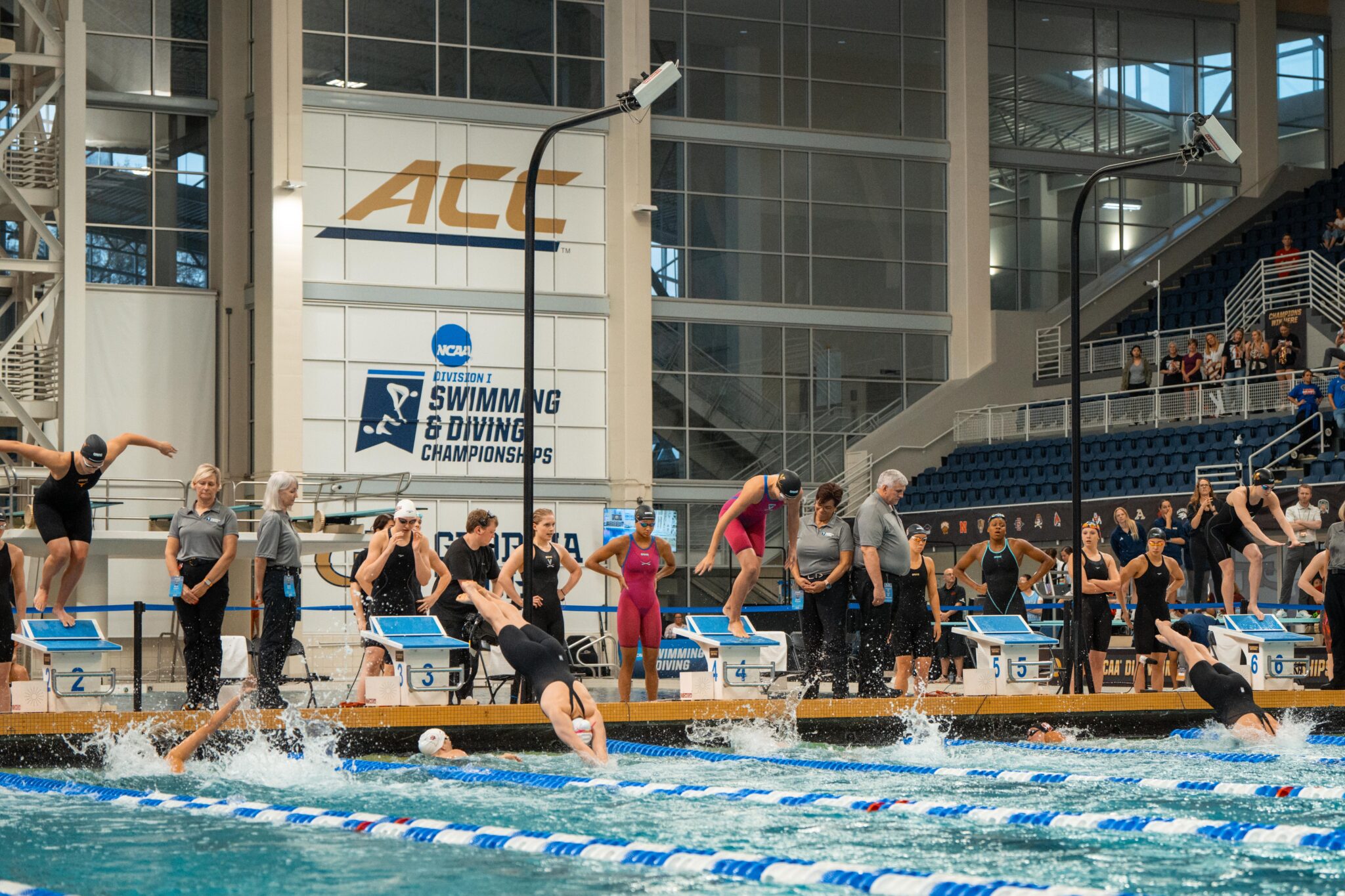
Courtesy: D. R. Hildebrand
The swimming community has been abuzz in recent days about this year’s numerous changes to the Division I NCAA competition schedule, qualifying standards, and eliminated B Finals. Conversations have been valid but deficient. They have centered solely on disappointments, complaints, finger-pointing. Little to no discussion has emphasized opportunities.
Observing the recently completed national championships, at least three new opportunities were created or highlighted. Each was an unintended consequence of the adjustments made, and each deserves some reflection if we want to utilize this moment advantageously.
First, when the CSCAA voted to adopt its new schedule in October, the most significant change was not the shuffling of events. It was the long-overdue expansion from a three-and-a-half-day meet to a full four-day meet. How the CSCAA chose to use the additional time can be debated, and I’ll share my own proposal below. But the extension itself is wise and should be applauded. Teams were already arriving on Sunday or Monday for a meet that began Wednesday night. The switch to Wednesday morning allows for fewer events per day, more rest for athletes, more time to use the televised slots beneficially, and a chance to rethink event order.
When the meet was three days, and later three and a half days, the event order was optimal. When the change occurred for the 2026 meet, moving only the mile to Day 1 left opportunities on the table and lengthy yawns in the Day 1 program. The following is just one event schedule that better utilizes precious time and, in doing so, accommodates a reinstatement of B finals.
| Day | 2025 Event Schedule | 2026 Event Schedule |
2027 Event Proposal
|
| Day 1 | 200 Medley Relay 800 Free Relay |
1650 Free 200 Medley Relay 800 Free Relay |
100 Back
200 Breast 800 Free Relay 1M Diving 200 Medley Relay |
| Day 2 | 500 Free 200 IM 50 Free 1M Diving 200 Free Relay |
100 Fly 400 IM 200 Free 100 Breast 1M Diving 200 Free Relay |
500 Free 200 IM 50 Free 3M Diving 200 Free Relay |
| Day 3 | 100 Fly 400 IM 200 Free 100 Breast 100 Back 3M Diving 400 Medley Relay |
100 Back 200 Breast 500 Free 50 Free 3M Diving 400 Medley Relay |
100 Fly
400 IM 200 Free 100 Breast Platform Diving 400 Medley Relay |
| Day 4 | 1650 Free 200 Back 100 Free 200 Breast 200 Fly Platform Diving 400 Free Relay |
200 IM 100 Free 200 Fly 200 Back Platform Diving 400 Free Relay |
200 Back 100 Free 200 Fly 1650 Free 400 Free Relay |
It reverts the mile back to Day 4 with the thinking that fewer milers contest the 400 free relay than the 800 free relay. It moves each diving event up a day, positioning the 1-meter on Day 1, the 3-meter on Day 2, and Platform on Day 3, which then ensures none of the longest events—diving and the mile—share a day. It extracts the 100 back and 200 breast from their respective long-standing positions and advances them to Day 1, which lightens Days 3 and 4. And it keeps the 50 and 500 paired with the 200 IM, all on Day 2, a configuration that permits the remainder of the meet to return largely to its original format, ensuring 200 IMers are not forced to choose between that event and a 200 of stroke.
Second, this year’s changes laid bare the importance of our commentators. When the CSCAA adjusted and reduced the schedule, it created less swimming and more silence. This required the commentators to talk more when there were gaps—a task that they met—and to talk better when races were approaching or underway, given the decrease in opportunities—a task that they failed to meet.
One commentator, Elizabeth Beisel, navigated this successfully. Two new approaches she took to utilize the extra time was to interview athletes about graduating teammates and to interview coaches immediately prior to, or during, their swimmers’ races. Coaches might not have liked the timing of the interviews, but they were thoughtful, candid, and illuminating. The interviews with athletes were even better. They had personality, emotion. They connected with viewers in heartfelt ways.
Such on-deck interactions, however, further elucidated the deficiencies of actual race reporting. In October, when CSCAA Executive Director Samantha Barany told Mel Stewart in an hour-long SwimSwam podcast that the new NCAA Division I Championship format was designed to be broadcast-friendly with “opportunities for storytelling and spotlighting,” I cheered. I assumed this meant the commentators calling the actual races would give us insights, background, stories about the athletes—anecdotes that humanized them.
Nothing. Pure boredom. There are only two things that manufacture a TV-friendly broadcast: the action and the reaction; the visual and the audio; the thing you see and the thing you hear. When every athlete’s storyline is limited to little more than their class year, do we expect anyone to develop an interest in our sport?
I’ve written previously about two topics apropos to this. One, on this exact subject, was titled The Amateurism of American Swimming Commentating, which was as hollow and unrefined then as it is now. There are a hundred things a commentator could discuss: the explosive burn in a swimmer’s chest while not breathing on the final lap; how much more a swimmer squats this year compared with last; some unique adversity a swimmer has overcome. Anything at all. Our sport and our athletes are as noteworthy as any, but none of it matters if it’s ignored. Swimming will remain a snooze-fest until we wake the audience up. Not shouted gibberish. Not breathless inaccuracies. Just simple, articulate, captivating content.
The other related editorial was William & Mary: A Case Study in Reinstatement. Its thesis: control the narrative. The narrative is the essence of commentating. Swimmers will swim fast. They’ll produce compelling races. But what aspects of those races, what relationships to them, will the commentators choose to examine? And do their choices pique the viewers’ interests or paint them a picture? The test for this is simple: when you turn on a race, if you close your eyes and only listen, would you still be engaged? If, instead, you want only to do the opposite—open your eyes and plug your ears—then it’s not the sport that has a problem, but the people delivering it. Perceptions of our sport won’t change because we moved the mile to Day 1. Perceptions of our sport will change when our commentators change how they deliver a story about the mile. Ms. Beisel does her part. Will the CSCAA demand her colleagues to do theirs?
Finally, the changes the CSCAA made have spurred dialogue, including among college coaches. One of the very first things Samantha Barany said to Mel Stewart in the October podcast was, “We need as many people as possible coming together right now.”
It is always easier to identify what is wrong with something than it is to construct an alternative. Most coaches would prefer not to spend their time contemplating and discussing all the things that their fellow coaches representing them in the CSCAA are. They’d rather spend their time coaching. But with swim teams being cut and the House settlement only making things worse, someone has to sacrifice their time, step away from the deck, have the difficult conversations, and explore novel approaches.
Attempts might succeed and attempts might fail, but they require dialogue and socialization, brainstorming and revision, implementation and review, and they need the coaches themselves to engage the process, to bring arguments, to bring data, to collaborate in the same manner that they coach—with an open mind.
Change should never occur solely for its own sake, and neither should routine. There must be weightier arguments than “blow it all up” at one extreme and “this is the way it’s always been” at the other. The CSCAA has shown it is willing to make difficult decisions. Its constituents must now decide if they’re going to respond constructively or obstructively to those changes. Our sport needs more of the former.
 ABOUT D. R. HILDEBRAND
David Hildebrand manages a private swim club in Philadelphia. He competed for the College of William & Mary and now races Master’s with Club Tribe.

What about adding the 50s for back, fly and breast (with those events being added to the Olympics. Isnt the ncaa looking to add those to the event list soon?
David do you remember your swim camp nickname?
It is not a 4 day meet. It is now a 3 1/2 day meet with the 1/2 day split into 2 sessions.
There are no prelims on the first day
“Save the Bs” as many a swim fan stated in Atlanta. #1 thing that will keep the meet exciting for the in-person fan. #2 thing: allow re-entry to the meet.
Did this happen?
“””
One commentator, Elizabeth Beisel, navigated this successfully. Two new approaches she took to utilize the extra time was to interview athletes about graduating teammates and to interview coaches immediately prior to, or during, their swimmers’ races.
“””
I was at the men’s meet and don’t recall hearing any of these interviews. Could be partially due to the terrible sounds system at McAuley.
Don’t know about the men’s meet but definitely on the broadcast of the women’s. She interviewed multiple coaches and multiple swimmers.
Thought I saw it for the men’s a little bit. Definitely remember Nesty
I attended the women’s meet. The interviews were a complete non factor. I could see them happening but could not hear them at all, due to crowd noise and the poor sound system.
Every time I saw an interview taking place I’d ignore it and rationalize that I’d look for the tape later. That worked well. Initially when I tried to listen from the stands I misinterpreted something that Bella Sims said.
There is far greater crowd noise than many prefer to believe. Often it is family and friends yelling down to swimmers and coaches on deck.
I am happy to see some people thinking about solutions already for next year. Complaining about what was without proposing something better just doesn’t cut it. And I am sure that an optimal meet event schedule can be made over four days that can reinstate B-Finals.
If the commentators are that bad (and it is), mention them by name. Beisel was mentioned for the good commentary. It’s time to call out the bad ones
Lol there are only so many!
I think Cynthia Potter is pretty good, given I have no idea what’s going on in diving and in the few dives I do see, she does a good job telling me what just happened.
And I mean, ofc I’ll call out the bad ones.
Maybe my least-favorite Rowdyism that doesn’t get mentioned much is when a race is REALLY… Read more »
And the oh so obvious rowdy-ism.. he’s definitely breaking 1:34!! No! But it’s a record! And he does this a lot. Too often. I mean, enjoy the race for what it is.
Some international commentators from Europe and Australia are really good (but there are some bad once), maybe we can have our US commentators listen and acquire some inspiration?
I’m glad to see some constructive dialogue on this topic. The importance of quality commentating in particular cannot be overstated. There was one set of relays this year where nothing was noted about a single athlete that wasn’t the swimmer’s year in school. If the commentators aren’t going to do their homework then the CSCAA needs to do it for them and hand them the intriguing talking points. They’re missing countless opportunities and making swimming seem dull.
ABSOLUTELY! Commentators can drive enhanced interest with interesting tidbits.
Roddie Rowdy Piper Gaines needs to be abducted by aliens or the mafia before the meet starts.
Elizabeth Beisel is OUTSTANDING.
Hire a celebrity color commentator as well: Dave Chappell, Jennifer Lopez or Rachael Maddow.
Please combine the meet! The stands will be full and the energy super atomized.
While no-one else has offered this suggestion – Bring back the B Final at night.
Roddie rowdy piper gaines 😭 😭 😭
Never had this problem with Sam Kendrick doing the in deck calls. We can do better and find that person.