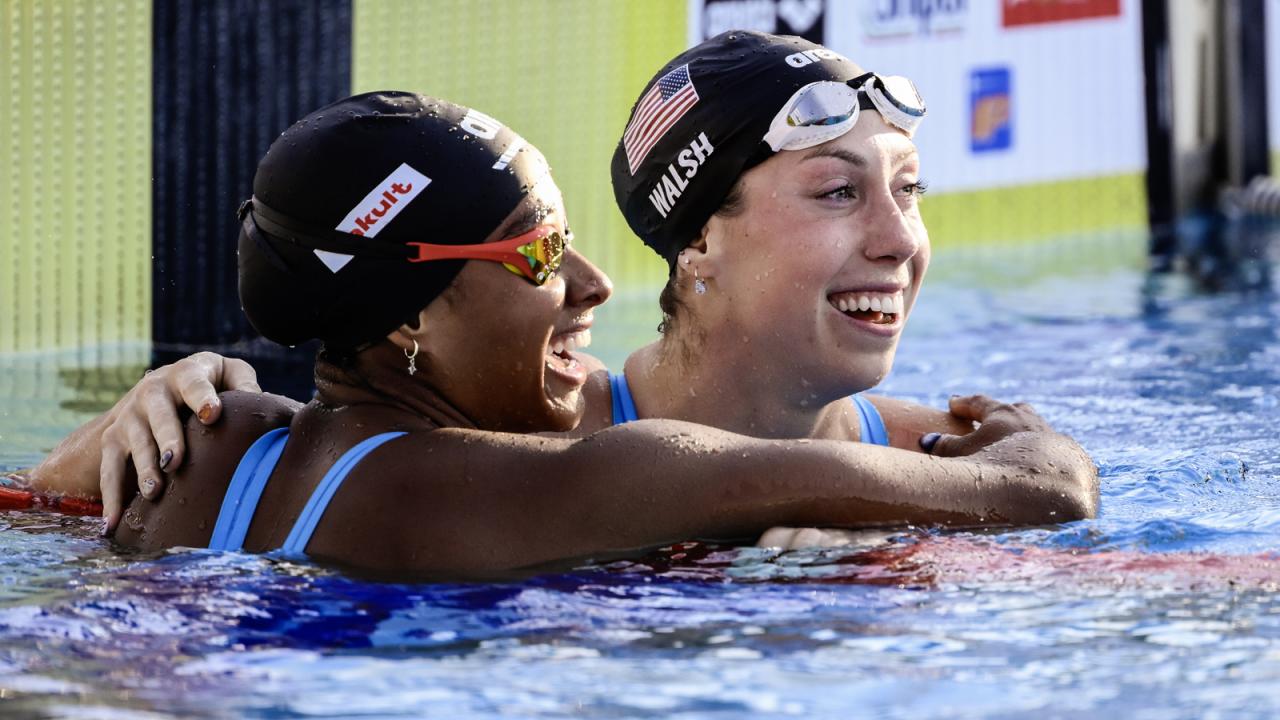
When Sara Curtis left Italy last fall to join the University of Virginia, she expected faster training, tougher competition, and a new way of balancing swimming with college life.
She didn’t expect the biggest change to happen in her own mindset.
Less than a year later, the 19-year-old Italian is preparing for the European Championships as one of the continent’s top medal contenders. Her first season in Charlottesville has already produced a series of career-defining performances, including the European record in the women’s 50m backstroke and Italian records in both the women’s 50m and 100m freestyle at the Settecolli Trophy in Rome.
For Curtis, however, those performances are the result of something deeper than faster swimming.
“I completely changed my perspective on both sport and life over the last year,” she told to Lia Capizzi for Italian Corriere della Sera. “The training became much more demanding, and the results followed.”
That transformation didn’t happen without challenges.
Along with adapting to one of the strongest college programs in the country under Todd DeSorbo, Curtis also faced the academic demands of being a psychology major. Rather than taking easier freshman courses, she immediately enrolled in classes like statistics and neuroscience.
“It made my life harder,” she admitted.
During one particularly stressful week, Curtis overslept before a 7 a.m. practice while preparing for a statistics exam.
“I woke up at 7:07 and rushed to the pool completely panicked,” she said to Corriere della Sera. “Todd could see something was wrong. I told him how stressed I was about the exam, and the next day he gave me the morning off.”
Curtis says those moments showed her another side of Virginia’s coaching staff.
“They expect the best from us, but they also understand we’re young and dealing with real challenges. We regularly meet with a sports psychologist, and there’s a lot of support.”
That support has translated directly into her racing.
Just twelve months ago, Curtis admits she often carried disappointment from one workout—or one race—into the next. Now, she approaches competition very differently.
“I don’t dwell on things anymore,” she said. “If I wasn’t happy with a practice or a race, I used to carry that frustration around for days. I’ve gotten rid of those negative thoughts.”
Perhaps the biggest example came after the 2025 World Championships in Singapore.
Curtis became the first Italian woman ever to reach a World Championship final in the women’s 100m freestyle, but instead of enjoying the moment, she found herself overwhelmed by pressure.
“I cried because I was desperate. I was living that experience the wrong way,” she said. “I promised myself that would never happen again.”
Today, she says, the fear is gone.
“I know how much work I’ve done to get here. Why should I be afraid? That has been a huge mental switch for me.”
The confidence showed itself at the Settecolli Trophy in June.
Competing in front of her home crowd, Curtis lowered her own Italian records in both freestyle sprint events while also breaking the European record in the women’s 50m backstroke. The meet carried extra meaning because it also brought her Virginia teammates to Italy.
“It was so special having Todd and the Walsh sisters in Rome,” Curtis said. “I was nervous because I wanted everything to be perfect for them, like when you have guests at your house and you don’t want them to find a single speck of dust.”
For Curtis, training alongside world record holder Gretchen Walsh was one of the main reasons she chose Virginia in the first place.
“I moved to Virginia because I considered Gretchen an idol and someone I wanted to learn from,” she said. “She’s such a simple and positive person. We train together almost every day, and now I can call her a friend. That’s really special.”
Despite spending much of the year in the United States, Curtis continues to work closely with her longtime Italian coach Thomas Maggiora, who coordinates her training with DeSorbo.
“Thomas has been incredibly supportive,” Curtis said. “He follows the program Todd prepares for me, and that’s not something every coach would be willing to do.”
Now, Curtis’s attention turns to the European Championships in Paris, where she enters as one of the favorites in both backstroke and freestyle.
“At the European level, I’m one of the swimmers to beat,” she said. “I’m happy to be able to say that because it shows how much I’ve grown.”
She’s equally excited about Italy’s relay prospects.
With 15-year-old Alessandra Mao emerging as one of the country’s brightest young talents after her standout performances at the European Junior Championships, Curtis believes the Italian women’s 4×100 freestyle relay is entering a new phase.
“Alessandra has been amazing,” Curtis said. “I’m so happy for her, and for all of us. We’re going to have a lot of fun together.”
Asked what lesson she has taken from the past year, Curtis didn’t point to a race or a medal.
Instead, she talked about discipline.
Currently reading David Goggins’ book Can’t Hurt Me, she says one sentence has become part of her daily mindset.
“I believe discipline will always beat talent,” Curtis said. “If talent doesn’t work, it becomes nothing.”
It’s a philosophy that seems to fit perfectly with the path she’s taken over the past twelve months.
The records have made Curtis one of Europe’s fastest sprinters.
The mindset may prove to be what carries her even further.
Quotes are translated from Italian. Original interview by Lia Capizzi for Corriere della Sera.
