2025 World Championships
- July 27 – August 3, 2025 (pool swimming)
- Singapore, Singapore
- World Aquatics Championships Arena
- LCM (50m)
- Meet Central
- Live Results
- SwimSwam Preview Index
With the Singapore World Championships fast approaching and speculation over relays building, what have the finals for each relay looked like over the last decade?
That takes into account eight world-level international summer meets, and we’ll take a look at the men’s 4×100 free here.
As a preview of what is included here, we’ll go through:
- Which nations have been in the final each year
- The nations with the most appearances
- How the final time for each finals position has changed
- How the finals time compares to that country’s add-up heading into the meet
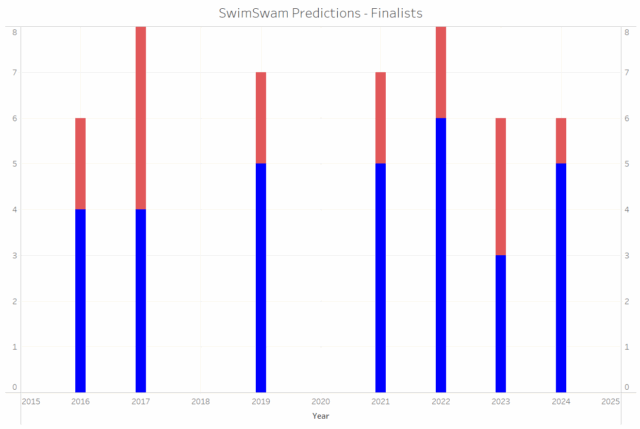
- How SwimSwam’s predictions have fared over the years
We’ll also take a look at the continuity of each final – for a recap of how we calculate this, take a look at the methodology explained in this previous article.
The Data
The cumulative times are taken from the calendar year best heading into the World Championships or Olympics of the top four individuals for each nation.
The calendar year best here is used for convenience. Far more of the data processing required here was manual than in an ideal situation, and finding season bests would slightly more than double that.
Additionally, there would come the decision on how to define when the season ends. For Asian nations this is often into the early-to-mid autumn, especially in an Asian Games year, compared to pretty much immediately after the summer meet for European and American swimmers. Using the calendar year best is a cleaner delineation, and the times should be more pertinent to the summer relays as well than those at the start of the season.
These may not necessarily be the swimmers that swim in the relay, and the drops may be due not only to internal improvement but a new swimmer or two.
Additionally, the data here is not 100% complete. The World Aquatics results database used is probably the best for blanket global coverage to the depth required each year, but there are gaps. Most major and national meets are captured, but results from medium to small meets are generally not.
For example, Carson Foster’s 4:08.46 400 IM that he swam at the 2021 Southern Sectionals is not in the database, despite it being the fastest 400 IM time in the world that year.
The result of this is that the cumulative data here is not quite perfect – there are likely a few of the cumulative times that would be slightly faster due to a swim that we’ve not managed to find.
However, with the volume of data and the fact that we’re looking to make general rather than specific conclusions, this should not have a material effect on what we see.
The Finalists
A huge shock to begin with – the U.S. is pretty good at this swimming thing. Along with Australia and Italy, they’ve consistently been near the top of the tree.
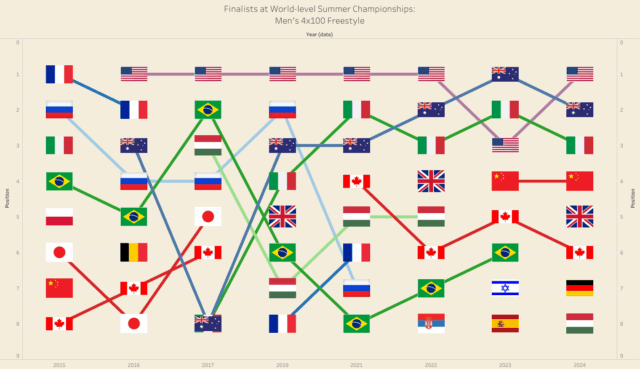
One of the surprises here for the number of finals they’ve been in is Canada. They’ve rarely had a team of elite 100 freestylers, but they seem to be able to make it more than the sum of its parts. They’ve been in the joint-most finals over this period.
| Country | Finals Appearances 2015-2024 |
| USA | 7 |
| AUS | 7 |
| ITA | 7 |
| CAN | 7 |
| BRA | 7 |
| HUN | 5 |
| RUS | 5 |
| FRA | 4 |
| GBR | 3 |
| JPN | 3 |
| CHN | 3 |
| ISR | 1 |
| SRB | 1 |
| ESP | 1 |
| GER | 1 |
| POL | 1 |
| BEL | 1 |
Surprisingly, Great Britain has only been in three finals since 2015. With their main relay focus on the 4×200 free, only recently have they been a threat in the shorter relay.
How Have The Finals Times Changed
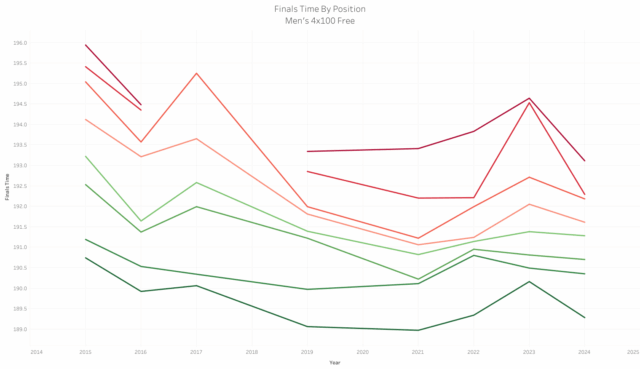
*Australia and Italy were DQed in 2017
The fastest final looks to have been in 2021 – France were 6th in 3:11.09, and Australia’s 3:10.22 for bronze would have picked up at least silver at every other edition in this time range.
The time each relay team drops in the final compared to their pre-meet add-up can be seen below.
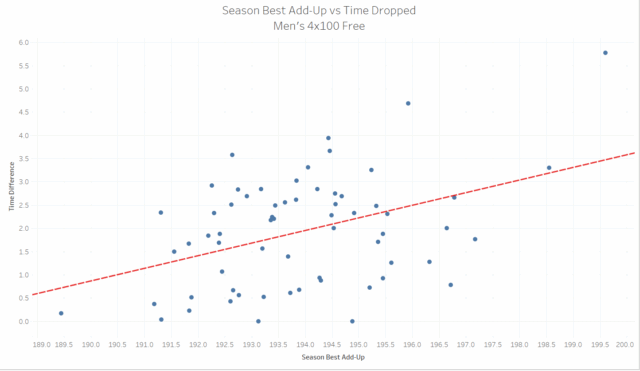
There is no strong relationship to build any sort of model from here, and certainly not one which we could use to predict the times for this summer. There is a tendency for the average time dropped to decrease among teams with a faster cumulative time, but there is a lot of variation. The R-Squared value – a measure of how much the dependent variable (the difference) is influenced by the independent variable (the top-4 add-up), where a score of 1 indicates they move perfectly in lockstep – is only 0.23.
Testing the difference data here for normality – how likely it is that the data can be modelled as coming from a normal distribution – the Shapiro-Wilk test just indicates that it is possible. That would give us a fairly uniform predicting tool – a standard range for the amount of time dropped, with extreme values far less likely. However, taking a look at a Q-Q plot there is a noticeable sinusoidal curve to the data, indicating that it may not be this simple.
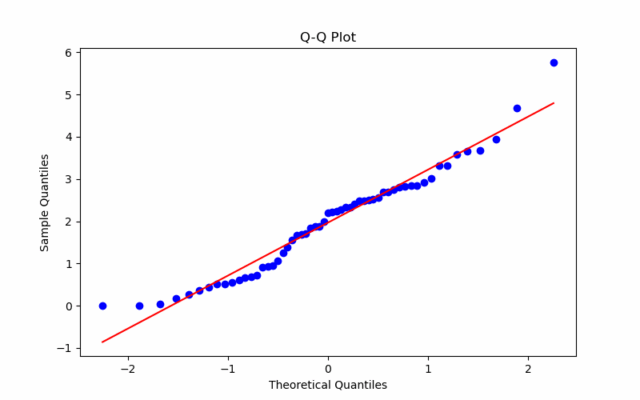
Either way, there is no neat and easy way to predict just how much faster a finals relay will be than its cumulative add-up. The average seems to be around 1.5-2 seconds, so we’ll leave our forecasting at that.
What might 2025 Look Like?
For 2025, the add-ups for some of the countries aiming to be in the final this year are as follows. It took a time of 3:13.15 to make the final in Paris – there are eight teams with an add-up faster than that this year.
| Country | Cumulative add-up (2025 Calendar Year Bests) |
| USA | 3:09.53 |
| AUS | 3:11.67 |
| RUS (NAB) | 3:12.17 |
| FRA | 3:12.49 |
| CHN | 3:12.55 |
| GBR | 3:12.80 |
| BRA | 3:13.07 |
| ITA | 3:13.09 |
| GER | 3:13.61 |
| CAN | 3:14.54 |
| POL | 3:14.62 |
Continuity and SwimSwam’s Predictions
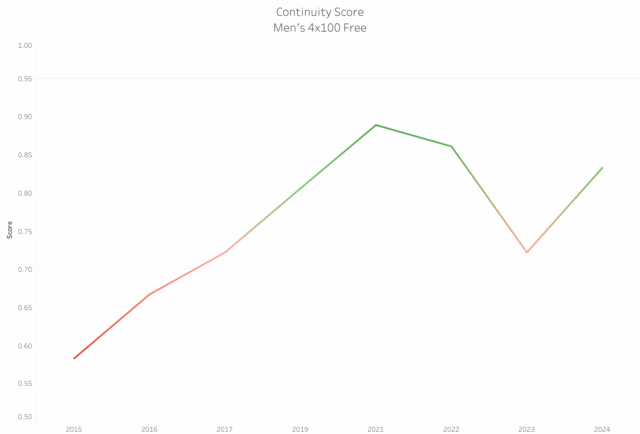
The continuity peaked in 2021 at 0.909, but rose again last year after dipping in the two years in between. With the top five from Paris heavily favored to return, this may increase again in 2025
Finally, here’s how our predictions have fared. Blue marks the countries where we were within a single position in our predictions, with red denoting those that made the final but where our predictions were slightly further away.
We did not have a full set of relay predictions in 2015, so this year has been omitted

Will be interesting. Bad fried rice has wiped out half the USA team. Particularly its sprinters.
I have a problem with the cumulative add-up table for 2025. There is no RUS competing this year. The country was sanctioned by swimming’s governing body for a reason. Referring them as RUS — whether overtly or by a 😉 — is not only technically incorrect but really undermines the force of their (earned) sanction. Some including myself wonder why they even get to field a relay.
Canada is ranked 10th here ,so will be hard pressed to final but I think they’ll get it done.Josh Liendo was ill at trials and qualified 3rd behind Ruslan Gaziev and Antoine Sauve.Both those swimmers appear to be in top form.Number 4 is Filip senc Samardzic.Others available include Finlay Knox and young Ethan Ekk.Laon Kim and Francis Brennan are young swimmers knocking on the door for 2028.Always wondered if Ilya Kharun could compete in 100 free at this level.He,s got the talent.Go Canada!
Why 2016? or is it SCM as proxy?
Really interesting article and analysis. Thanks a lot! Looking forward to the next ones.