
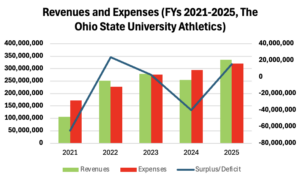
Ohio State athletics posted record revenue numbers for fiscal year 2025 (FY2025) with $336 million in revenue, surpassing the previous record of $280 million that was set in fiscal year 2023. The school also reported $0 in “Institutional NIL Revenue Share.”
The Buckeyes also operated in a $15.7 million surplus as Ohio State had $320 million in expenses. The surplus was over three times that of fellow Big Ten school Wisconsin who operated in a $4.3 million surplus.
Total Revenues By Sport
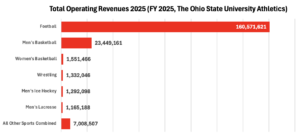
Unsurprisingly, football accounted for 81.77% of sport-specific revenues with $160.6 million and was followed by men’s basketball who brought in $23.5 million in revenues. Four other sports brought in more than $1 million in revenues: women’s basketball ($1.5 million), wrestling ($1.3 million), men’s ice hockey ($1.3 million), and men’s lacrosse ($1.2 million).
Ticket sales were the largest single source of revenues as they accounted for $81.7 million in revenues. This marked an uptick from FY2024’s $58.8 million in ticket sales.
$67.0 million of that total came from the football program which notably hosted eight home games during FY2025 in the regular season, and the program also hosted Tennessee in the first round of the College Football Playoff. Ohio State went on to win the National Title, its 9th in program history. FY2024 only had six home football games.
Total Surplus/Deficit By Sport
In addition to bringing in the most revenue, football and men’s basketball were the only two programs that operated in a surplus. Football had $92.4 million in expenses, resulting in a $68.2 surplus. Men’s basketball had $14.6 million in expenses, resulting in a $8.9 million surplus. All other sports operating in a deficit, with rifle, men’s golf, and women’s golf operating in a deficit that was less than $1 million. Women’s basketball ($5.6 million deficit), women’s ice hockey ($3.8 million deficit), and men’s ice hockey ($3.4 million deficit) had the largest deficits. Women’s basketball and women’s ice hockey were notably in the top three as well at Wisconsin.
| Sport | Surplus/Deficit |
| Football | 68,212,313 |
| Men’s Basketball | 8,860,268 |
| All Others Combined | -60,553,513 |
| Not Related To Specific Teams | -1,106,146 |
Swimming and Diving Revenues/Expenses
Men’s and women’s swimming both operating in deficits larger than $3 million, landing them both in the bottom 25th percentile. Women’s swimming and diving operated in a $3.3 million deficit, and men’s swimming and diving operated in a $3.1 million deficit.
The difference in the men’s and women’s programs can largely be attributed to the difference in revenues. Men’s swimming and diving is said to have generated $434,138 in revenues while women’s swimming and diving is said to have only generated $182,922 in revenues.
With combined programs, it often becomes difficult on how to allocate specific revenues/expenses. For example, in the chart below that includes all revenues for the men’s and women’s swimming and diving programs, the men’s team earned $133,265 in “sports camp revenues” while the women’s team earned $0. The same can be seen with “sports camp expenses,” in the detailed report, which gives $99,924 in expenses to the men’s program and $10 in expenses to the women’s program.
| Men’s Swimming and Diving | Women’s Swimming and Diving | |
| Contributions | 3,929 | 52,485 |
| NCAA Distributions | 23,350 | 28,726 |
| NCAA Host Revenue Settlements | 10,450 | 13,246 |
| Post-Season NCAA Expense Reimbursements | 12,900 | 15,480 |
| Program, Novelty, Parking & Concession Sales | 535 | 2,549 |
| Royalties, Licensing, Advertisement & Sponsorships | 57,485 | 41,983 |
| Sports Camp Revenues | 133,265 | 0 |
| Restricted Endowment & Investments Income | 84,859 | 50,532 |
| Other | 130,715 | 6,647 |
| Total Operating Revenue | 434,138 | 182,922 |
Overall Revenue/Expense Trends For Ohio State Athletics (Last 5 Years)
Ohio State athletics has been in a deficit twice in the last five years. In FY2021, the department operated in a $64.7 million deficit, largely attributed to COVID-19. The second deficit was in FY2024 when the department operated in a $40.2 million deficit. In the last five years, the department has totaled a deficit of $62.9 million.
Ohio State’s Full FY 2025 Report
- See page 52 for Total Operating Revenues
- See page 91 for Total Operating Expenses
A few items to note:
- NCAA athletic departments typically have their fiscal years run from July 1 of the year prior to June 30 of the reported year (ie: July 1, 2024-June 30, 2025)

Wild prediction OSU will be the school that ends Texas title run. It won’t be anytime soon, but the only schools that have a realistic shot must have the full backing of a robust athletic department. OSU has that.
Do Indiana or Cal not have the full backing of a large athletic department?
The implication of calling it a wild prediction is it’s not the obvious choice. Those are the obvious predictions.
Is there a breakdown of the budgets for the Swim teams? At 7 million a year (combined) that seems to be pretty high right?
Are they allocating costs for their pool to the teams?
Just curious how that compares to other programs because most that I see are way under that figure. If that’s the cost of a D1 program then kiss collegiate swimming goodbye.
I think this number would include things like coaches’ salaries as well as athletic scholarships that the team has “paid” to the student-athlete.
Replying to myself because it took too long to edit:
Not sure how they arrive at $7 million, even if this number includes things like coaches’ salaries, athletic scholarships that the team has “paid” to the student-athlete, facilities expenditures, etc.
Let’s do some very fuzzy math for the current school year: At OSU for the 25-26 academic year, tuition, fees, room & board was $28,818 for in-state and $57,600 for out-of-state. These two numbers give an average of $43,209 if OSU’s roster contains an equal number of in- and out-of-state members. If OSU has the full, pre-House scholarship allotment for theirs teams (9.9 for men and 14 for women), that comes to a total scholarship cost of $1,032,695.1.
Salaries (that… Read more »
I did look at the financials a quick minute. They have 500K in mens scholarship costs, 900K in female scholarship costs.
However, each team takes a 750K facility hit each year.
Also, travel is over 1/2 million. Things add up and that’s not a good sign for the future
You need to add fringe benefit costs to the salaries (health insurance, retirement, etc) which can be 30% or so. Then you have travel, recruiting, and facility surcharge costs.
Like last time, please feel free to give me feedback on data that you might find interesting in the full report that is linked and might want more detail on for my next case study.
Reporting varies school by school so I try and pick out something that stands out to me such as the Direct Institutional Support with Wisconsin and then the Camp Revenue/Expense differences for the men’s/women’s programs at OSU.
Also, if anyone is interested in reading my research this past summer on the “Conference Realignment and the Rise of the SEC: How The SEC Became The Leader In Collegiate Athletics” feel free to message me on LinkedIn. https://www.linkedin.com/in/anya-pelshaw-8379b2208/
Hi Anya,
When you say zero NIL revenue share, how do you speculate the school is spending its 22 million dollars? Are they offering more scholarships to programs?
How does this compare to your analysis on Wisconsin? I don’t recall seeing anything in there about NIL/institutional share.
Thanks for such an in-depth dive.
Great question, and I actually don’t even think OSU went into any of the new rules during FY2025. Based on the records, I don’t see OSU having any more scholarships for FY2024-2025. Page 100 shows 85 for football, which was the previous limit.
OSU AD Ross Bjork announced in Nov. 2024 that the school would add 91 scholarships for 2025-2026. Bjork also talked about the revenue sharing plan in that letter, stating that would go into effect on July 1, 2025 (right after FY2025 ended).
https://swimswam.com/ohio-state-ad-ross-bjork-says-school-will-add-91-scholarships-across-varsity-programs/
Wisconsin also had $0 in NIL revenue share during FY2025…Penn State did pay NIL revenue share and I have that scheduled to come out in the next hour.
I believe this is a misreading of what it means that they report zero NIL revenue share. My understanding is that the NIL funds work like the soft cap in baseball. If a school spends “x” amount of dollars over the “cap” they have to pay into a general fund a specific amount that is than distributed to all other schools. tOSU clearly spends way over whatever the cap is, so they pay into NIL and do not receive anything.