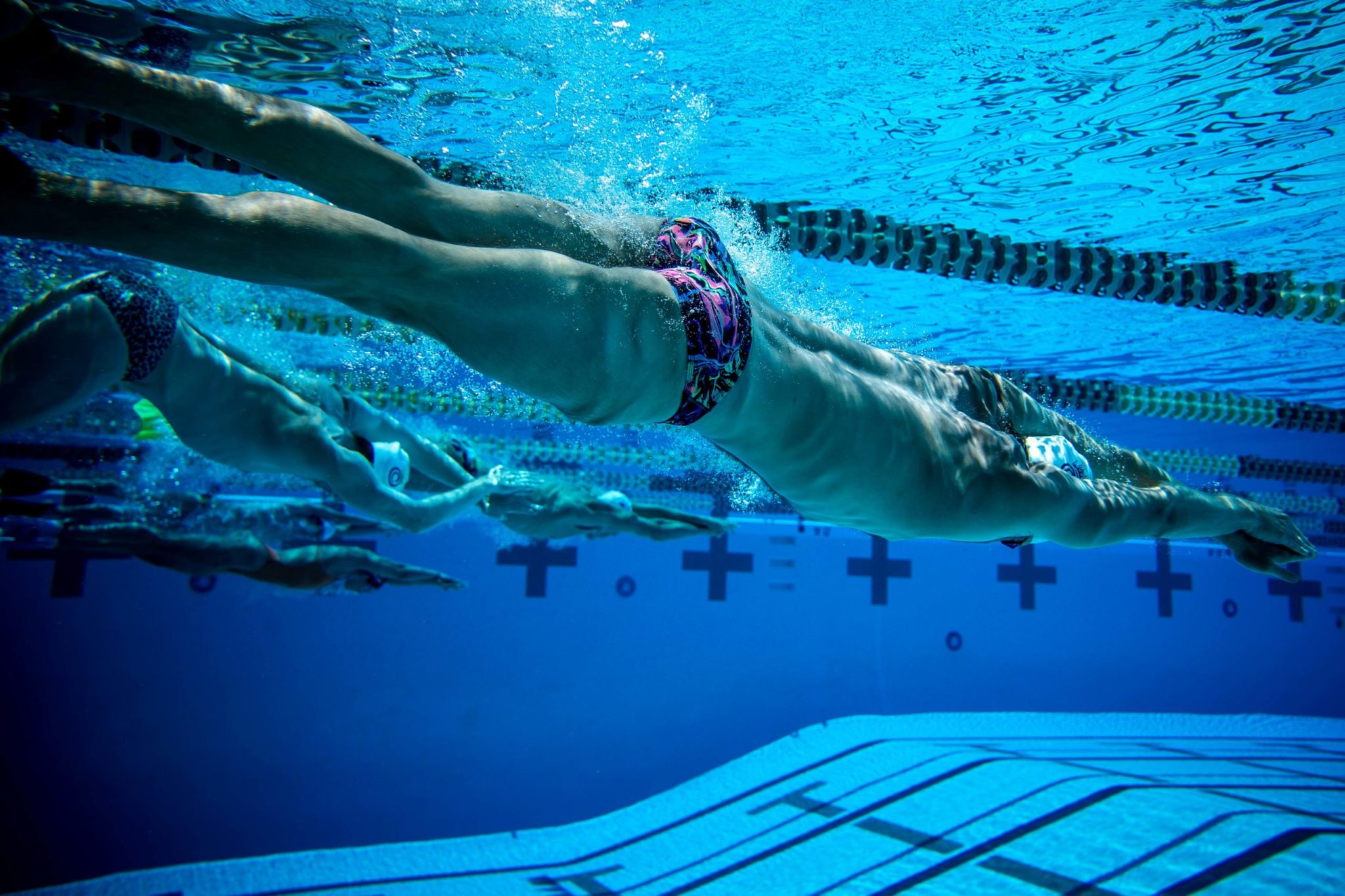
Courtesy: Andrew Sheaff
Keeping track of improvements in fitness is easy. Times, volumes, heart rates, and more make it easy to quantify progress. Coaches know when there’s been improvement or not, and swimmers know when there’s been improvement or not.
That’s not the case when it comes to improving skills. Historically, assessing skills has come down to whether skills ‘look’ better. That’s not particularly useful or accurate, and there’s not much room for progression beyond skills looking ‘even better’.
As a result, both swimmers and coaches find it easier to focus on improving fitness rather than improving skills. And considering that skill influences performance every bit as much as fitness, that presents a problem.
Skill Benchmark Sets
The solution to this problem is one that’s already being implemented in a different context. Most clubs have some sort of benchmark training sets that they expect their swimmers to be able to perform. We can take the same concept and create sets that require swimmers to execute specific skills at a high level.
The key is to create sets where swimmers must demonstrate the desired skills to successfully complete the set. Benchmark sets can then serve to make skill development more objective, while also providing swimmers with clear, concrete goals as to what they need to achieve.
Before we examine what makes a great benchmark set and how to use them, let’s take a look at a few examples. These examples are simple versions to demonstrate the concept. As we’ll see below, the physical and technical demands of any can easily be ramped up as high as you’d like.
Freestyle Propulsion – 4×50 freestyle with upside-down paddles and buoy, take 2 fewer strokes each 50
To be able to perform this set, swimmers must use their whole arm to create propulsion, and they have to be able to create more propulsion per stroke as they move through the set. Because they have the buoy in, swimmers can’t compensate with the legs. They have to hold water with the upper body.
Backstroke Alignment – 8×25 Paddle cap backstroke; ODD build to fast EVEN under 15 seconds
Swimmers have to have a stable head and body position to keep the paddle on the crown of their head. More importantly, they need to be able to execute this skill at speed.
Breaststroke Kicking – 8×75 Breaststroke kick ODD take 1 less kick per 25 EVEN descend 1-4 at the same kick count
Breaststrokers must be able to create a lot of propulsion per kick on the ODD repetitions. On the EVEN repetitions, they must learn to create more speed with each kick. Both tasks require swimmers to control their skills to achieve the goals of the set.
Butterfly Timing – 6×25 as 8 cycles of head up butterfly + DragSox
Swimmers must have a powerful 2nd kick to successfully perform this set. Holding the head up forces swimmers to execute a strong, well-timed 2nd kick if they want to recover their arms over the water. Adding the DragSox makes it much more difficult to do. While this set doesn’t have a clear performance goal in terms of numbers, the ability to get the arms out of the water or not with rhythm is quite clear.
What Makes a Good Benchmark?
Notice how each benchmark combines a technical skill with a performance demand (stroke count, speed, or resistance). That combination ensures the skill transfers to racing. The sets can be as technically challenging and physically demanding as you’d like.
Having seen a few examples, what separates effective benchmarks from ineffective ones? A good benchmark shares three qualities:
- Specific It defines exactly what the swimmer must do
- Measurable Either the skill was performed successfully or it wasn’t
- Relevant It connects directly to performance in races
The sets above are specific in that swimmers have clear goals as to what needs to be accomplished. They’re measurable as success and failure are clearly defined. They are relevant because the sets test skills that help swimmers go faster.
When written well, benchmarks become the bridge between skill goals and day-to-day training. The bottom line is that if there is anything you want swimmers to be able to do, it’s possible to design a set that requires swimmers to execute that skill well. And you can make the successful (or not) completion of the set as objective as possible.
Using Benchmarks in Practice
Benchmarks aren’t just end-of-season tests and aspirational goals. Here’s how they can guide training on a daily basis:
- Design sets that target benchmarks. Once you know the end goal, it’s much easier to design sets that help swimmers make progress toward that goal. You can build skill work into training.
- Track progress. As swimmers improve performance on these sets, or they make progress on components of the sets, they can see how they’re improving.
- Celebrate achievements. When specific achievements are recognized, it’s a lot more powerful than ‘that looked good’. That gets swimmers excited about improving skills.
Why This Approach Works
When skill development benchmarks are implemented, three things happen almost immediately:
- Swimmers see progress every week. They’re working towards something concrete. That makes practices more rewarding, which keeps athletes engaged.
- Coaches gain clarity. Benchmarks simplify planning by focusing coaches and swimmers on what matters most, and skill development becomes objective.
- Alignment. As swimmers move up groups, the same skills can be challenged in progressively more difficult ways.
The result is better engagement, more consistent improvement, and faster swimmers over time.
Scaling Benchmarks Across a Swimming Career
The 3rd point above is worth expanding upon. While these strategies are powerful for facilitating progress in the short-term, they are really powerful for facilitating progress in the long-term.
As swimmers age up through a club program, each group typically has concrete training targets for swimmers to achieve. With the concept of skill development benchmarks, we can create concrete skill targets for those swimmers to achieve as well.
Once a benchmark for a skill has been created, it’s simple enough to develop easier versions for less skilled swimmers and more challenging versions for more advanced swimmers. just like we already do with physical training.
This might be the most potent value of implementing benchmarks. They can be used to create a tangible roadmap for developing the most important skills for speed over the course of a club swimming career.
It’s a simple concept that can have a profound impact.
 ABOUT ANDREW SHEAFF

Andrew Sheaff has coached swimming for almost 20 years, including 6 years at the University of Virginia where he helped the Cavaliers win 3 NCAA team championships. He is the author of the book ‘A Constraints-Led Approach To Swim Coaching’, which identifies strategies for optimizing individual skill development in large group training environments. The book focuses on enhancing skills that directly improve performance and training those skills to reliably show up in races. He currently works as a consultant to coaches, clubs, and swimming organizations. He can be reached at his website www.coachandrewsheaff.com.
