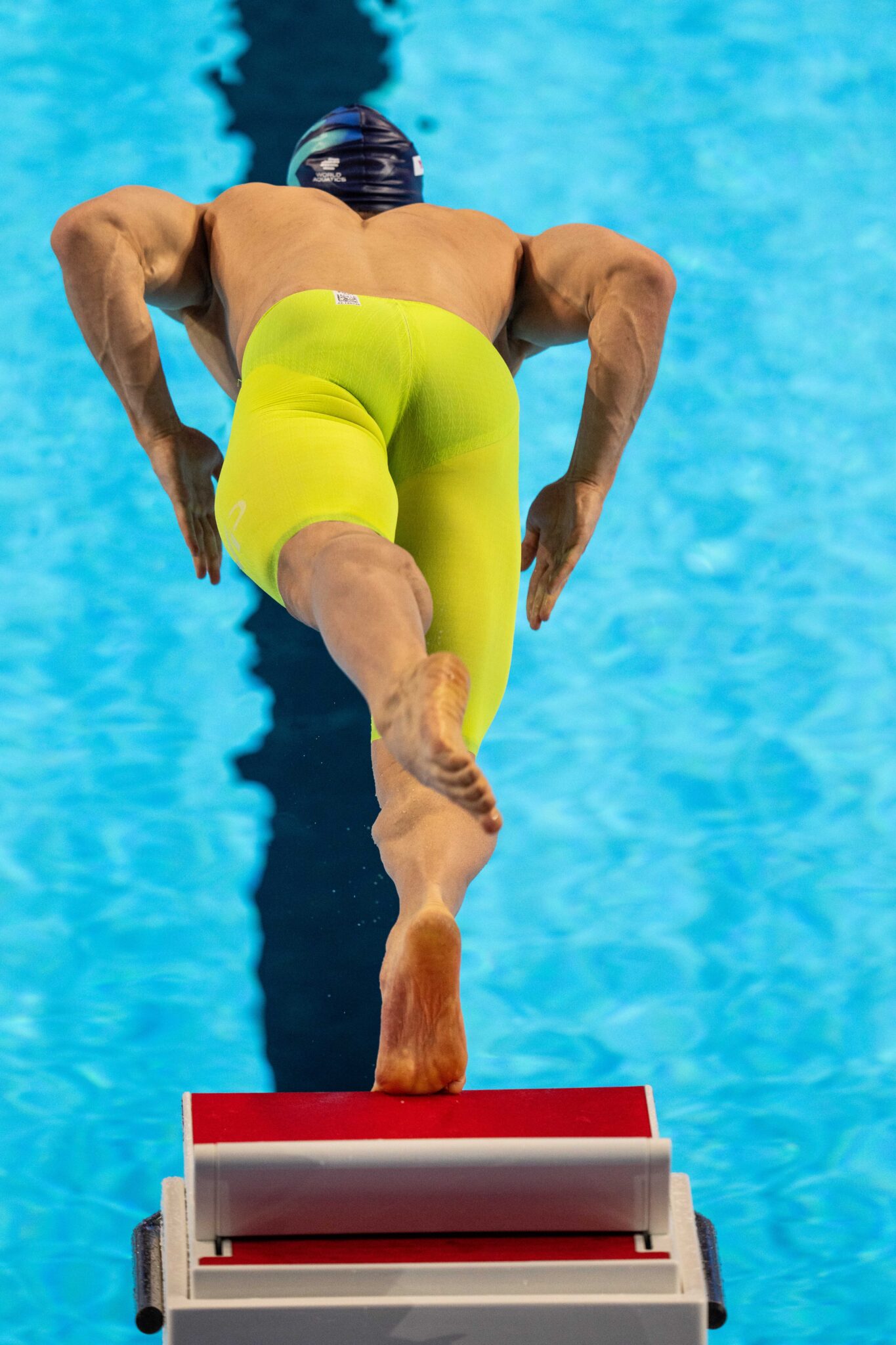
A blazin’ stroke rate is one of the most important characteristics of an elite sprint freestyle.
Being able to wind up your arms and let them fly with controlled fury and power gets you to the other side of the pool faster. And when it comes to the splash and dash, stroke rate numbers are in a class of their own.
For example, let’s take a lookie-loo at the stroke rates of the men’s and women’s finalists at the Paris Olympics. Stroke rate peaks hard in the 50 freestyle and decreases steadily before leveling out at the 200 freestyle:
| Event | Men (SR) | Women (SR) |
| 50 Free | 62.2 | 59.5 |
| 100 Free | 51.4 | 51.5 |
| 200 Free | 42.3 | 44.6 |
| 400 Free | 41.9 | 44.15 |
Maintaining a high tempo, err, tempo, essentially redlining your upper body muscles and coordination skills, is hard work. This progressive sprint set tests your ability to hold tempo as distance gradually increases.
Do a solid warm-up of your choice, a pre-set that wakes up your nervous system, grab your FINIS Tempo Trainer, and let’s get after it.
A Sprint Set for Increasing Tempo Control
2 rounds:
- 15m swim at target stroke rate
- 20m swim at target stroke rate
- 25m swim at target stroke rate
- 30m swim at target stroke rate
- 35m swim at target stroke rate
- Take 60-90s rest between repetitions, 5+ minutes between rounds
If you can maintain your stroke rate and continue holding water (not just spinning your arms), increase the difficulty by adding light resistance (small chute, DragSox) or nudging your tempo slightly faster.
A Pyramid Variation for Boosting Tempo
The set can also be done as a pyramid:
- 15m swim at target stroke rate
- 20m swim at target stroke rate
- 25m swim at target stroke rate
- 30m swim at target stroke rate
- 35m swim at target stroke rate
- 30m swim at target stroke rate
- 25m swim at target stroke rate
- 20m swim at target stroke rate
- 15m swim at target stroke rate
I like this variation as it builds tempo control as the distance ascends and descends. Even though you are fatigued, the decreasing distance will make the tempo feel “easier” on the way down.
The Bottom Line
Sprinting and redlining stroke rates go hand in hand. But it’s more than just swinging your arms in circles until they shoot out the shoulder socket.
Elite sprinters can hit those quick turnovers and connect their hands to the water with power and precision, propelling them through the water.
The stroke rate set above helps teach this specific control and conditioning so that you can step up on the block with confidence on race day and know that your stroke rate and timing are locked in place.
Happy sprinting!
ABOUT OLIVIER POIRIER-LEROY
 Olivier Poirier-Leroy is a former national level swimmer, 2x Olympic Trials qualifier, and author of several books for swimmers, including YourSwimBook, Conquer the Pool, The Dolphin Kick Manual, and most recently, The 50 Freestyle Blueprint.
The book is a beastly 220+ pages of evidence-based insights and practical tips for improving freestyle sprint speed.
It details everything from how to master stroke rate, technique, build a thundering freestyle kick, improve your start and underwaters, and much more.
The 50 Freestyle Blueprint also includes 20 sprint sets to get you started and a bonus guide on how to master the 100 freestyle to complete your sprint preparation.
👉 Learn more about The 50 Freestyle Guide today.

As a Masters swimmer, I love articles like this that can set me up with an achievable workout intended to build speed! I will give this a try in the pool soon.
Thanks, Olivier. Not sure I entirely understood. What does ‘m’ stand for in the above rounds? Meters? Minutes?
Meters, yes.
I’m assuming it’s measuring stroke cycles vs each stroke ? Just wanting to make sure. 🙂
Michael Andrew will be upvoting this article while eating Chips Ahoy’s on his sofa.
Seems to me quite interesting that the 200 and 400 free stroke rates are about the same.