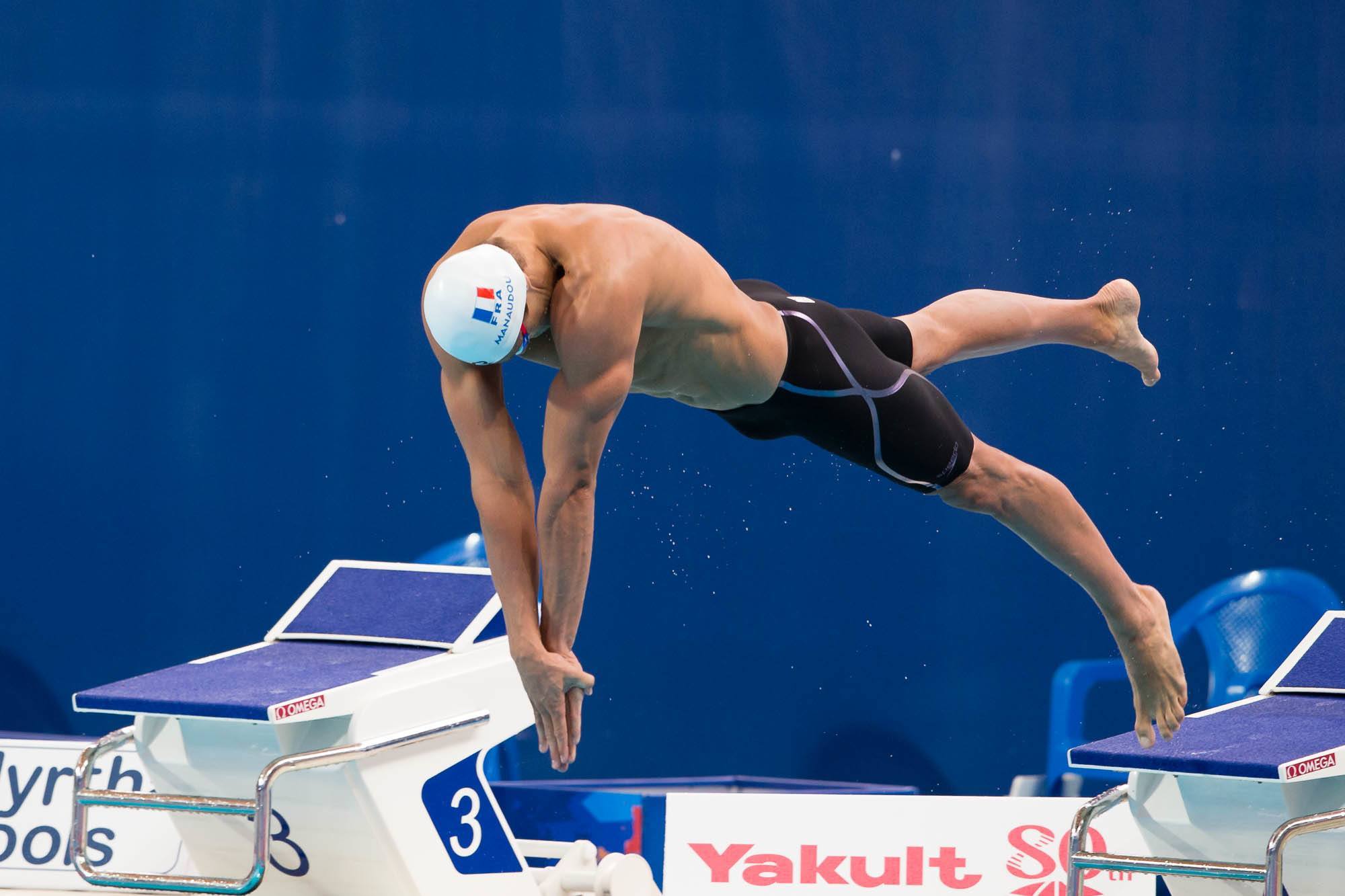
Want to unleash more top-end speed in the pool? Here are some proven ways to add more horsepower to your 50 freestyle and see faster times on the clock.
The 50 freestyle is the Splash and Dash, the Grip and Rip, the Hurry and Scurry, the purest expression of precision and power in the water.
Behind the thundering kick and white water arm returns is the mastery of technique, coordination, and power. Getting faster isn’t just about sprinting harder—it’s about training like a high-grade smarty pants.
This means mastering sprint specific technique, building explosive power in and out of the water, and training the right way.
For the speed-obsessed, here are some proven strategies for squeezing more go-go from your freestyle.
Train sprint-specific mechanics
One of the biggest mistakes swimmers make when trying to improve sprint speeds is not training the specific technical and kinematic demands of the event.
Sprint freestyle is distinct from regular freestyle in a lot of important ways:
- Higher stroke tempo. Sprint freestyle uses a high tempo to create lots and lots of power. For example, the men’s finalists at the Paris Olympics in the 50 freestyle hit stroke rates of 60-65 stroke per minute. This is way higher than the stroke rates in the 100 freestyle (~50) and the 200 freestyle (~40-45).
- Stroke timing. Your standard freestyle technique has a lopping, gliding arm action. This type of freestyle is highly efficient, but is not designed for top end speeds. Sprinters overlap strokes (achieving positive “Index of Coordination” scores) which contrasts significantly from the slight gallop seen at submax speeds (Seifert and Bardy, 2004).
- Different body roll. The body roll when sprinting differs from regular freestyle in several important ways. First, the increased tempo and timing of a sprint stroke mean there is increased shoulder roll velocity. The shoulders roll the same amount but do so much quicker. And secondly, the hips roll less (Andersen et al., 2020). This gives sprinters a more stable platform to twist the torso against and stabilizes the legs when kicking at full thrust.
And that’s just the tip of the sprint vs. regular freestyle iceberg: Sprinters use a straighter arm during the catch and the pull phase. Glide less at hand entry. Use faster hands through the push phase. Return the arm with straight or scooped arms. And much more.
Combined, the sprinter’s freestyle technique is a different beast compared to your usual freestyle.
Add resisted sprints
Resisted sprint training via tools like chutes, tubing, power towers, and mesh netting like DragSox are an awesome way to build sprint freestyle speed!
Studies with swimmers doing sprint training with drag chutes saw boosts in freestyle velocity (Valkoumas et al., 2020). Resisted sprint training has also shown to out-perform unresisted sprint training in elite swimmers (Grznar et al., 2018).
The trick to this kind of training is to keep it short and oriented towards power. For example:
- 6x15m all out with a medium drag chute taking 90s rest between repetitions.
There are lots of reasons to add resisted swimming to your workouts, from strengthening your stroke to increasing stroke coordination to using it for post-activation potentiation, but leveling up those top end speeds is the best reason of all.
Train the right energy systems
The 50 freestyle relies almost exclusively on the anaerobic alactic (phosphagen) and anaerobic lactic (glycolytic) systems to produce golden performances. The aerobic system plays a minor role during the event itself but is still important for recovery and repeat efforts.
Per Rodriguez and Mader (2011), here’s how the three systems work in the 50:
- Phosphagen: 38%
- Glycolytic: 58%
- Aerobic: 4%
When trying to swim a faster 50 freestyle, training should address these energy systems.
- Maximal efforts for short durations (<10 seconds) with lots of rest (+90 seconds) work the early, explosive energy system.
- Repeated near-maximal efforts train the body to sustain speed as lactate accumulates (20×25 all out on 20s rest).
Sprint freestylers need both to create violent power at the beginning of the race and to sustain it all the way to the wall.
Hit the gym
Dryland training, whether we are talking about strength training, core training, conditioning, plyometrics, or mobility/stretching gives sprinters the raw materials to sculpt more powerful results in the water.
- Strength training. Lifting weights builds strength and power for success in the sprints. In just one example, a study by West et al. (2011) showed a strong link between barbell back strength and start performance in elite British male sprinters.
- Core training. Building stability and control in the trunk is essential for sprinting fast, giving you control of your power. Karpinski et al. (2020) saw significant improvements in sprint performance with national-level swimmers after six weeks of core training.
- Plyometric training — Plyos are all about power and explosive movement—just like when sprinting freestyle! They are helpful for improving start performance (Rebutini et al., 2016) and getting out of the walls faster (Potdevin et al., 2011).
Dryland, when used properly, gives swimmers the stability, strength, and power to sprint faster and crank out quicker 50s.
Use paddles and fins smartly
Paddles and training fins are frequently viewed as power/strength development tools for swimmers, but it’s a little more complicated than that. Swimmers’ strokes change when sprinting with fins and paddles.
- Paddles slow down stroke rate significantly and can increase the gallop/hitch in the stroke. Using paddles is also easier than regular swimming at similar velocities (Tsunokawa et al., 2019).
- Fins boost speed (by a lot!) but also have non-sprinty effects on technique, increasing glide and lengthening the stroke (De Matos et al., 2023).
Another study by Barbosa et al. (2020) did a sprint training intervention with paddles. Swimmers did 3x weekly sprint sets with paddles (10×10 strokes all out with 60s rest between reps). After four weeks, the paddle group saw no increase in speed versus the control group.
While both tools are fun and useful, make sure to prioritize sprinting the way you plan on sprinting in competition.
The Bottom Line
Speed in the water is a precious commodity, and experienced swimmers know how hard it can be develop.
To unlock some more of high-grade freestyle sprint speed that slices the pool in half, train sprint-specific technique, target the right energy systems, use resistance (in the water and in the gym), and use your favorite swim gear smartly.
Happy sprinting!
ABOUT OLIVIER POIRIER-LEROY
 Olivier Poirier-Leroy is a former national level swimmer, 2x Olympic Trials qualifier, and author of several books for swimmers, including YourSwimBook, Conquer the Pool, The Dolphin Kick Manual, and most recently, The 50 Freestyle Blueprint.
The book is a beastly 220+ pages of evidence-based insights and practical tips for improving freestyle sprint speed.
It details everything from how to master stroke rate, technique, build a thundering freestyle kick, improve your start and underwaters, and much more.
The 50 Freestyle Blueprint also includes 20 sprint sets to get you started and a bonus guide on how to master the 100 freestyle to complete your sprint preparation.
👉 Learn more about The 50 Freestyle Guide today.

I keep trying to order the book, but the Captcha keeps rejecting me even though I ‘check’ it. Any recommendations?