Relays inspire, shall we say, ‘lively debate’ across any sport they are a part of. They allow for a hypothetical discussion; the atmosphere, the team aspect, and the weight of expectations all allow for athletes to soar to new heights as well as sink to hitherto unknown depths.
The anchor leg especially in swimming has something of a mythic quality. Jason Lezak’s fabled 4×100 freestyle relay leg from the 2008 Olympic Games, which stands as the defining moment when Michael Phelps’ dream of eight Olympic golds began to seem real, is the gold-standard. That win over France, by just 0.08 seconds, remains seared in the collective consciousness. France’s revenge, four years later, is decidedly less so.
The identity of the best relay swimmer in the world is then inherently tied to the athlete who anchors. This consecrated relay spot is almost always reserved for the alpha in the team, the swimmer who you would back when the chips are down and everything seems lost.
Who that swimmer is, given the choice of anyone in the world, is a debate as emotional as it is statistical. U.S. swim fans would point to Jack Alexy, who dragged their men’s medley relay to a bronze medal last summer that seemed a pipe dream just days beforehand, thanks to the second-fastest relay swim in history.
Chinese fans could also make a case for Pan Zhanle who is the only man to have split faster than Alexy, doing so last summer at the Paris Olympics (At just 20 years old, Pan already has the second-most swims of anyone under the hallowed 47-second barrier). Italy’s Carlos D’Ambrosio, a newcomer on the world stage at 18, was a blistering 47.4-or-better on six occasions last summer as he becomes their banner relay athlete.
The question for any head coach is this: who do you trust when the stakes are highest? The ultimate answer, for several years now, has been Kyle Chalmers. Australia’s golden boy from the Rio Olympics has been the most terrifying sight on any 100 freestyle anchor leg for a decade now.
The Record-Setter
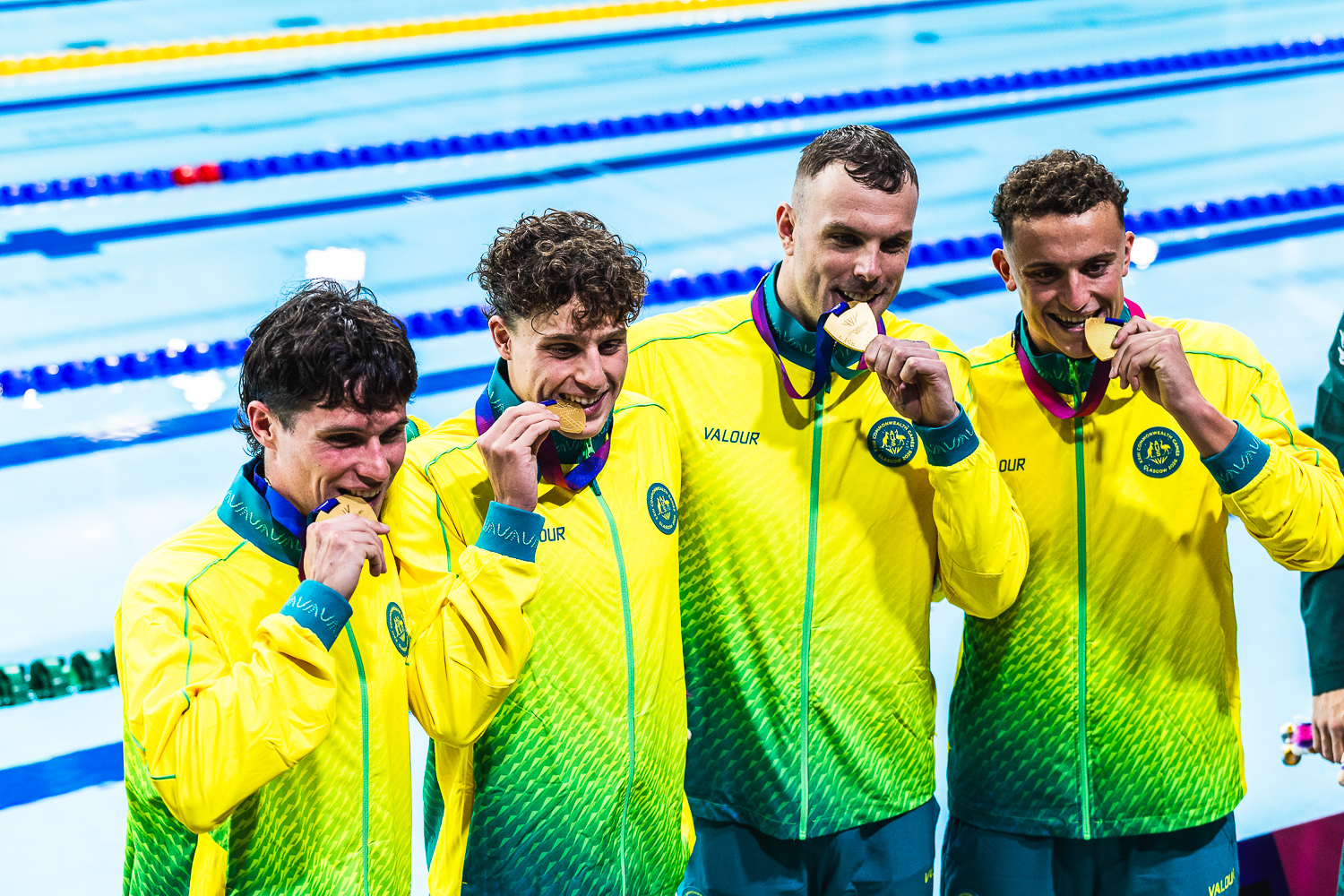
Chalmers anchored home Australia’s 4×100 free relay last night in 46.93, en route to a new Commonwealth Games record of 3:09.49. That was the 9th-fastest swim in history in the event, and only half a second behind the 3:08.97 Australia swam last summer to win World Championship gold.
For Chalmers, this was par for the course. For six years in a row he has anchored a men’s 4×100 free relay in under 47 seconds – in total he has 15 splits under the 47 second barrier.
For all his individual success, and he has won everything there is to win in the 100 free, his career will be reminisced on for his relay prowess. No one else in history has quite had the effect that he has.
Volume
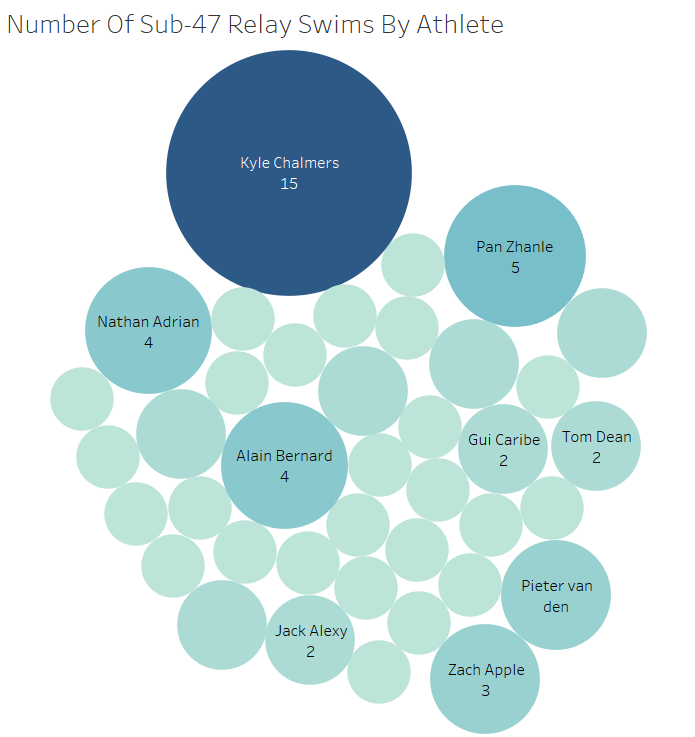
In fact, only one country other than Australia has more than ten. Thanks to Chalmers, Australia are top by this metric with a total of 17 sub-47 relay swims. The U.S., the most successful swimming nation in both Olympic and World Championship history, are just one behind with 16.
Take a moment just to appreciate that. The U.S., as a whole, has just one more sub-47 splits than a boy from Port Lincoln. The 16 swims for the U.S. are spread across eight athletes. Chalmers has more sub-47 splits than the next three best swimmers combined and 20% of all sub-47 splits in history.
Nathan Adrian leads the way for the U.S. with four sub-47 swims, but even for the best swimming nation in the world there has not always been a clear choice on this leg. Their recent stars in sprint freestyle, Caeleb Dressel and Jack Alexy, have been more often used on the leadoff.
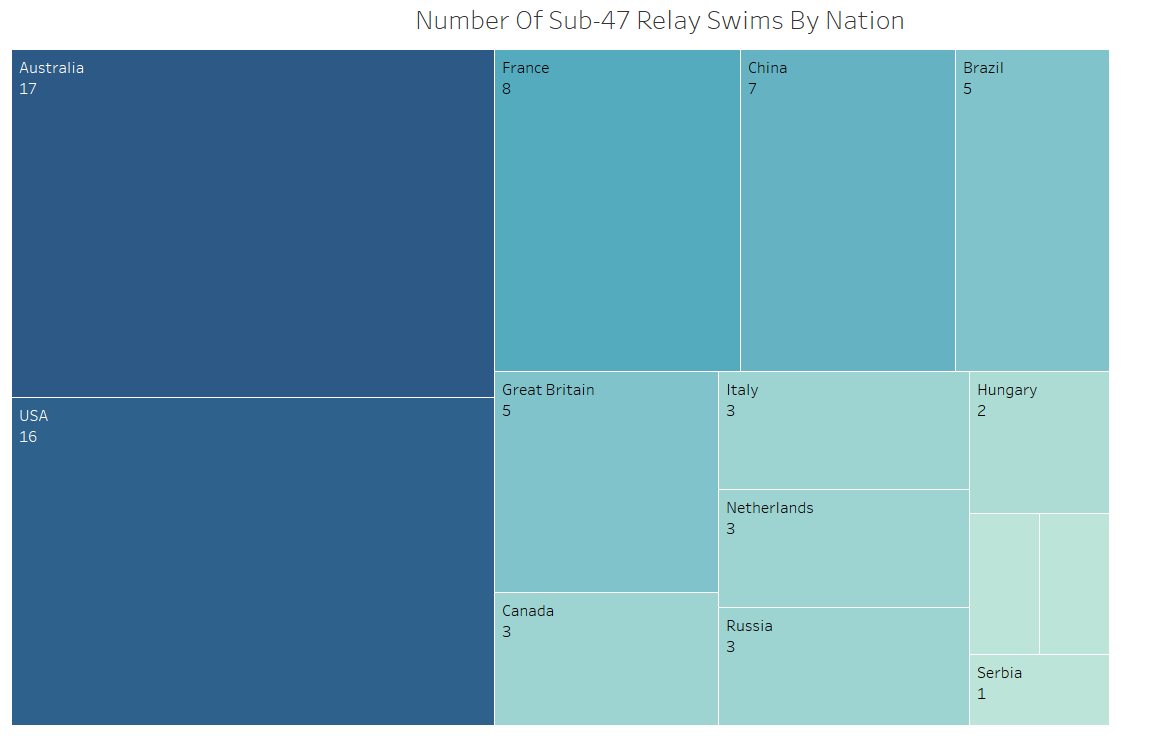
The only swimmers to have more of a stranglehold over their nation’s top swims are from the quartet of nations in the bottom right hand corner. Paul Biedermann, David Popovici, Andrej Barna, and Pieter van den Hoogenband hold the only 46-point splits in the history of Germany, Romania, Serbia and the Netherlands, respectively.
From nations with at least two swimmers having splits under the 47 second mark, Chalmers (88.2%) leads Pan Zhanle (71.4%, China) , Vladimir Morozov (66.7%, Russia), Brent Hayden (66.7%, Canada) and Alain Bernard (50%, France) for the highest ownership ratio.
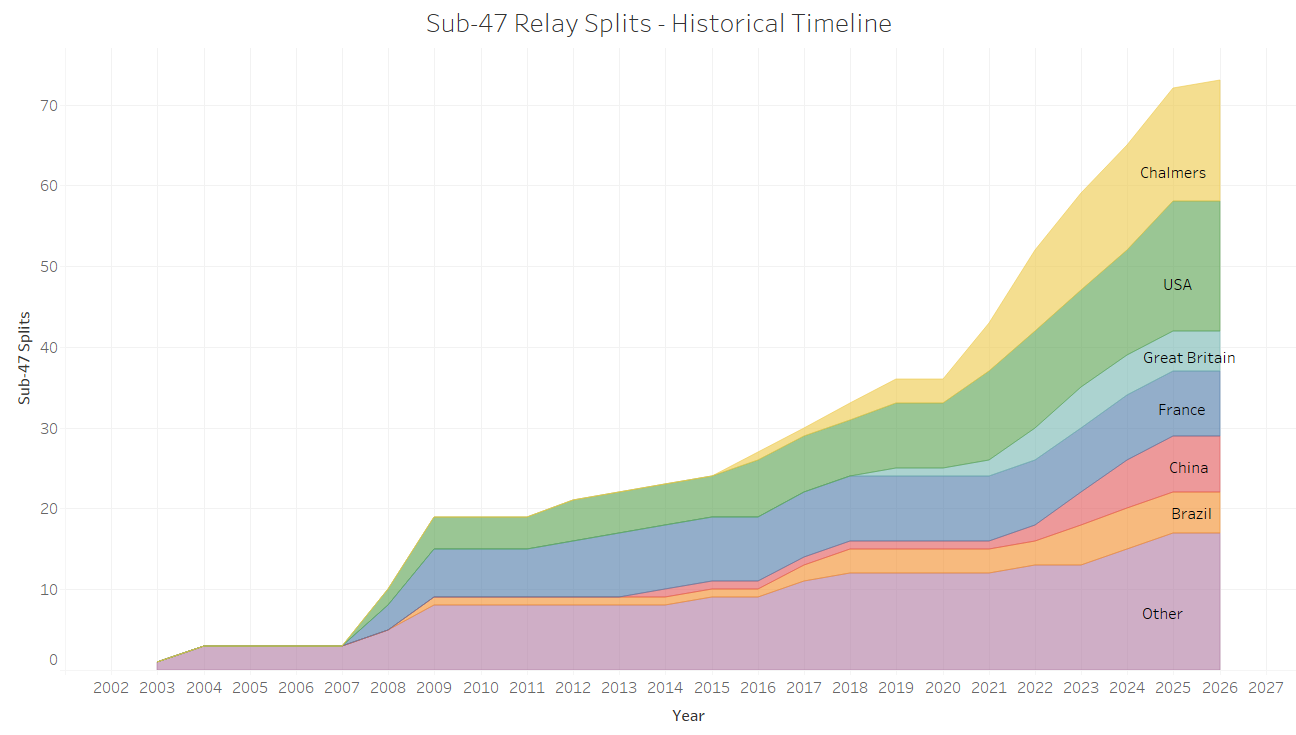
In the near-decade since 2016, Chalmers has swum 15 of the 49 relay splits under the barrier (30.6%). The most from any other nation in that period is 11, from the U.S..
Consistency
Since the turn of the decade, Australia has won five world or Olympic medals in the men’s 4×100 free relay – one bronze (2021), two silvers (2022, 2024) and two golds (2023, 2025). In exactly zero of those finals have they been higher than third place heading into Chalmers’ leg, and in only two (2023, 2025) have they even been in a podium position at that point.
All five of those anchor legs from the Aussie star have been between 46.46 and 46.60. They make up one-third of the top 15 100 freestyle relay splits in history and, along with his 46.60 anchor from the 2019 4×100 medley relay and 46.63 anchor in the heats from the 2021 Olympic 4×100 freestyle relay, give him seven swims in the top 20. No other swimmer even has that many swims in the top 100. Chalmers has 18 of those, triple anyone else, and has more swims in the top 20 than anyone else does in the top 100.
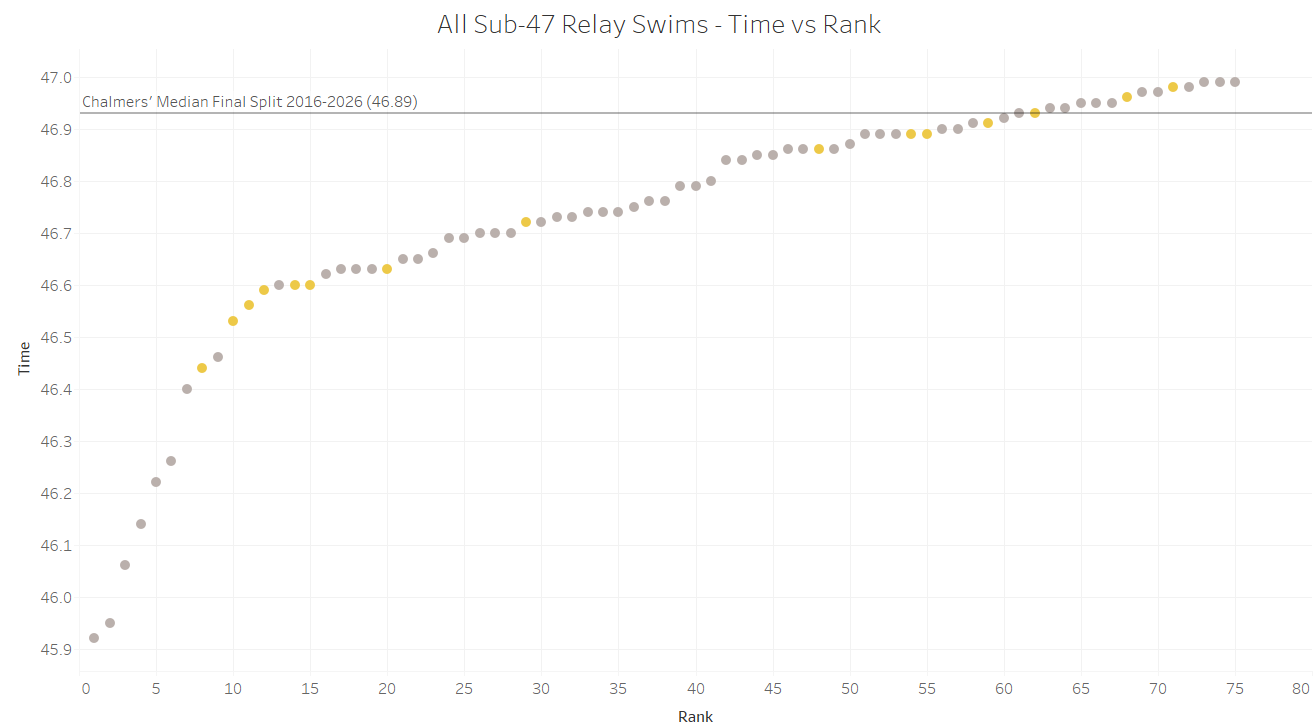
There may be swimmers who have split faster than him, but no other swimmer can match either his ability to churn out 46-mid splits or his longevity – he’s faced off with six different U.S. anchors on the 4×100 freestyle alone, and is the only swimmer to have made every major individual 100 free final since 2019. Not a single one of the swimmers from the 2016 4×100 free relay final – his first senior international final – were in the World Championship field with him last summer.
After (thankfully unfounded) concerns that his time at the top would be short-lived after Rio due to a heart condition (supraventricular tachycardia) that he has now had three major surgeries for, his continued reign as Australia’s #1 has not been handed to him on a silver platter. The South Australian athlete also had shoulder surgeries in 2020 and 2021 – neither of which appear to have slowed him down either.
Impact
Ever since winning Olympic gold in Rio at just 18 years old, Chalmers has been the Aussies’ go-to on the anchor leg for every men’s relay, and he keeps coming up with the goods.
Back in that previous graph, you can see that Chalmers’ average finals split since then would rank just outside the top 50. Some of those legs are non-anchor legs, such as on the mixed free relay where the status quo is M-M-F-F, but the majority of his swims have come on this critical leg.
Australia have won 13 medals on relays where he has anchored, from a total of 18 finals. Through all of those – remember, 18 finals – he has been overtaken by exactly one swimmer, Brazil’s Pedro Spajari, on one occasion, the 2018 Pan Pacific Games 4×100 freestyle relay.
Even so, Chalmers ran down Japan’s Juran Mizohata in that race, ending his leg a net neutral second place. Chalmers has never finished a finals anchor leg in a lower position than he started it.
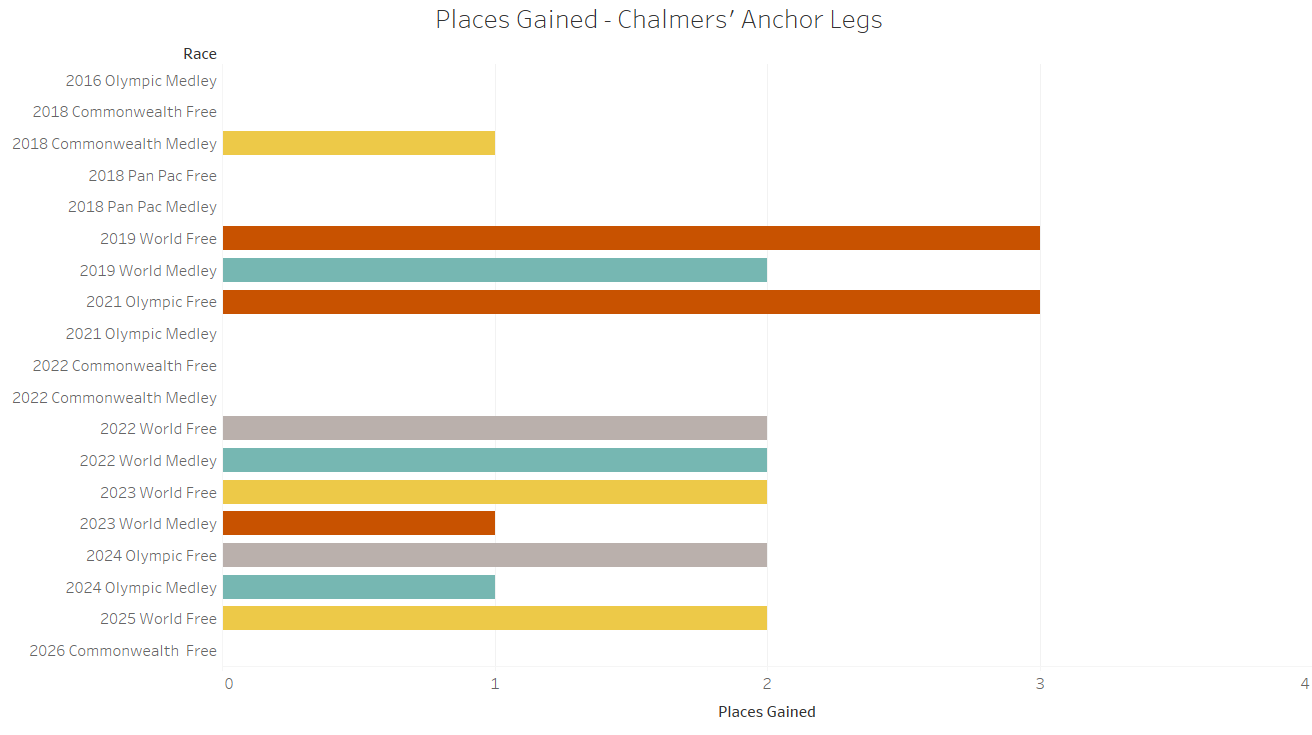
Replace his anchor legs over the years with a time of 47.50 – a mark only around 100 swimmers have ever been under – and look at the difference in some of the results.
- 2025 World 4×100 freestyle relay: 3rd (from 1st)
- 2024 Olympic 4×100 freestyle relay: 3rd (from 2nd)
- 2023 World 4×100 freestyle relay: 3rd (from 1st)
- 2023 World 4×100 medley relay: 5th (from 3rd)
- 2022 World 4×100 freestyle relay: 6th (from 3rd)
- 2021 Olympic 4×100 freestyle relay: 6th (from 3rd)
- 2019 World 4×100 freestyle relay: 4th (from 3rd)
- 2018 Commonwealth 4×100 medley relay: 2nd (from 1st)
- 2018 Pan Pacific 4×100 free relay: 3rd (from 2nd)
Those 13 medals drop to just nine, and just two golds rather than five. Chalmers has been the ultimate joker on the final leg for Australia.
No other swimmer is as important to their nation’s relay success as Chalmers is right now. In a way, after a decade of delivering, that is nothing new for him.
“King Kyle” Chalmers, All Sub-47 Splits
- 2020(1) Olympic Games, Men’s 4×100 Free Relay Final – 46.44 (#8 all-time)
- 2025 World Championships, Men’s 4×100 Free Relay – 46.53 (#10 all-time)
- 2023 World Championships, Men’s 4×100 Free Relay – 46.56 (#11 all-time)
- 2024 Olympic Games, Men’s 4×100 Free Relay – 46.59 (#12 all-time)
- 2019 World Championships, Men’s 4×100 Medley Relay – 46.60 (#T-13 all-time)
- 2022 World Championships, Men’s 4×100 Free Relay – 46.60 (#T-13 all-time)
- 2020(1) Olympic Games, Men’s 4×100 Free Relay Heats – 46.63 (#T-17 all-time)
- 2016 Olympic Games, Men’s 4×100 Medley Relay – 46.72 (#T-29 all-time)
- 2022 Commonwealth Games, Men’s 4×100 Medley Relay – 46.86 (#T-46 all-time)
- 2022 World Championships, Men’s 4×100 Medley Relay – 46.89 (#T-51 all-time)
- 2023 World Championships, Men’s 4×100 Medley Relay – 46.89 (#T-51 all-time)
- 2018 Pan Pacific Games, Men’s 4×100 Medley Relay – 46.91 (#T-58 all-time)
- 2026 Commonwealth Games, Men’s 4×100 Free Relay – 46.93 (#T-61 all-time)
- 2020(1) Olympic Games, Men’s 4×100 Medley Relay – 46.96 (#68 all-time)
- 2022 World Championships, Mixed 4×100 Free Relay – 46.98 (#T-71 all-time)

Thank you Sam Blacker for proving it once and for all. Kyle is the King.
If AUS beats USA in the M 4 x 100 FR-R at the 2026 Pan Pacific Swimming Championships, Greg Meehan should be fired on the spot. Ditto the M 4 x 200 FR-R. Losing on home soil is not an option.
As for the athletes, avoid the petting zoos in SoCal.
King Kyle and Mr Southam are not attending Pan Pacs
Jason Lezak clears
Thank you King Kyle ❤️
King Kyle
There is only one: Lezak
Consistency and quantity is one thing. But given his fastest split is ranked 8th — he may have the volume – BUT here we are 18 years on — Jason Lezak is still number 1, and that swim is still the world record. Therefore Lezak is #1, and it’s not contest. (except in volume).
Pan?
You’ve made the point for greatest SWIM but the headline is swimmer… which implies multiple performances.
Pan and Alexy faster than Lezak.
Seems like the name of Matt Biondi should at least be mentioned here, no?
I would bet that from 1985-1992 his collection of relay splits, when compared to the top 100 swims at the time, look even better than this.
The downvoter motivated me to look it up:
1991 pan pacs 48.65 and 48.74
1987 pan pacs 48.64 and 47.90
1985 pan pacs 47.66 and 47.84
1988 Olympics 47.81 (swam fly on medley)
1986 Worlds 48.29 and 47.78
1991 Worlds 48.27 and 48.53
Rowdy was 48.93 in Los Angeles 1984.
Brent Lang was 48.77 on the relay at 1991 Worlds.
Those are the only 48-anything splits I can find by someone other than Biondi until 1992.
I rest my case.
There may well be an argument for that (with the caveat that Biondi retired before I was born, so I personally don’t have the same experience of his career as I do with Chalmers). Getting the top-100 data for him would be a pretty horrendous task though.