Courtesy: James Schuler
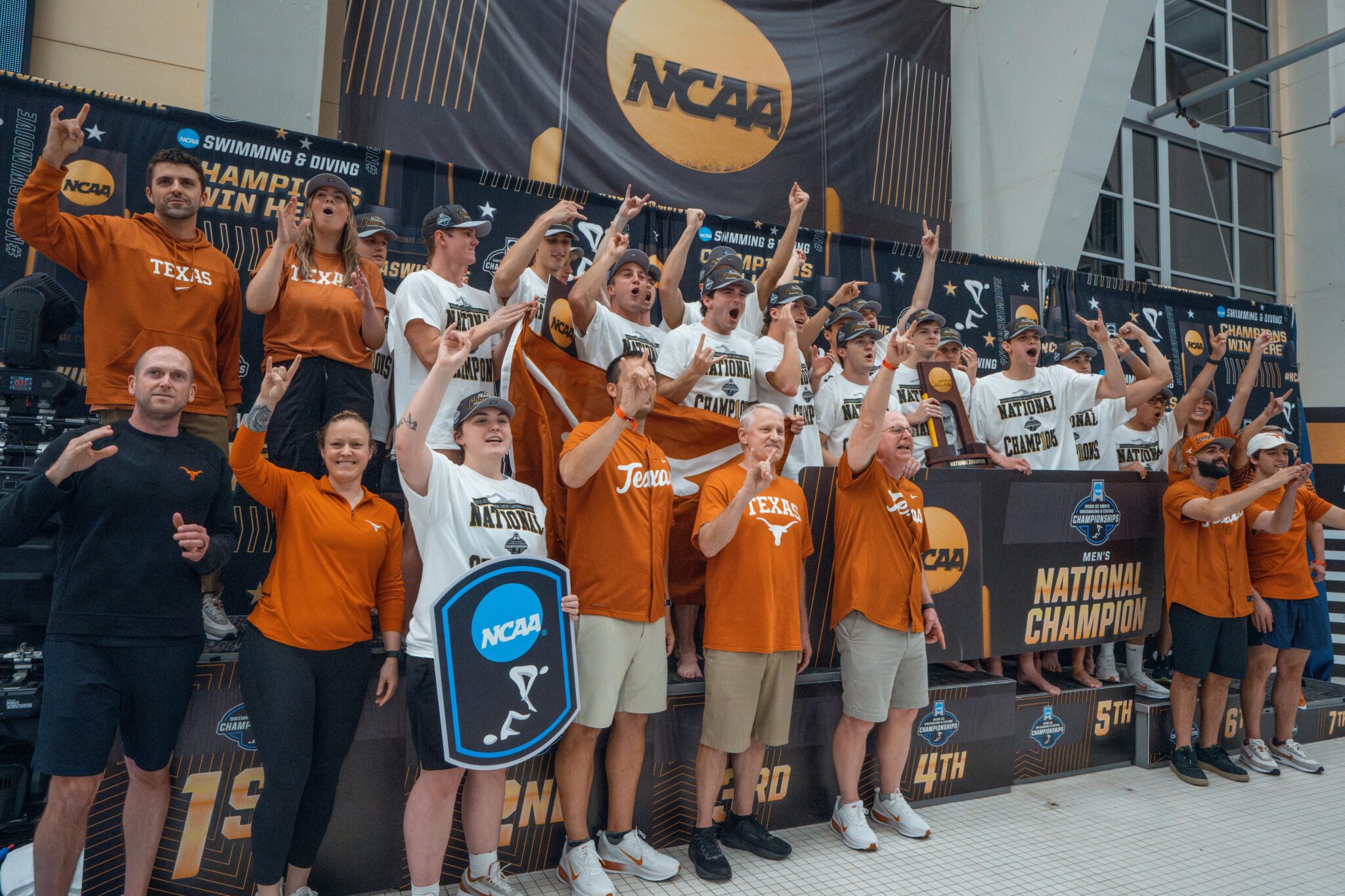
Watching the ESPN+ streams of the evening finals’ sessions of the Men’s NCAA Division 1 Swimming and Diving championships this past week, you would have sworn that Texas and Florida were separated by a razor-thin margin. A meet coming down to the final relay, where every place and point would matter. Except it didn’t- Texas had a 35-point cushion heading into the final race, meaning only a DQ and a Florida win in the event could snatch the championship from the Longhorns. In relative terms, this meant it was a close meet, but it finished just short of a full-on championship clinching, “Buzzer Beating”, winner-take-all 400 Free Relay that my March Madness-addled brain desired as the vehicle to crown the 2026 National Championship-winning team.
So while Texas raised their well-earned championship trophy, I asked myself how many points did we SEE scored in the finals sessions? So I set to work looking through the results and doing a little math. And as it turns out, when you account for the scoring that took place in the 9th through 16th places after prelims, along with the early heats of the 1650, to go with the morning relay swims, Texas did just outtouch Florida, 384 to 381 in TV points; points scored during the evening sessions that you would have seen on TV. If you were a fan of Arizona State and their 4 relay wins, you would have thought the Sun Devils finished in 3rd with 305 TV points, just passing the IU Hoosiers at 301.5 in 4th. But Indiana scored 49.5 points in ‘B’ Finals”, a 26.5 point edge over ASU’s morning swims, and more than enough to land the squad from Bloomington in 3rd overall. 5th place Tennessee scored the most points outside of the evening livestreams, putting up 101 of their 272 behind the scenes. Among the teams finishing in the top 15, Louisville (12th), Stanford (10th) and UVA 9th) had the highest % of their points come from ‘B’ finals, which is maybe expected of teams in that placing range. The Cardinals scored 59% (48/82) of their points away from the evening TV slot, while Stanford landed at 53% (72/136), along with Virginia at 48% (93/192). You can see a full breakdown of every team and their TV points in the table below.
| Finish Order | School | Total | B Final Points | TV Points | TV Points Rank | Rank Change Actual to TV Points | % of Points From B Finals | |
| 1 | Texas | 445.5 | 61.5 | 384 | 1 | 0 | 14% | |
| 2 | Florida | 416 | 35 | 381 | 2 | 0 | 8% | |
| 3 | Indiana | 351 | 49.5 | 301.5 | 4 | 1 | 14% | |
| 4 | Arizona St | 328 | 23 | 305 | 3 | -1 | 7% | |
| 5 | Tennessee | 272 | 101 | 171 | 7 | 2 | 37% | |
| 6 | NC State | 258.5 | 68.5 | 190 | 5 | -1 | 26% | |
| 7 | California | 231 | 74 | 157 | 8 | 1 | 32% | |
| 8 | Michigan | 220 | 39 | 181 | 6 | -2 | 18% | |
| 9 | Virginia | 192 | 93 | 99 | 9 | 0 | 48% | |
| 10 | Stanford | 136 | 72 | 64 | 10 | 0 | 53% | |
| 11 | VA Tech | 86 | 35 | 51 | 13 | 2 | 41% | |
| 12 | Louisville | 82 | 48 | 34 | 18 | 6 | 59% | |
| 13 | Ohio St | 72 | 9 | 63 | 11 | -2 | 13% | |
| 14 | USC | 69 | 27 | 42 | 15 | 1 | 39% | |
| 15 | Georgia | 64.5 | 21.5 | 43 | 14 | -1 | 33% | |
| 16 | LSU | 61 | 7 | 54 | 12 | -4 | 11% | |
| 17 | Auburn | 55 | 44 | 11 | 35 | 18 | 80% | |
| 18 | Kentucky | 52 | 14 | 38 | 16 | -2 | 27% | |
| 19 | UNC | 50.5 | 35.5 | 15 | 28 | 9 | 70% | |
| 20 | Pittsburgh | 48 | 22 | 26 | 22 | 2 | 46% | |
| 21 | Miami (FL) | 46 | 14 | 32 | 19 | -2 | 30% | |
| 22 | Princeton | 45 | 22 | 23 | 23 | 1 | 49% | |
| 23 | SMU | 44 | 7 | 37 | 17 | -6 | 16% | |
| 24 | Alabama | 41 | 14 | 27 | 21 | -3 | 34% | |
| 25 | Florida St | 40 | 8 | 32 | 19 | -6 | 20% | |
| 26 | Northwestern | 39 | 28 | 11 | 35 | 9 | 72% | |
| 27 | Arizona | 35 | 23 | 12 | 31 | 4 | 66% | |
| 28 | Missouri | 32.5 | 12.5 | 20 | 24 | -4 | 38% | |
| 29 | Purdue | 32 | 15 | 17 | 27 | -2 | 47% | |
| 30 | Texas A&M | 28 | 8 | 20 | 24 | -6 | 29% | |
| 31 | Minnesota | 22 | 7 | 15 | 28 | -3 | 32% | |
| 32 | Wisconsin | 19 | 1 | 18 | 26 | -6 | 5% | |
| 33 | U.S. Military Academy | 17.5 | 4 | 13.5 | 30 | -3 | 23% | |
| 34 | Yale | 17 | 17 | 0 | 39 | 5 | 100% | |
| 34 | Georgia Tech | 17 | 6 | 11 | 35 | 1 | 35% | |
| 34 | Utah | 17 | 5 | 12 | 31 | -3 | 29% | |
| 37 | Notre Dame | 16 | 4 | 12 | 31 | -6 | 25% | |
| 38 | Delaware | 12 | 0 | 12 | 31 | -7 | 0% | |
| 39 | Harvard | 9 | 0 | 9 | 38 | -1 | 0% | |
| 40 | IU Indy | 6 | 6 | 0 | 39 | -1 | 100% | |
| 41 | Penn State | 5 | 5 | 0 | 39 | -2 | 100% |
Much has been made of the changes to the Division 1 Swimming and Diving championship format this year, namely the elimination of the ‘B’ Final opportunities for swimmers and divers for the sake of a condensed TV window, along with only racing the top eight seeded relays at night. In doing so, this year’s Men’s Championship meet saw 27% (1086/4030) of its points scored outside of the evening streaming sessions via the early heats of the 1650, Relays and 9th to 16th finishers in the morning sessions. 27%! Imagine a football broadcast or a basketball game where 25% of the points appear out of nowhere to decide the final outcome of the competition…
When coaches, admins and media consultants debrief the 2026 men’s and women’s championships, they will inevitably talk about the same things we in the stands have been talking about: ‘B’ Finals, schedules, formats, how to reduce dead airtime, to name a few. But maybe what they need to be talking about is storytelling. Sports are about storytelling. Fans don’t just check the box scores of our favorite athletes at the end of the day; we watch. We want the ebbs and flows of the game, the match, the race, to see the at-bats, the strikeouts and home runs, touchdowns and interceptions. We watch to see our favorite swimmers, divers and schools finally get that record, gold medal, or best team finish. The storyline that develops throughout a competition is what makes sports the most valuable live commodity TV broadcasters can buy. But a swimming championship meet is a hard story to follow for the average person if 25+% of the scoring happens off-screen. Between the early heats of the 1650 (x3) and Relays (x7), there were 10 top eight performances; athletes and teammates earning 1st team All-American Honors, and you would never know by just watching the evening finals races. All 5 Relays featured at least one morning time drop to land a team into the eventual top 8. Notably, the 400 Medley relay saw a Luka Urlando-less Georgia relay team fall from their 7th seed all the way to 15th, but both Tennessee and Virginia moved into the top eight in the morning and undercut the Dawgs’ seed time, meaning one or both would have still been All Americans depending on how UGA would have swum with a healthy, participating Luca. Speaking of UVA, they nearly won the 800 Free relay out of the early heats, ultimately finishing in 4th, just 1.03 seconds back of the eventual 1st place time from Texas. Talk about what a hard story that would have been to tell and follow for the live broadcast and viewer at home, if an epic attempt by Stanford’s anchor leg Henry McFadden to chase down the Longhorns was to decide which team got second and which team got third.
As we look to the future, and stakeholders take an accounting of what the priorities of our sport are, and where they maybe should be, I hope they consider how to be able to tell the story of their swimmers and divers, individually and as teams. If decisions are going to be made for the sake of the TV product, it is because, in some part, there is a belief that mainstream broadcast television and the money it can bring will be a rock against which the wave to cut swimming and diving programs will break. And if that broadcast is going to succeed at the level we want or even need it to, we need to empower it to tell the entire story of the NCAA championship meet as best it can. Maybe that means swimming the top 16 relays at night, or showing a quick highlight cut-up of the scoring athletes who did not make a second swim. If time allows, I know coaches would advocate for adding back ‘B’ finals entirely, although the consolation rounds of diving present the biggest challenge there. Whatever event lineup, meet format and broadcast layout the leaders of our sport come up with, swimming is in a race, not against each other, but a race for survival in a new world of college sports where finding revenue streams to offset costs is instrumental to every sport’s continued existence.
Television loves live sports because viewers love live sports. Live sports thrive on great storytelling, so swimming must use all the mediums at its disposal to communicate and sell itself to its TV audience. All the things that we love as swim fans, swimmers, swammers, coaches and parents, we must find a way to share those things with the world at NCAA championships, the same way we find a way to do every four years in the summer. That’s how we make all these new changes work for the benefit of our sport. And for that I would tell the stakeholders who are looking forward to the next year and beyond to determine the next steps Swimming and Diving will take at the NCAA level…
We are all seated. Tell us a story.
ABOUT JAMES SCHULER
James Schuler is a swim fan, engineer and Notre Dame alumni living in Michigan.

Do people who aren’t swimming nerds really care or even know that they aren’t seeing 27% of the points?
Don’t get me wrong I like B heats but don’t think having them Will substantially change the ratings!
A radical idea I had was to re-work the schedules of several non-revenue sports so they could all be packaged together for a championship week you could sell to a tv network. I’m thinking Track and Field, Swimming and Diving, Gymnastics, Wrestling, Fencing, Rowing, etc. They could do it like the Olympics where someone in a studio says “ok now we’re heading out to Oregon for the 200 meter hurdles final and then after that we’ll go back to the pool in Austin for the 100 Backstroke. Have one week for all the women’s championships and then another for all the men’s. Could that work if all the “niche” sports that alone don’t have enough fans to support a prime… Read more »
Indoor Track and Field does not have nearly the appeal and audience of Outdoor Track and Field
It’s not like comparing SCY and LCM
NCAA Outdoors are held in June
They use this concept in D2 where all their championships in a season are held in the same place, and its a festival of events
Another potential scheduling idea is to hold diving Mon-Tue-Wed and swimming Wed-Sunday. We go into swimming knowing where the teams stand. Then bring back B finals and awards after each event.
Oops- swimming Wednesday through Saturday
I always thought that putting swimming and diving together was like saying ‘let’s have a football and baseball game at the same time’ / they are totally different skill sets that happen to use “a pool”. Separate them. I love diving, too, and would gladly watch it as a stand-alone with excellent commentary. Swimming is SO fast paced; diving is so methodical and slower paced.
As a Canadian, it has always seemed absurd to me that NCAA Diving not only takes place the same week NCAA Swimming does, but even further, they are scored together despite being entirely different sports that just happen to both take place in a pool.
Seeing how much broadcasting (and general profitability) is being disastrously effected by this nonsensical union, the answer to be has been obvious all along: separate the two distinct sports entirely. Hardly anyone who is a fan of one wants to watch the other.
Imagine if the football and rugby national championships occurred on the same day, and the broadcast alternated between the two games/tournaments. Furthermore, a team could win the football championship, but because of… Read more »
1)Swimming losing air time at an alarming rate will not be fixed with story telling.
2)No broadcasting company will start to spend more money on programming that is being cut.
Swimming and it’s setup is very confusing to 95% of the viewership. Diving is, at least, relatable by scoring(gymnastics/figure skating). Swimming parallel is probably closest to track, and we don’t see multiple finals of the same event in track.
I personally love the idea of open scoring in the top 16. Time determines final place. No more lane 8 dogging.
Is there a perfect answer, no. But be aware that if changes make sense monetarily, they will happen. And once it’s been taken away, there is little… Read more »
I think diving should be moved to the front of the meet and then have B finals, but allow the B finals to outscore A if times are faster. This would make the B finals more interesting imo
Moving diving to the start doesn’t really change anything. Coaches are still going to want that break before the relays.
wouldn’t have to watch it
Oh no. Is someone making you watch the diving? Do you need help? Are you safe?
If we dropped diving the swim meet with prelims/finals of every event including relays (which would solve the problem of UVA not racing head-to-head) the meet could easily be 90 minutes. I would gladly tell the coaches to have their swimmers toughen up if we could go 4 days of a 90 min live finals on any station.
The racing would be electric even if it was a little slower. But I think the swimmers would adapt and be fine.
Or combine men and women and go 2hr finals.
Plus move the meet to before March Madness