
2026 Commonwealth Games
- July 24 – 29, 2026 (pool swimming)
- Glasgow, Scotland
- Tollcross International Swimming Centre
- LCM (50m)
- Meet Central
- Preview Index
BY THE NUMBERS – MIXED 4×100 FREESTYLE RELAY
- World Record: 3:18.48 – USA (2025)
- Commonwealth Record: 3:19.38 – Australia (2022)
- Commonwealth Games Record: 3:21.18– Australia (2022)
- 2022 Commonwealth Champion – Australia, 3:21.18
Australia Likely To Defend Their Title
The mixed free relay has been dominated by Australia and the U.S. at the World level, and that does not look likely to change this year. While the men’s half of this relay is unlikely to end with more than a second between the leaders and the chasing pack, the Australian women will probably put that much time between them and the field individually.
Kyle Chalmers and Flynn Southam should be the front half, although Kai Taylor is also under 48 seconds this season, and there isn’t another nation that can boast two 47-point season bests. Southam has established himself as a reliable leadoff in recent years, clocking 47.69 on the world-title-winning men’s 4×100 free relay last summer.
Mollie O’Callaghan (52.33) and Meg Harris (52.63) are the most likely legs for this relay, and have both split 51-point within the last two years. Shayna Jack, Alexandria Perkins, and Milla Jansen are also options. Realistically, 53-flat from each leg would be enough for the win here – they should win and win comfortably.
Behind them, it is probably England who have the most top end talent across both their men’s and women’s swimmers. Jacob Mills should be joined by one of Gabe Shepherd and Jacob Whittle, with Tom Dean also in the frame, and a pair of 48-flat swims should be the minimum expectation. That probably gets them to the wall second, with their second male swimmer at a higher level than Wales, Scotland, Canada, or South Africa will have.
The women’s pair should be British Champion Eva Okaro, who clocked 53.75 in April, and 200 freestyler Freya Colbert. Colbert split 53.16 at the British Universities Championships in February, and has been on fire in the 200 free this season, breaking the British record twice.
Freya Anderson anchored the silver medal-winning quartet four years ago in 52.78, but has not broken 54 seconds this season and will need to earn her way onto the finals team. Tom Dean is the only other potential returner, but even with significant turnover this team should have the 3:22.45 clocked in Birmingham in their sights.
Canada will have Antoine Sauve and Josh Liendo, which figures to be one of the strongest men’s pairs as both should be 48-low or better on their legs, but none of the six women on the squad have broken 55 seconds in the individual 100 free. Delia Lloyd and Ella Jansen are probably the two most likely to feature, but a time in the 3:25s would be a good return. They won bronze in 3:24.86 at the last Games, and despite fielding a weaker team they could match that result.
South Africa could be the spoiler to that dream, although they did not swim the event four years ago. They have Pieter Coetze as a 48-low swimmer for the men, and despite being yet to break 49 seconds from a flat start Guy Brooks did split 47.95 at the World University Games last summer. Olivia Nel and Aimee Canny should be aiming for 54-flat on their splits on the back half. They probably have the edge on Canada but need everyone to be on form.

PIETER COETZE BY NARDIA MULKERRINS
Scotland were 5th in 2022, but opted not to use Duncan Scott and led off with Stephen Milne instead. Evan Jones, who swam second and split 49.64, has broken 49 seconds this season, and combined with a 48-low from Scott on the leadoff will give the Scots a much better platform than they had four years ago. Evie Davis and Emma Wood have been hacking time off their personal bests in the 100 free this year, Davis dropping to 53.99 and Wood clicking 54.61 for bronze at the European Junior Championships earlier in June. They should challenge the podium, but may not have the elite leg that some of the other nations have and Scott is yet to swim the 100 free this season.
Wales took 4th ahead of Scotland in Birmingham, and look to be stronger this year. Matt Richards and Dan Jones could be the leadoff pair again, although Harry Milne is also in the conversation after splitting 48.60 at the European Junior Championships earlier this month. Richards probably leads off rather than going second, but may clock a similar time of 47-mid.
Theodora Taylor is the X-factor for them on the second half of the relay. She split 53.42 as the Great British team set a new European junior record in the 4×100 free relay this month, nearly a second faster than Medi Harris swam on this relay last time out. Rebecca Sutton anchored in 55.33, and with three other women between 55.6 and 55.9 this year that should be replicable. The 3:24s beckon, but a lot will depend on the second male swimmer.
SwimSwam’s Picks
| Place | Nation | 2022 Commonwealth Games Finish |
| 1 | Australia | 1st |
| 2 | England | 2nd |
| 3 | Wales | 4th |
| 4 | Canada | 3rd |
| 5 | Scotland | 5th |
| 6 | South Africa | N/A |
| 7 | Northern Ireland | 8th |
| 8 | Guernsey | 7th |
BY THE NUMBERS – MIXED 4×100 MEDLEY RELAY
- World Record: 3:37.43 – USA (2024)
- Commonwealth Record: 3:37.58 – Great Britain (2021)
- Commonwealth Games Record: 3:41.30 – Australia (2022)
- 2022 Commonwealth Champion – Australia, 3:41.30
A quartet of Iona Anderson, Sam Williamson, Matt Temple, and Mollie O’Callaghan looks to be the hot favorite in the mixed medley relay. Even without Kaylee McKeown, who is missing the Games through illness, Australia has a top-two swimmer at this meet on every leg.
Anderson will be fighting for the backstroke titles with Kylie Masse, and is the fastest so far this season in the women’s 100 back among swimmers entered thanks to the 58.60 she clocked at Australian Trials. Sam Williamson sits just behind Adam Peaty with a 59.07, while Matt Temple posted a time of 50.50 in the 100 fly at Australian Trials.
That trio should give them a lead of at least a second by the final takeover, and in O’Callaghan they have by far the fastest anchor leg. She won Australian Trials in a season best 52.33, just off her best of 52.08 but well over a second ahead of the fastest non-Australian attendee, England’s Eva Okaro. Meg Harris and Shayna Jack are also under 53 seconds this season, if O’Callaghan is off form at all with a stress fracture in her back.
Par for this relay would be a 3:41 – no other nation looks able to match that.
England look like they are just about the strongest of the home nations and will be slight favorites for silver, having edged out South Africa for bronze at the last edition. The M-M-F-F order probably makes the most sense for them, with Ollie Morgan and Adam Peaty giving Emily Richards and Eva Okaro some clean water on the back half. Putting Lauren Cox on the leadoff and Ed Mildred on the fly leg could end up being quicker, but that is probably only used if there are some extreme performances by a swimmer on one of the legs in question.
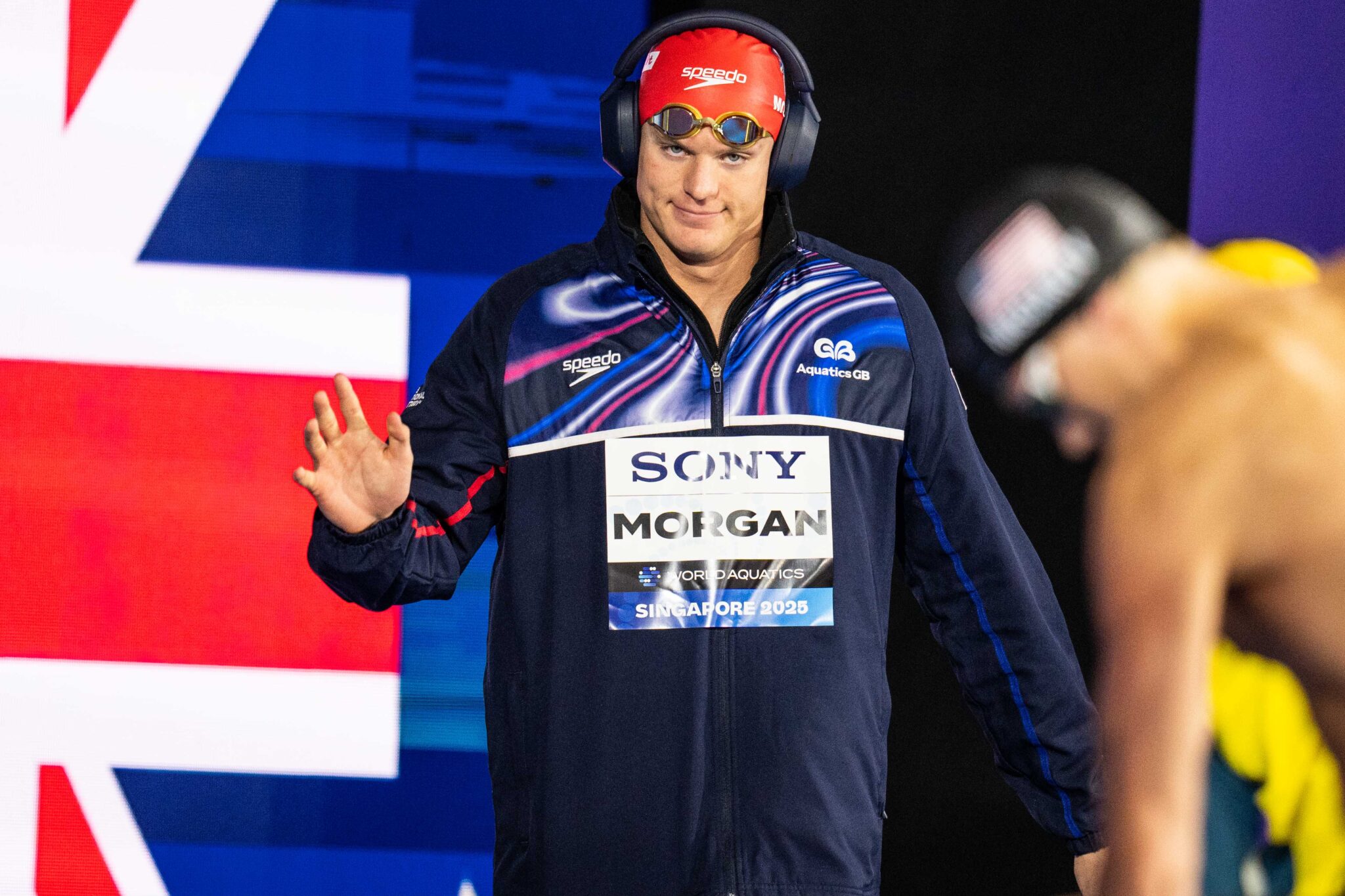
Oliver Morgan (photo: Jack Spitser)
Morgan has been 52.41 so far this season but has a best of 52.12, while Peaty split 58.16 at the Paris Olympics and was 58.97 at the Aquatics GB Championships in April. The fly leg is the weakest relative to the field, with England’s fastest female flyer so far this season (Betsy Wizard) left at home, but with Emily Large this team should still be strong enough to beat out the rest of the home nations for a medal.
Eva Okaro won the 100 free at the Aquatics GB championships in 53.75, but split 53-mid at the Paris Olympics two years ago and is coming off a strong freshman season in the NCAA with Texas. They are also the only non-Australian team who has alternative options that don’t tank their chances, which could prove decisive if anyone is off form.
The Challengers
There are however a trio of nations they should be very worried about if they plan to be on the podium. Canada has a small team of just 12 swimmers, but they line up to make a near full-strength mixed medley relay with Kylie Masse, Oliver Dawson, and Josh Liendo in attendance. They may struggle on the anchor leg, with Ella Jansen or Delia Lloyd likely to feature there and neither having broken 55 seconds in their career. Expect them to be well in the fight for a medal heading into the final leg, but it to be a close-run thing at the touch.
The second nation is South Africa. They will likely match England’s M-M-F-F lineup, and have clear advantages on both backstroke and butterfly. Pieter Coetze is the top 100 backstroker in the world this season with the 52.40 he clocked at the South African Championships in April, and won the world title last year in a time of 51.85. He has an additional four swims under 52.30 over the last 12 months, and while he will be up against another elite swimmer in Morgan it should be the South Africans in the lead at the first touch.
Chris Smith is the most likely leg on breaststroke, but will struggle against Peaty. If he can take it out fast and hang on, which given his prowess in the 50 looks to be the best way for him to swim the 100, he could give Erin Gallagher a chance on fly. She owns the African record in the 100 fly at 57.32, and has already been 57.36 this season. Importantly, that is over a second faster than England’s Emily Richards has been this year.
That probably leaves it down to a battle on the anchor leg. Aimee Canny is a fine swimmer, but is more suited to the 200 than the 100, so it may be NC State’s Olivia Nel in action. She split 53-point at the World University Games last summer, and could push Texas’ Eva Okaro all the way.
Finally, the hosts can put together a strong team of Matt Ward, Angharad Evans, Keanna Macinnes, and Duncan Scott. They are probably the only team among the medal contenders to go with a female breaststroker, but Evans has been so good this season that it would be a mistake to leave her off. She set a new British record of 1:04.96 in April, and split 1:04.41 on a mixed medley relay at Scottish Nationals in June. Realistically, that is around four seconds slower than you would expect Archie Goodburn to swim, making her selection a no-brainer.
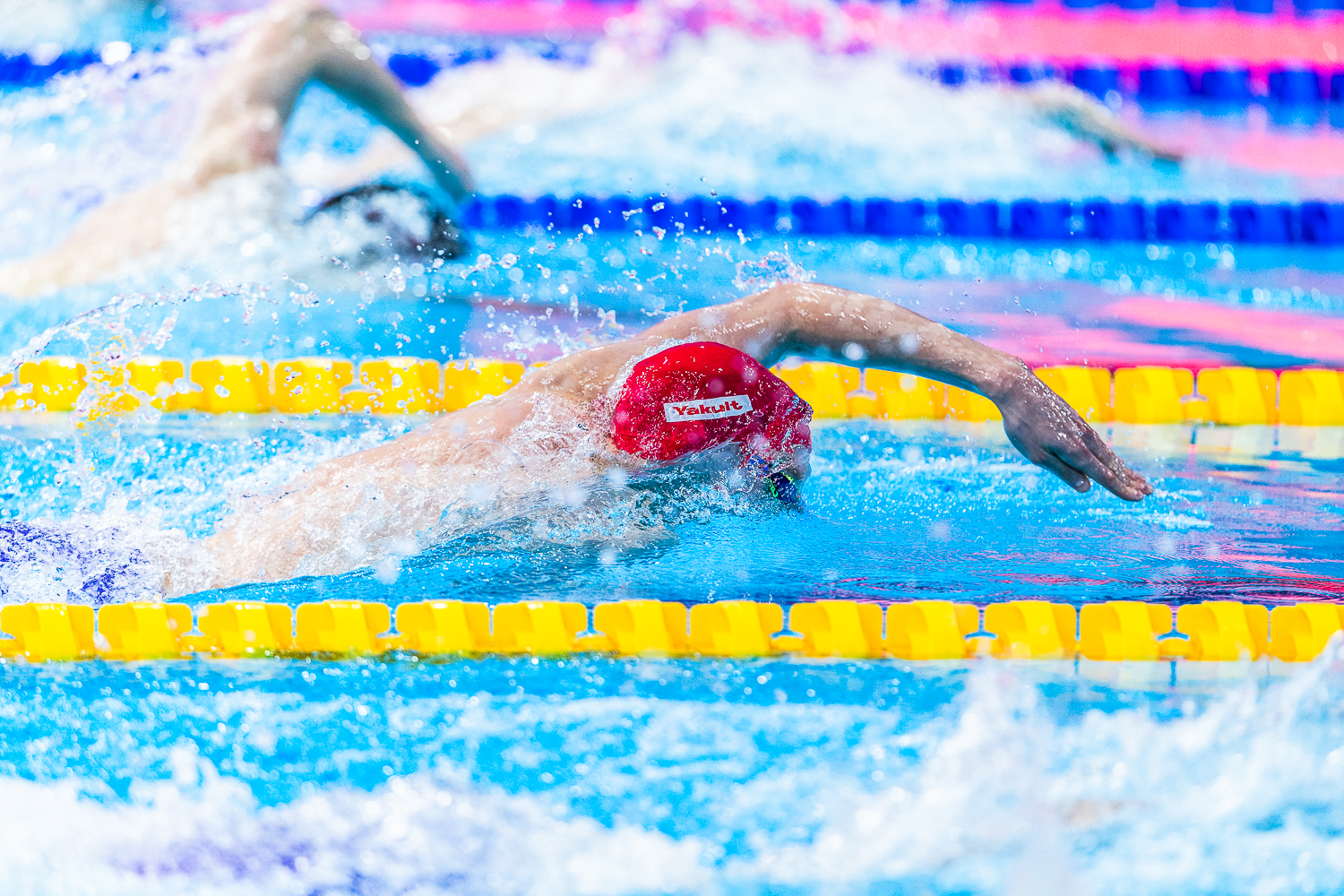
Duncan Scott credit: Mickaël Malaper
Malaper Photography
The rest of the quartet falls into place after Evans. Macinnes is inching her way towards the British record in the 100 fly and has a best of 57.57, while Ward set a Scottish record of 53.29 in the 100 back this April. Rounding them off, Scott is one of the most consistent relay swimmers in the world, and if all four of this quartet can swim at their best then a time in the 3:43s – good enough for silver four years ago – looks like a real possibility.
Wales have Medi Harris back in the fold, and could return three of the four legs from four years ago in Harris, Kyle Booth, and Matt Richards. However, they may swap out Richards for Theodora Taylor and move Lewis Fraser onto the fly leg, which figures to be the fastest combination this year.
SwimSwam’s Picks
| Place | Nation | 2022 Commonwealth Games Finish |
| 1 | Australia | 1st |
| 2 | England | 3rd |
| 3 | Canada | 2nd |
| 4 | South Africa | 4th |
| 5 | Scotland | 6th |
| 6 | Wales | 5th |
| 7 | Jersey | 7th |
| 8 | Guernsey | 8th |

I feel like one of the biggest upsets for relays might be Canny. (Not upsetting gold but she might help SA get some more medals) I know you mention she is suited better for the 200 and while that is definitely true in scy she seems to just be better in lcm. If you look at her best time in the 100 it is from leading off a relay at nationals where she really wasn’t racing for anything really significant. She clearly wasn’t at her best at nationals as seen in the Indy pro series going faster in all her events. (Probably due to the proximity to NCAAs). If you look at her splits in the 100 they are 25.7… Read more »