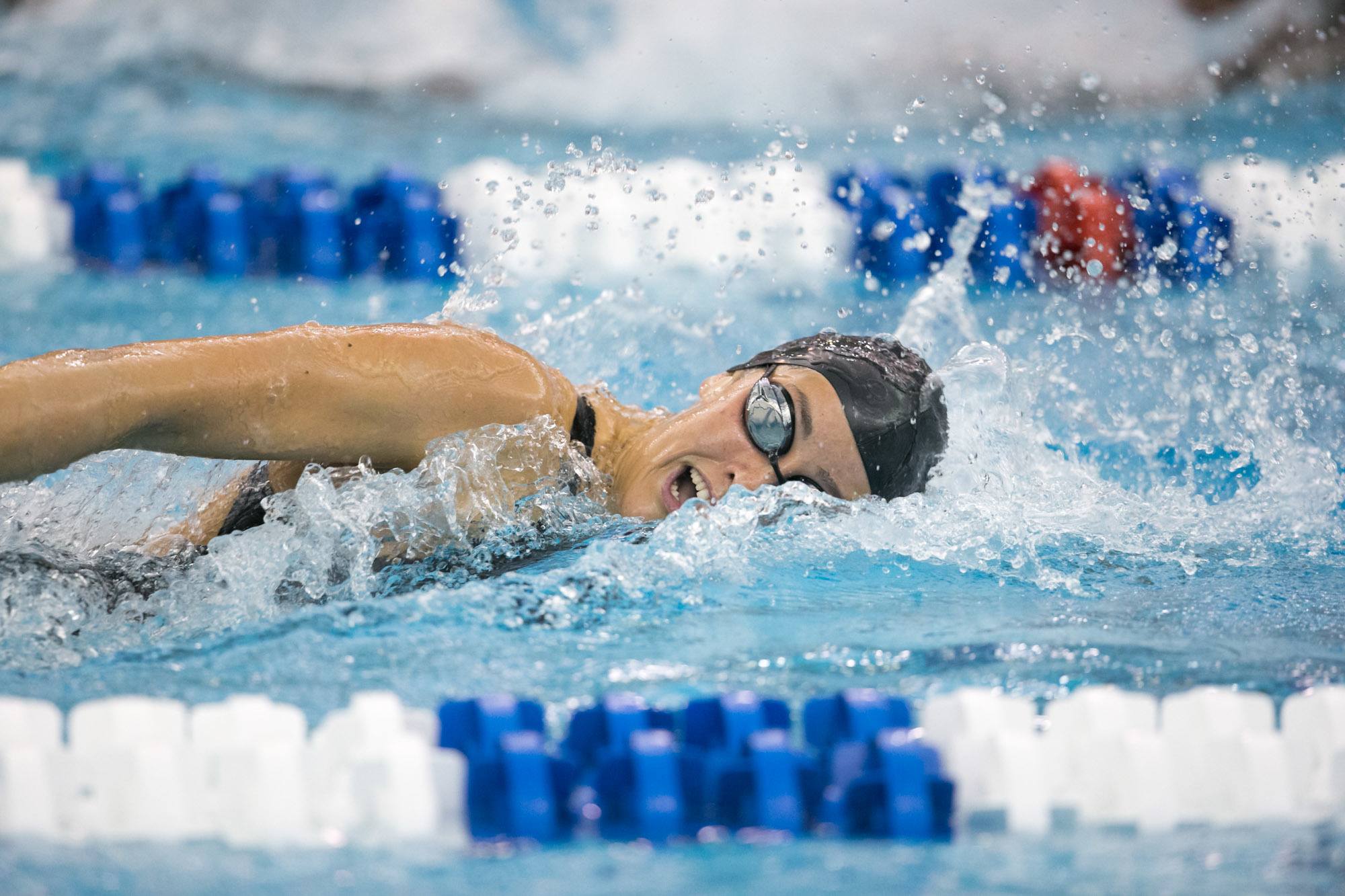
Swimmers spend a lot of time going up and down the pool, counting laps (and losing count), turning at the wall, trying to see pace the clock, and breathing that sweet, sweet chlorinated air.
Along the way, things change—intervals, volume, intensity, conditioning, and yes, even your stroke.
The swimming we do changes our stroke in ways that are subtle but consequential, and in ways that are specific to the type of training we are doing.
So, curious what a steady diet of aerobic training does to your stroke?
Let’s take a lookie loo.
What Happens to Freestyle Technique from Sustained Aerobic Training
A study by Schnitzler et al. (2014) looked at this question with a group of nine national-level French swimmers. Our test swimmers did a 3-month block of training that was heavily aerobic, with >90% of total training volume in low to moderate intensity zones.
Before and after this chunk of training, swimmers did a 400 freestyle for time. Researchers also tracked and logged stroke kinematics like stroke rate, stroke length and stroke coordination.
After the aerobic block, swimmers:
Improved 400 free time trial performance – Swimmers went ~3% faster. Perhaps not too much of a surprise, given that the 400 free is 80-85% reliant on the aerobic system (Kalva-Filho et al., 2015), but it’s a reminder that training relevant energy systems can reap real dividends in performance.
Stroke length increased – Swimmers got more distance with each stroke: 2.12m > 2.20m. Doesn’t sound like much, but the more efficient pull can add up quickly over 400m and up swims.
Stroke rate remained the same – Swimmers kept their old stroke rate but combined it with the new-and-improved stroke length for increased speeds.
Stroke coordination changed, too – Longer strokes also changed how swimmers timed their arms. Their technique veered further into catch-up mode, where one arm begins pulling slightly later, creating a longer glide between strokes. In smarty-pants terms, the Index of Coordination became more negative (-9.6% > -13.8%). This is not a bad thing, as it reflects a more efficient way to swim at aerobic speeds.
For swimmers in the mid-distance and distance lanes, this is generally a bouquet of good news.
More efficiency, longer strokes, and more proverbial horsies in the aerobic engine.
For the sprinters, the story changes.
Training the Right Stroke for Competition
All those miles can build a bigger aerobic engine and better feel for the water, but pulls your stroke away from “sprint technique.”
After all, for sprinters their stroke should revolve around things such as:
- High stroke rates
- Continuous stroke coordination (no catch-up)
- Very short glide
- Reduced hip roll
- Straighter hand path during the pull
And so on.
Cam McEvoy’s recent shift to a super low yardage training program highlights the differences in stroke kinematics at intensity.
In his interview with Mel, McEvoy explains that cutting back on easy/regular freestyle swimming in practice was centered on preserving the feel and form of his race technique:
“You don’t develop technique at speeds away from that [race speed],” said McEvoy. “So if I’m easy swimming, that’s not going to help me keep my race technique and it’s also actually going to take me further away from it.”
The Bottom Line
Before the keyboards get firing and start clacking in the comments section with all the usual debate points about the longstanding case of aerobic v. non-aerobic training, let’s be clear that this isn’t a debate against aerobic training for sprinters.
(“Look coach, this guy on the swim internet said aerobic sets are certified sucky!”)
The point is to highlight the fact that different types of training generate different types of technique and results. Being aware of these differences can help you plan and balance your training accordingly.
Ultimately, whatever your event choice is, keep in mind that the stroke and meters you are doing in practice is building your race day performance.
Not just the energy systems, but also your stroke mechanics.
Train accordingly, and happy swimming!
ABOUT OLIVIER POIRIER-LEROY
 Olivier Poirier-Leroy is a former national level swimmer, 2x Olympic Trials qualifier, and author of several books for swimmers, including YourSwimBook, Conquer the Pool, The Dolphin Kick Manual, and most recently, The 50 Freestyle Blueprint.
The book is a beastly 220+ pages of evidence-based insights and practical tips for improving freestyle sprint speed.
It details everything from how to master stroke rate, the specifics of sprint technique, how to build a thundering freestyle kick, improve your start and underwaters, and much more.
The 50 Freestyle Blueprint also includes 20 sprint sets to get you started and a bonus guide on how to master the 100 freestyle to complete your sprint preparation toolkit.
👉 Learn more about The 50 Freestyle Guide today.

Being a Swim coach in the 70s would’ve been way better. Didnt have to put up with these 50 bandits. Honestly what’s the point, things are bad enough as they are already
Water is wet ahh article
>“ Before the keyboards get firing and start clacking in the comments section”
Bro thought this article would have caused some major discussions 😭 We know that race pace training is important and swimmers should prepare for the event they are going to compete in. Thanks for reminding us 🤝🏻
“Bro thought this article would have caused some discussions.”
– buddy discussing bro’s article in the comments
Is there any follow up research on how aerobic training affects non free performance/technique?
The longest non-free event is 200m (or 400, if doing IM).
Olivier,
The data from the Schnitzler (2014) study is a valuable reminder of the principle of specificity: that high-volume aerobic work develops an efficient, high-DPS, “catch-up” style stroke.
This is a useful and well-supported point. However, the article creates a dangerous and misleading narrative by juxtaposing this data with Cam McEvoy’s low-volume, high-intensity model. While your conclusion rightly calls for “balance,” the implication left for many coaches and athletes is that these two models are equally viable philosophies for development, when in fact they are not.
The piece fails to make the single most important distinction in all of athletic development: the difference between building an athlete and peaking one.
Your article highlights what I call the “Finished Product Fallacy.”… Read more »
🙌 mint explanation 👏👏👏.
I disagree with everything in here. Just wanted to get that out. Swimming does way too much high volume training. And coaches over emphasize the value to volume and the aerobic engine. We swim mostly 2 min or less events. They are mostly anaerobic events. Swimming suffers from another more important fallacy that doesn’t get discussed enough: Survivor Bias. Ok I await comments
It’s a well thought out answer, but isnt the only answer. Fast twitch aerobic athletes could follow the combination path you talk about, but fast twitch glycolitic athlete will struggle with it. Coaches must evaluate every athlete on a physiological and psychological level before arbitrarily starting down the foundational path you suggest. Suggesting that all athletes’ should follow a foundational path before they can begin to polish is misleading. There are many different ways to develop propelling efficiency without endurance based training and suggest that coaches employ those methods with athletes who don’t fit the profile.
@Mali4944,
Thank you for the thoughtful and nuanced reply. You are absolutely correct that athlete typology (fast-twitch glycolitic vs. aerobic) is a critical factor in high-level program design and that coaches must evaluate athletes individually. Your point is well-taken.
However, I believe you may be misinterpreting the core of our argument, which is not about specialization but about foundational development.
You mentioned that “fast twitch glycolitic athletes will struggle” with a foundational path, but this seems to confuse the goal with the tool. The foundational path isn’t designed to turn them into endurance swimmers; it’s designed to build the “engine” that allows them to be successful sprinters.
Our core premise, which we stand by, is this: Even the most “fast-twitch… Read more »
I believe CAM would disagree with you. I think it was in the recent interview he did with Mel that he said he would train along his current lines if he were to start his swimming career again.
@Craig,
You’re bringing up what McEvoy has said about his own training, but let’s analyze the logic of that statement, because it highlights a profound misunderstanding of his own success.
Let’s look at the two inescapable facts:
The entire “what if I had just done sprint work” idea is a hypothesis with zero evidence. It’s an athlete in his 30s, who is a “finished product,” retroactively questioning the very foundation he was built on.
This is a complete logical fallacy. As coaches, we have to look at the… Read more »
I’d love to see Cam’s response to your points.
What technique coaching were they getting during the 10% high intensity swimming?