Big West Conference – Men and Women
- Dates: Wednesday, February 11–Saturday, February 14
- Location: CRWC Natatorium, Houston, TX
- Defending Champions: UC Santa Barbara women (1x); UC Santa Barbara men (1x)
- Live Results
- Schedule of Events (PDF)
- Championship Central
- SwimSwam Fan Guide
- Teams: Cal State Bakersfield, Grand Canyon (men)*, Hawaii, San Diego(women)*, Seattle*, UC Davis (women), UC San Diego, UC Santa Barbara
- Night One Results
The Big West Championships kicked off last night, and the women’s standings look very different than we thought they would after two events. The UCSB women are in the lead with 70 points, sitting just four points ahead of UC Davis in 2nd with 66.
On the men’s side, Hawaii is in 1st after winning all three events on the first day of competition.
Scores After Day 1
Women’s
- UCSB — 70
- UC Davis — 66
- USD — 54
- CSUB — 54
- UCSD — 40
- Hawaii — 34
Men’s
- Hawaii — 125
- Grand Canyon — 118
- CSUB — 84
- UCSD — 64
- UCSB — 62
- Seattle U — 54
Women’s Recap
There were no women’s diving events on Wednesday, so the only events were the 200 medley relay and the 800 free relay.
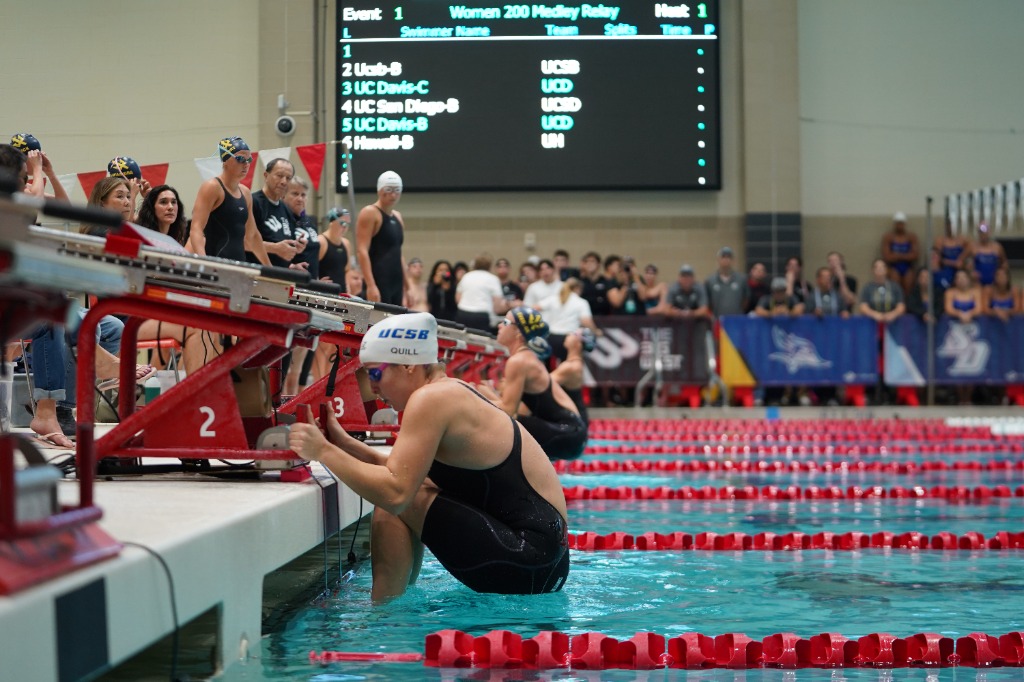
The 200 medley started off with a bang after the top three teams all swam under the previous meet record in the event of 1:37.71 set by UCSD last year.
The Hawaii ‘A’ relay had the fastest time at 1:37.04 with Aziza Meyer on backstroke (25.22), Zofia Tyminksa on breaststroke (27.41), Holly Nelson on butterfly (22.66), and Quincy Key on freestyle (21.75).
UCSD touched in 1:37.30 with their team of Maddie O’Connell (24.97), Chloe Braun (26.69), Eva Boehlke (23.16), and Dani Carter (22.48).
After the race, Hawaii and UCSD were both disqualified for false starts, which led to the 3rd finishing team UCSB earning the title and the meet record. They touched in 1:37.69 with their team of Hazel Derr (24.93), Ashley Ray (27.10), Makena Leacox (23.79), and Miranda Stevenson (21.87). They came in more than two seconds ahead of UC Davis’s 2nd place team, who touched in 1:39.96.
The women’s 800 freestyle relay saw UCSD and Hawaii bounce back to earn the top two spots.
UCSD broke the meet record with their 7:11.42 coming in two tenths faster than the 7:11.65 they swam at this meet last year.
Asia Kozan led off in 1:45.20. This was a massive season best time for her, and will put her under the NCAA qualifying time of 1:45.53. If she replicates this performance en route to the conference title on Friday, she will earn an NCAA qualification in the event.
Kozan was followed by Sydney Niles (1:48.00), Sophia Bell (1:48.80), and Edana Huang (1:49.42).
Hawaii finished 2nd with their team of Brooke Bennett (1:48.08), Gaby Kelly (1:49.67), Mia Blazevska Eminova (1:49.26), and Rebekka Luoto (1:50.19)
UCSB finished 4th in 7:18.35 to lock up the top spot in the overall leaderboard.
Men’s Recap
Hawaii kicked the meet off with the top time in the men’s 200 medley relay. They touched in 1:24.48 to come in a little more than half-a-second ahead of Grand Canyon’s 1:25.16 in 2nd.
Karol Ostrowski swam 21.04 on the backstroke leg. Tom Caps was 23.71 on the breaststroke. Jack Simon swam 20.75 on the fly, and Finn Brophy was 18.98 on the freestyle.
The Grand Canyon men’s team of Alex Volkov (21.36), Carter Dooling (24.03), Mario Perez (20.71), and Guillermo Carrey (19.06) finished half-a-second ahead of UCSD’s 1:25.64 for 3rd.
In between the two relays, the men had their 1-Meter diving finals. Hawaii junior Tamayo Ramirez came out on top by just two points over Grand Canyon sophomore Omar Elsayed, who finished 2nd in 358.65. After Elsayed, there was a 60 point gap before Hawaii’s Olly Wignall, who finished 3rd with his score of 294.55.
The final event of the meet saw Hawaii pick up their 3rd gold medal. Adam Zdybel (1:37.42), Regan Richardson (1:38.43), Victor Dagenais (1:34.53), and Tom Thalau (1:33.25) swam 6:23.63.
They won by almost five seconds over the 2nd place UCSB team of Elek Zettle (1:35.86), Lucas Hubbard (1:38.47), Mason Wendler (1:37.61), and Owen Barry (1:36.41) who swam 6:28.35.

Is anyone familiar with the early start recognition technology they use? How accurate it is? Are there allowable deviations? From the 200 IM women relay finals PDF file, there seems each DQed team has a one participant with a negative r: value. I assume it points to whom started earlier. I see r:-0.20; r:-0.02, and r:-0.01. In case of human official, 0.02 and 0.01 of a second early start would not be noticed. Even if it was a doubt, the benefit would go to the team. I understand how the finish part works. My question is about the start sensing part. I assume they use piezoelectric types and react on the force change. That’s maybe why the No Flinch on… Read more »
I understand that the very last change of force should count for the rolling start to account for two steps. However the final launching effort is a long one and the most force applied somewhere on the middle. There is a time when a swimmer’s mass has left the block, but their thumb is still touching it. This time might be well on the 0.01-0.02 of a second range, right?
I assume nobody made the auto qualifying times as conference champs?
Why is this in Houston? It is Big but not West
There is a severe shortage of available facilities than can host the meet. We have a lack of facilities than can handle major meets to begin with, but when you figure in diving, the list shrinks significantly. Not many facilities have a ten meter platform. You’re also looking for indoor, which isn’t a thing in California. Once you shrink the list down to indoor facilities with a ten meter platform, you have to look for ones that aren’t being used by their school for either their own conference meet or not wanting to give it and compromise practice schedule before conference. Once you narrow that list down, you’re looking for a facility that will rent to you. Not a lot… Read more »
I’m surprised they aren’t looking at KCAC in Seattle. It makes more sense and there’s nothing lined up there right now.
I think they only do a couple of meets like this a year. It takes a lot to host, especially if you aren’t part of the conference. There was a scramble to get into there a couple of years ago for the open slot(s) they had. I think Big 12 got it, but I could be wrong. There aren’t a lot of places that’ll do them back to back (to back). But you’re right, that would be an appropriate facility.
I don’t know if it would be worth it considering you can fill an outdoor pool with programs year round in California, but if anyone ever built an indoor pool with ten meter tower there, they could get a bunch of events.
wow 32.71 split on winning team that’s crazy