It’s been 41 years since the Olympics last came to Los Angeles, and nothing has been the same since for the sporting phenomenon.
With only three years to go until the Olympic flame is back in the City of Angels for the third time, let’s take a look back at how LA 1984 changed the Games forever.
A Dying Spectacle
In the run-up to the 1984 Olympics, many people were starting to question if the Games were dying.
The Munich Olympics in 1972 were forever marked by a dark cloud following the terrorist attack that killed 11 Israeli athletes and coaches. The 1976 Games were tainted by a massive financial toll, which left host city Montreal over $1 billion in debt. And the 1980 Games in Moscow saw 65 countries, including the United States, boycott the Olympics to protest the Soviet Union’s invasion of Afghanistan.
When it came down to selecting the host city for the 1984 Olympics, the usual clamor to bid for the honor was missing, leaving it down to just two cities: Los Angeles and Tehran. The Iranian city’s bid was withdrawn in 1979 due to civil unrest, giving Los Angeles the right to host the Games by default.
With the spirit of the Olympic Games now tainted by the turmoil surrounding the last few iterations, people were starting to wonder if the Games as they knew them would cease to exist after the 23rd Summer Olympics in Los Angeles.
They were partially right: the Olympics would never be the same after the LA84 Games.
Changing the Game
The athletes may be the stars of the show, but it was Peter Ueberroth, the chairman of the Los Angeles Olympic Organizing Committee, who transformed the Games behind the scenes.
Ueberroth and his team devised a new financial model to fund the Olympics without the help of the government and revolutionized the way the sporting event intersected with technology, media and commerce in the process.
One of the first things to change under the new model was how television rights were sold for the Games. In 1976, ABC had paid $25 million to broadcast the Montreal Olympics; after staging a bidding war between several of the top American networks, the LAOOC got ABC to agree to pay $325 million total to broadcast the Los Angeles Olympics in the United States and manage television production for the world.
When it came to marketing, LA84 was the first Olympics to have major corporations act as exclusive sponsors for the event. Ueberroth and marketing director Joel Rubenstein set a minimum bid of $4 million, and Coca-Cola and Budweiser became the official soft drink and beer companies of the Games, followed by McDonald’s.
These corporate sponsors proved to be hugely beneficial with the introduction of naming-rights deals; the construction of the outdoor swimming arena was funded by a grant from the McDonald’s Olympic Trust, while 7-Eleven provided the funds needed to build the velodrome in exchange for both companies putting their names on the facilities.
In a far cry from the financial debt crisis caused by the 1976 Olympics in Montreal, this new commercialization of the Olympic Games not only covered the costs of the event but created a $233 million profit.
The Faces of History
Breaking down barriers in more than just the financial realm, the 1984 Olympics marked a significant milestone for female athletes.
For decades, the Olympics had featured far fewer events for women than it had for men, contributing to significantly lower numbers of female athletes being able to compete even after the passage of Title IX in 1972. The Los Angeles Games showcased women athletes more than any other Olympics before it, with 23.1% of competitors being women.
Los Angeles also introduced new women’s events, including a 3,000-meter run and a marathon, putting their athletic abilities on display like never before, with several female athletes becoming some of the most recognizable faces from these Games.
Team USA’s Joan Benoit won the women’s marathon in 2:24.52, faster than 13 of the 20 men’s Olympic champions up to that point. Mary Lou Retton became the first American woman gymnast to win gold in the all-around, and Nawal El Moutawakel became the first Olympic champion from Morocco, man or woman, after winning the 400-meter hurdles.
These athletes became some of the most recognizable faces associated with the Los Angeles Games and set a new precedent for women’s sports in the Olympics. The percentage of female athletes has risen at every Games since 1984; in Paris last summer, that number reached 49%.
From Amateurs to Professionals
LA 1984 marked the first time the sports community saw a big shift towards professionalism in the Olympic Games. Since the inception of the modern Olympics in 1896, only amateur athletes had been permitted to compete. In 1984, FIFA allowed professional athletes to play in the soccer competition, provided they had no prior World Cup experience, paving the way for a new class of athletes to make a name for themselves in the Olympic arena.
In the following Olympic cycle, professional athletes were formally welcomed into the Games after a 1986 decision by the International Olympic Committee to let individual sports federations decide whether or not to allow professionals.
Another four years later, the American basketball “dream team”, featuring the likes of Michael Jordan, Larry Bird, Charles Barkley and Magic Johnson, won gold over Croatia at the Barcelona Games. Today, the only sport that does not allow professionals to compete in the Olympics is amateur wrestling.
A Lasting Impact: The LA84 Foundation
The Los Angeles Games were a runaway success. Ticket sales hit a record high of 5,797,823, and over 180 million Americans tuned in on TV, making the 1984 Olympics the most-watched event in television history at the time.
The transformation of the Olympics from its dying state of a few years earlier to a commercial enterprise helped bring in a profit of around $233 million. Ueberroth, the man behind the curtain, was awarded a $475,000 bonus, which he donated to charity.
The profits from the Games were reinvested back into the Los Angeles community through the creation of the LA84 Foundation. After giving 60% of the 1984 Games’ surplus to the U.S. Olympic Committee, the nonprofit used the remaining money to fund and expand youth sports programs in Southern California.
Some of the LA84 Foundation’s projects included funding a series of after-school football teams in Compton and supporting a program called National Junior Tennis and Learning, which aimed to introduce the sport to kids from lower-income neighborhoods.
The LA84 Foundation is still active today; between 1984 and 2017, the organization reached over three million young people with an emphasis on female participation in sports.
44 Years Later
The city of Los Angeles has already begun preparations for LA 2028, building on the legacy left behind by the 1984 Olympics.
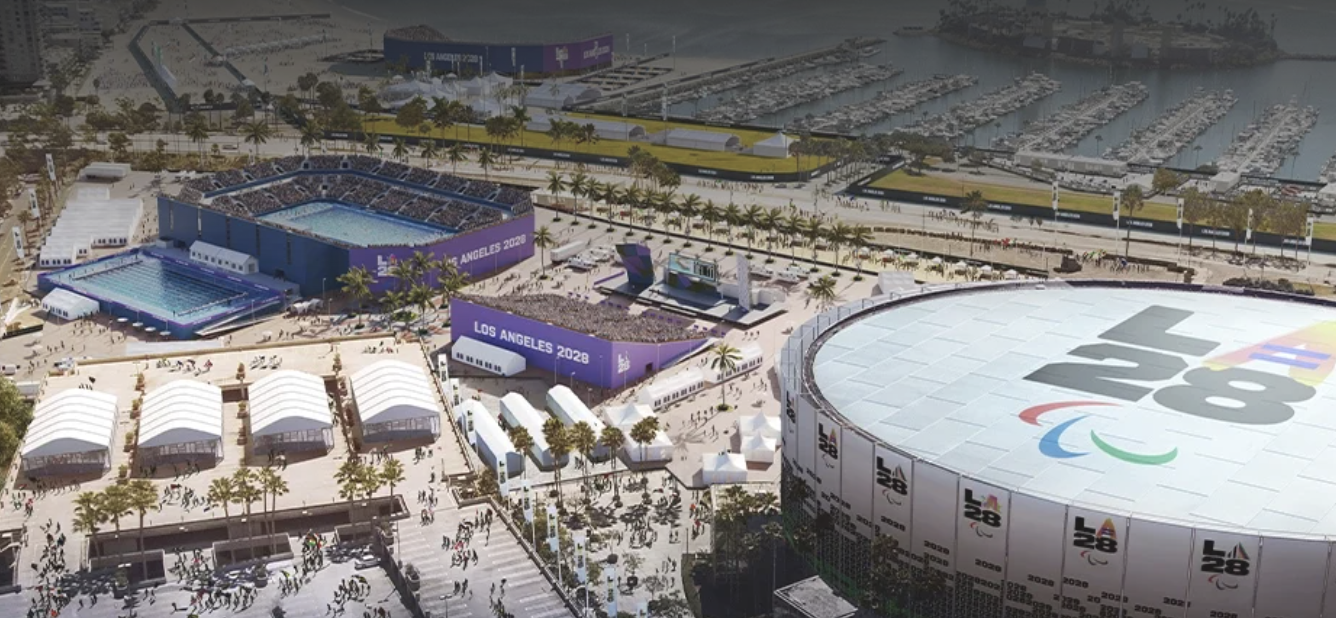
With 21 of the venues from the last Los Angeles Games still intact and in use today, LA28 is set to host the Olympics without building any permanent venues. Some of the sports venues have already been announced, with swimming set to take place in a temporary pool at SoFi Stadium. The stadium is expected to have a capacity of 38,000 spectators around the 50-meter pool, making it the biggest Olympic swimming venue in history.
The LA28 venues are set to make history in more ways than one, as it was announced that the 2028 Games will be the first to have naming rights attached to Olympic venues.
Five new sports will be added to the Olympic program in 2028: baseball/softball (which are new from 2024 but not new to the Olympics), flag football, cricket, squash and lacrosse. According to the IOC, these sports were chosen to help showcase iconic American sports and to bring international sports to the U.S.
On top of preparing for the Games themselves, LA28 is continuing the work started by the LA84 Foundation. The IOC and LA28 Organizing Committee are funding the PlayLA program to support accessible and affordable high-quality sports activities for kids of all backgrounds, abilities and ages. Since 2018, the program has helped more than 500,000 young people.

The only countries that will compete are the USA, Russia, North Korea, Belarus, and other countries in Trump’s orbit. Just like 1984, enjoy stroking yourselves.
The history here included the boycott of Moscow in 1980, but ignored the boycott of 19 countries of Los Angeles in 1984, led by the Soviet Union. Mary Lou Retton may never have become a household name had the top gymnasts from the Soviet Union competed.
I googled the 1984 Olympic pool and it was at USC. The seating seems smaller than today’s standards, maybe that can be an extra warmup pool before the games.
Odd stock photo with swimming venue in the parking lot of The Forum
That is the para swimming venue.
Maybe I missed it, but no T-word?