2025 World Championships
- July 27 – August 3, 2025 (pool swimming)
- Singapore, Singapore
- World Aquatics Championships Arena
- LCM (50m)
- Meet Central
- How To Watch
- SwimSwam Preview Index
- Entry Book
- Live Results
- Live Recaps
The U.S. Miss The Forest For The Trees In Their Search For A Backstroker
Keaton Jones has a best of 53.87, but there is no world in which using him was the best option for the U.S. in the heats. He was slightly over that time anyway, touching in 54.20, and the U.S. never made it back to the front of the field.
Regan Smith may have had four individual swims already on day four, thanks to heats and semis of the 50 back and 200 fly, but Katharine Berkoff (50 back heats and semis) and Claire Curzan (no events) could have realistically delivered a 59-low at worst, just five seconds slower than Jones.
Slotting a male fly swimmer in or one of Jack Alexy or Patrick Sammon on the anchor would have given back more time than that. The U.S. prioritised finding a men’s backstroker in the heats: due to that, they didn’t have the buffer to respond when they needed to later in the race.
This should have been a simple decision – go against the meta and lead off with one of their elite female backstrokers. Not doing so left them at the mercy of a deep field which is catching up with them, and left them looking on as an final in which they were favored for at least a podium place took place without them.
M-M-F-F Is Still The Meta For The Fastest Swims
Six of the teams in the final led off with a man on backstroke, and seven put a male swimmer on breaststroke. All eight had a woman on the anchor leg.
Rarely have we seen one of the top teams use a female swimmer on the breaststroke leg – Lilly King for the U.S. in 2017 and 2019, and Lydia Jacoby for the Americans in 2021, Dominika Sztandera for Poland in 2024 (Worlds) and 2025, and Reona Aoki (Japan) and Anna Elendt (Germany) in 2022 are the female finals legs – or a male swimmer on freestyle. Those two legs are almost uniform among all teams, leaving fly and backstroke as the legs where a choice needs to be made.
The majority of the time, that choice ends up being to go male on backstroke, female on fly. Nearly two-thirds of all finalists in this event who have had the choice (39/60) have gone with a male leadoff leg.
Of the teams that have stood on the podium, 10 out of 28 have gone with a female leadoff and a male fly leg. However, all ten are teams from Australia, who have had Kaylee McKeown and no male backstroker, Great Britain, who did not have a male backstroker or female flyer at the time which made this choice a fairly simple one, and the Netherlands, who used National Record holder Kira Toussaint to lead off.
China this year had the option of going Peng Xuwei on back and swapping out Wu Qingfeng for Pan Zhanle on free, which would actually have been 0.33 seconds faster based on each athlete’s best time at the meet so far by this point. They did not do so, sticking with Xu Jiayu on backstroke despite his reasonably poor form in Singapore.
Avoiding being caught in the wash is worth a lot on this relay. Male backstrokers look like being almost every top nation’s first choice for the foreseeable future.
Canada Step Up Big Time
Canada was not one of the names on everyone’s lips when predicting the podium for this relay – we had them in 7th – but thanks to a scintillating fly leg from Josh Liendo and solid splits across the board elsewhere, managed to hang on down the final 50 against the fast-finishing Dutch and Australian teams.
Liendo was 49.64 to take the Canadians from 7th to 4th on the fly leg, the 8th-fastest split in history. They have an embarrassment of riches on the fly right now. There are only five men in history to have split under 50 seconds, and two of those are current Canadian swimmers at the peak of their powers – Josh Liendo and Ilya Kharun.
Oliver Dawson was more than a second faster than his flat start best on breaststroke as he split 59.63, and Taylor Ruck showed flashes of her previous form with a 52.94 anchor – a second and a half under her season best of 54.41.
While Kylie Masse was a little off the 58.45 she went individually, she did well to go 58.69 in a race essentially on her own over in lane 2 as one of only two female leadoffs in the field.
Their time of 3:40.90 was a new national record, beating out the mark from 2017. This is probably not a medal you’d expect Canada to defend, but all four legs showed up when it counted to get on the podium in the first place.
A Missed Opportunity For Italy?
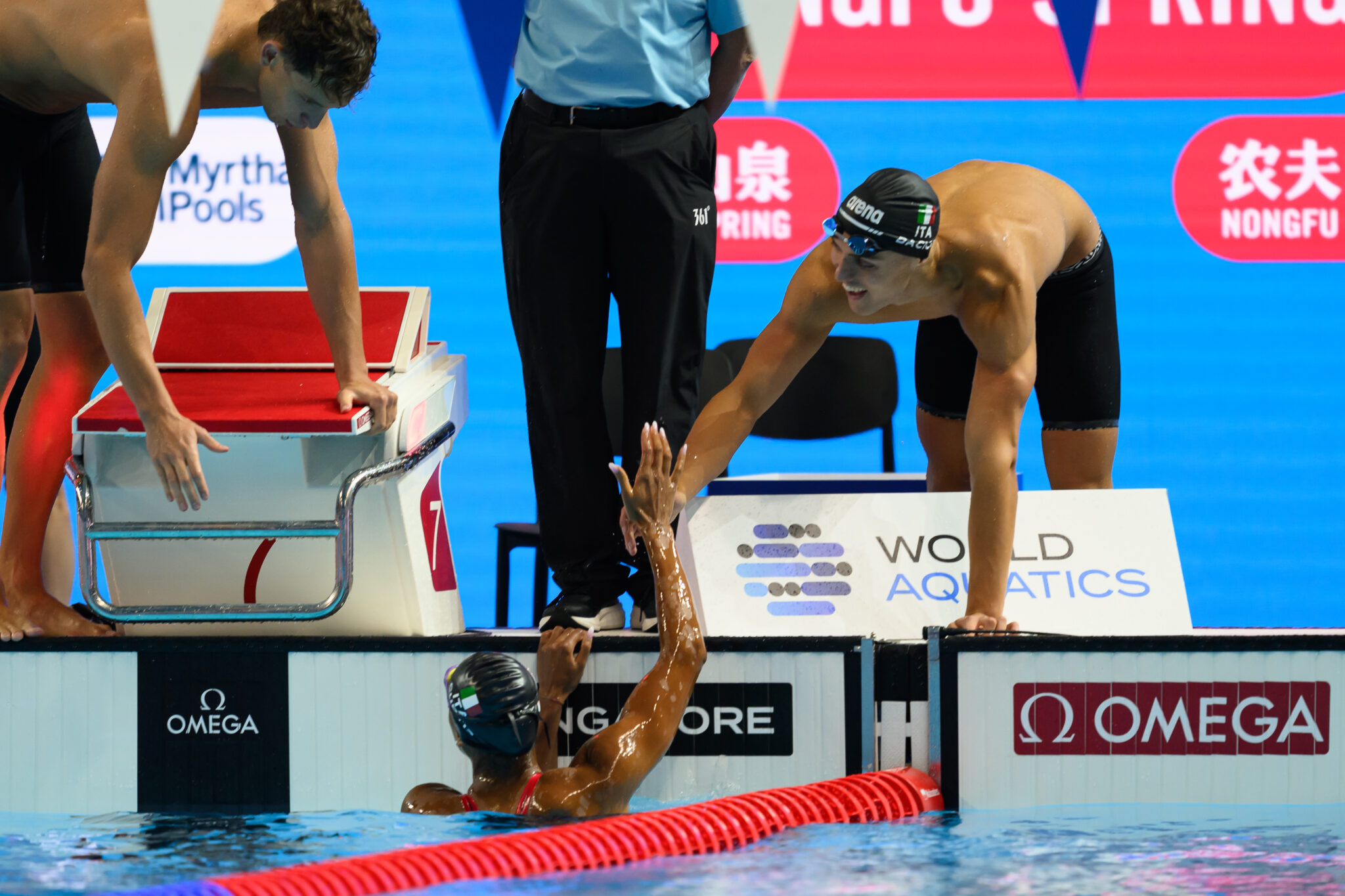
Italy finished 6th in this final, matching to the hundredth the 3:42.19 they went in the heats.
There were reasonable hopes of a first ever medal in this event after that morning swim, but leaving Thomas Ceccon off the finals team seemed a strange decision for a team angling for the podium.
Christian Bacico was strong on backstroke, clocking 52.78, which was his third sub-53 second swim after coming into Singapore with a best of 53.42. However, Ceccon ended up breaking 52 seconds twice in Singapore and would have been good for at least another half a second. With some stronger performances in the second half of the race as well, they could well have taken bronze.
Constanza Cocconcelli was slower than her morning swim and her flat start best on fly, slower too than Viola Scotto di Carlo (57.58) went at the World University Games, while Sara Curtis was half a second off her best split on free.
In the end they were over a second behind the three way fight for the final step in the podium. A single bronze medal may not have caused too much movement in the final medal table, but would have doubled Italy’s relay medal count for the meet. Those things matter.
The Fastest Front Half In History
NAB had a 51.78 backstroke leg from Mirin Lifintsev, unofficially the 2nd-fastest swim in history, and one of the quickest non-Peaty breaststroke legs ever from Kirill Prigoa in 57.56. Together, they gave NAB the fastest first half of a medley relay in history.
The previous mark had been set by Italy in 2022, where Thomas Ceccon (51.93) and Nicola Martinenghi (57.47) combined to go 1:49.40. Lifintsev and Prigoda were six hundredths of a second faster in 1:49.34.
That gave them a phenomenal platform to build off, as NAB posted the 4th-fastest time in history in this event with their winning time of 3:37.97. Interestingly, all four of those have come from different teams: The U.S., China, Great Britain and NAB.
Lifintsev stepped up after a slightly disappointing individual 100 where he finished 7th to set a new best, but it was Kirill Prigoda who was the biggest part of this achievement – splitting four-tenths faster than his previous best split of 57.94 and a full second under his flat start time of 58.53. He stepped up in a big way on relays this year, and nowhere more so than here.
The Dutch Are Caught In Two Minds
Nyls Korstanje split 50.27 in the heats of this relay last summer, but did not break 51 at all in Singapore, whether individually or on the relay. After coming in with a season best of 50.84, that was a little disappointing from the former NC State swimmer.
That made the choices on this relay a little more complicated than they had seemed, despite Caspar Corbeau and Marrit Steenbergen being near-certainties on breaststroke breast and free respectively. Korstanje was no longer a lock, especially with Tessa Giele’s form this season, but he was on the morning team with Maaike de Waard on backstroke De Waard was 59.82, which is a solid, semi-finals worthy backstroke time, but is not elite in a field where the top men are going seven seconds faster.
De Waard and Korstanje’s combined time from the morning was 1:50.86, around seven-tenths of a second slower than the 1:50.18 that Kai van Westering and Tessa Giele combined for in the final.
Despite being their fastest female backstroker in 58.96, it’s unlikely we see Marrit Steenbergen on the backstroke leg, given that the stroke will not be a priority of hers and she is currently so important on the freestyle. Until they find someone to lock down that first leg they may well be stuck in a cycle.
Their one medal in this event came with Korstanje on the fly, but it may be events out of his control that keep him off in future. Tessa Giele on that leg was the right decision here, but even if Korstanje is back in 50-low form then the decision will be influenced most strongly by the backstrokers, not the flyers.

In 2021 it was Lydia not Lilly in the final, I vividly remember her getting blitzed by Peaty with her goggles down
Small correction, 2021 tokyo, usa used Olympic champion Lidiya Jacoby, not the lily king
The availability of both male breast and back legs that could outswim, or edge out at least, their corresponding opponents is considered a pivotal factor in the event. Miron and Kirill from NAB delivered an jaw-dropping 51.78 & 57.56 to get the Russian quartet an upper hand, physically and psychologically, to lead the race throughout the relay.
China couldn’t set their goal too high, given that its leadoff leg Xu Jiayu put himself in a test mode ( yeah, he experimented technical changes in the Worlds, quoted his saying, unbelievable right ?! ) and swam all his swims in a range of 53 + something. Although Zhang and Wu did a better than expected job altogether, China was in no… Read more »
The male contingent of USA Swimming has alot of work to do to replace R. Murphy (52.08) and N. Fink (58.29) on the mixed 4 x 100 meter medley relay.
Lots of work for sure, but we can easily see ways forward, even without the old guard (Murphy, Armstrong, Fink)
Modglin is on a great trajectory right now with Texas, and having Kos right alongside him for training is great for him.
Diehl has finally broken through his plateau, going significant PBs that now catapult him up to being worlds finals worthy, or at least borderline. NC state also has a solid men’s backstroke squad and arguably one of the better female backstroke training groups in the world with Berkoff, White, Noble, Shockley, etc
Aikins obviously has potential – unfortunate that he got sick at worlds this year and the 200 is his better event, but anyone with a 52-anything… Read more »
That’s pure speculation going forward.
As of calendar year 2025, USA Swimming failed to qualify for the final of the mixed 4 x 100 meter medley relay.
The front half was even faster for USA at Budapest, Armstrong 52.1 Fink 57.8
at fukuoka Murphy 52.0, fink 58.0
N. Fink was younger in 2022, 2023.
Hunter Armstrong is on the verge of missing out on the Pan Pacs.
The fact that a record breaking lead off leg would not be recognized undermines the legitimacy of this relay
One surprising outcome for me was Canada landing on the podium without needing 2 of their 3 current biggest names (Kharun, Liendo, McIntosh). Can’t say I expected that.
McIntosh isn’t really a game changer on any relays other than the 4×200. Doesn’t currently have the speed for 100s. And unfortunately it’s hard to fit both Liendo and Kharun on the mixed relay with the optimal lineup. But this medley team exceeded expectations and Tierney and Dawson look exciting for the future
It’s just too bad that the men are ramping up as Masse’s 100 Back times are understandably slowing down and we don’t have a fast female sprint flyer anymore
A slight correction to Bull Puoy’s comment – Liendo swam the butterfly in both the prelims and the final.
As the article says congrats to the whole Canadian relay team that stepped up. 3 of the 4 were veterans. The least experienced of the team, Oliver Dawson I think really impressed by going significantly faster than his flat standing start PB, in the final getting down to a mid 59. The team only won the bronze by .07.
He didn’t go quite as fast in the men’s medley but at only 18 hopefully he will continue to improve and the breast stroke leg will become less of an impediment for the relays for the next few years.