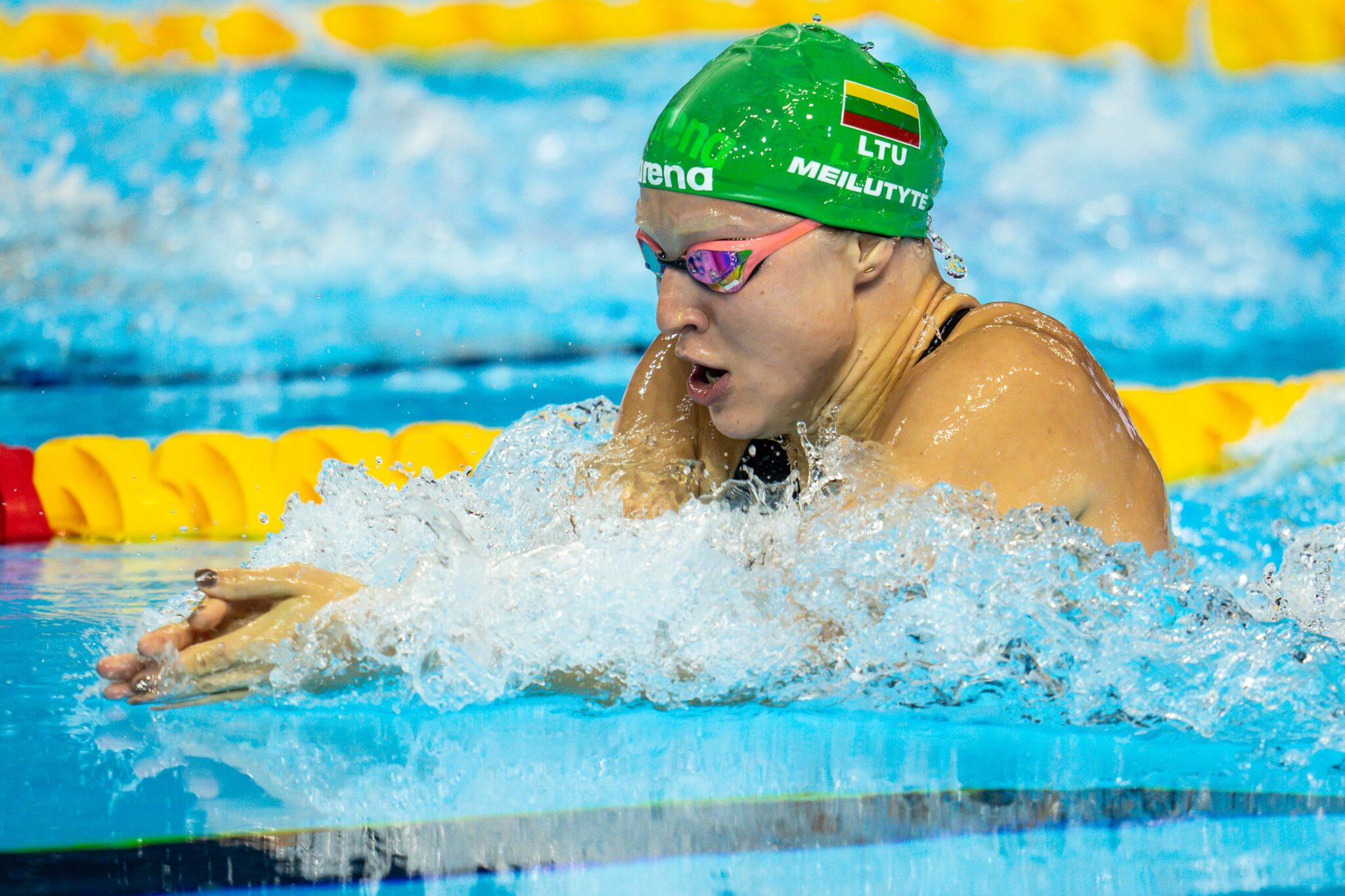
Courtesy: Vladimir Zaytsev
Anyone who has spent time around breaststroke has probably run into two completely opposite coaching philosophies.
One says higher tempo means faster swimming. Turn the stroke rate up, kick more often, and your time will come down.
The other says the opposite. Focus on a powerful kick, an efficient pull, and a long glide. If you can cover the distance in fewer cycles, you’ll probably go faster.
So which camp is right?
To find out, I analyzed race video from 174 female swimmers competing in the 50m breaststroke (LCM) between 2023 and 2025. Every swimmer competed at the national level or above, and all video was publicly available.
Methodology
The block start is a huge part of a 50, but it’s a fundamentally different skill from the swimming itself. For that reason, I excluded:
- Reaction time
- The start off the blocks
- The underwater phase
Timing began at the swimmer’s first surface armstroke and ended at the wall touch. That gave me what I’m calling “net swim time.”
I also simplified how cycles were counted. Instead of using the traditional breaststroke cycle (one arm pull plus one kick), I counted arm strokes only. That made it possible to count cycles accurately from video and avoided the half-cycle problem that shows up whenever a swimmer finishes a race on an arm pull and touches the wall before completing the kick.
From those two numbers, I calculated one simple metric: Seconds Per Cycle (SPC).
SPC = Net swim time ÷ Number of cycles
A higher SPC means each cycle takes longer — the swimmer is spending more time gliding between strokes. A lower SPC means the swimmer is cycling more frequently, with less glide time in between.
The numbers
Across all 174 swimmers, the average SPC was 1.07 seconds, and the average net swim time was 27.15 seconds.
Next, I looked at whether SPC actually predicts net swim time, and if so, how strongly. The relationship turned out to be statistically significant but surprisingly weak. The correlation between SPC and net swim time came out to r = 0.32 — meaning SPC differences explain only about 10% of the variation in swimmers’ results.
A lot of swimmers treat tempo as one of the most important factors in sprint breaststroke. Based on this dataset, that’s not quite true — at least not for the women’s 50 breaststroke LCM. Tempo is a meaningful piece of the puzzle, but it isn’t what separates the fast swimmers from everyone else. Swimmers can post very similar times while using very different tempos.
That’s because swimming speed depends on two variables working together: cycle rate (tempo) and distance covered per cycle.
A swimmer taking slower, longer strokes might cover more distance on each cycle. Another swimmer might move faster but cover less distance per stroke. If those two factors balance out, both swimmers can finish with nearly identical times. That’s why looking at tempo alone only tells part of the story. Faster isn’t automatically better.
A surprising direction
One of the more interesting findings was the direction of the relationship. In this group, a higher tempo was actually associated with a slower net swim time — not a faster one. In other words, the swimmers with the quickest stroke rate tended to finish the 50 breaststroke slower than those with a more relaxed tempo. That said, the effect was small.
The most likely explanation is that swimmers naturally settle into a length/frequency combination that fits their technique, strength, anthropometrics, and race strategy. Pushing tempo up without the propulsive force to back it up may simply add wasted movement and burn extra energy, rather than adding speed.
What this means for coaches
The biggest takeaway isn’t that tempo doesn’t matter — it does. But tempo is only one piece of the puzzle. Two swimmers can have nearly identical tempo and still post very different times, because one of them is covering more distance per cycle. If a coach is only tracking stroke rate, they’re missing an equally important question: how much distance is the swimmer covering on each cycle? Ideally, both variables should be evaluated together.
Improving performance isn’t about speeding up or slowing down tempo in isolation — it’s about finding the combination of cycle length and cycle rate that produces the most speed for that swimmer.
Bottom line
If you’re looking for one “ideal” tempo for the women’s 50 breaststroke, it probably doesn’t exist. Stroke tempo on its own is a relatively weak predictor of performance. The fastest swimmers aren’t necessarily the ones moving their arms the quickest — they’re the ones who combine efficient movement with the rhythm that works best for them.
 About Vladimir Zaytsev

Vlad is an ASCA Level 5 coach from Russia with over 20 years of experience coaching competitive swimmers, including national-level junior athletes. He specializes in sprint performance and data-informed coaching methods.

if the time starts at the first stroke, arent people who go further/longer underwater going to have a quicker time regardless of tempo? correct me if i misunderstood