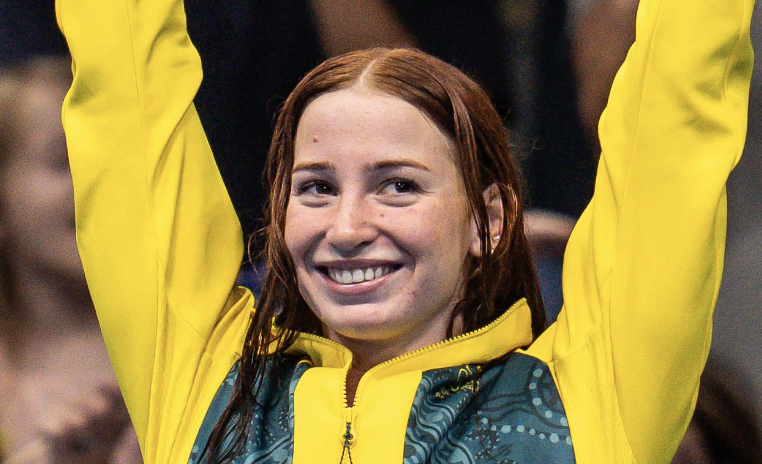
Five-time Olympic gold medalist and 14-time world champion Mollie O’Callaghan gave 60 Minutes Australia a behind-the-scenes look at some of her day-to-day practices, including her high-altitude tent in her apartment, and opened up about pre-race nerves that had plagued her in the past.
O’Callaghan, among the fastest female swimmers in history, walked 60 Minutes Australia’s Tara Brown through some of her training regimens; among them was her in-unit high-altitude tent, which, according to the interview, O’Callaghan spends somewhere around 10 hours a day inside and 300 hours a month. O’Callaghan comically calls the other version of “glamping” (a term often used to describe luxurious camping).
“I think it is definitely such a weird thing that not many people get to see that not many people get to see that athletes do in their spare time to try and get that one percenter,” O’Callaghan told 60 Minutes Australia. “[The high-altitude tent] simulates 3,000 meters [at] altitude. It forces your body to actually use the oxygen in your body more efficiently to supply it to your muscles, and especially is the best for aerobic capacity.”
O’Callaghan trains about six kilometers in the water before breakfast, and repeats that distance after lunch. But her hunger to be the best also stems from her training at St. Peter’s Western in Brisbane under legendary head coach Dean Boxall.
“There’s no one part of me that wants to do an easy session. There’s not one part of me that wants to give up because I just don’t think I have it in me.” O’Callaghan said in a sit-down interview with Brown. “It sounds so weird, but I know I have the potential. In each race that I do, each training session that I do, I could improve in that.”
O’Callaghan, who just recently celebrated her 22nd birthday earlier this month, made her first Olympic team at the age of 17 in Tokyo in 2021. She was the youngest member of the Australian Olympic team that year, as she would represent her home nation on multiple relays, but would only swim on the prelims squads, still earning golds in both the 200 freestyle relay and 200 medley relays.
Leading up to the Paris Olympics in 2024, she suffered a panic attack at the Australian Trials, which nearly cost her a spot in her signature 200 freestyle event.
“It was the worst anxiety I’ve ever dealt with,” O’Callaghan told 60 Minutes Australia. “That night I couldn’t sleep, I couldn’t breathe, I was just crying because I wanted to do the best that I could, but obviously in that final, it got the best of me, and it ate me alive.”
She ended up finishing behind recently retired Australian superstar Ariarne Titmus in the race at those Australian Trials, but later went on to secure Gold in Paris in that same race, swimming to a new Olympic record in the process.
“I know nerves make me race fast. I know it’s my superpower. I know that I’m going to get something good out of it,” O’Callaghan said.
The 22-year-old freestyler is currently competing at the 2026 Australian Open, where, after just one day of competition, she has already made her mark on the competition, winning the 100 free in 52.66, making her the 2nd fastest performer in the world this season, as she now only trails her fellow countrywoman Meg Harris‘ top season time from December of 52.56.

Red Dragon is a good nickname
You are privy to a great becoming!
It was good to hear Mollie say again that she is very keen to continue on to the Brisbane Olympics.
I knew she had nicknames Molldog/Molldoggy and ‘Mollie O’ but I didn’t know she is also called ‘the Red Dragon’.
Altitude tents have been popular in the running world for a while now, but this might be the first time I have seen one being used by a swimmer. Ones as big as she has cost tens of thousands of dollars so its no small investment
Other Australians are using them too.
Phelps did it years ago
I’m pretty sure Kyle is using one
I saw her swimming in Paris and Singapore. The pre race anxiety is so visible, her hands were shaking
always do
I follow swimming a lot so didn’t learn much – the altitude tent was the main interesting feature. It was a good interview though. Mollie did cry a bit when they asked about the costs of swimming to her family in time and money, especially in the early days.
Any swimmer with any degree of compassion would cry knowing the time and money costs their parents put in, but also knowing this the athlete should be reassured of the level of commitment and support their parents happily give is given with absolute belief in their child being the best they can be. Parents are winning in the equation as well when they see their child being their best.
Such a dynamic creates an insane amount of pressure for the athlete.
So the question begs then, how to take the pressure off the athlete when Parents ARE the athlete’s financial backers?
It’s not even the finances growing up it’s even the time and effort they put in. Failing a race even in your own mind seems even worse when you feel like you let your parents down. That’s a lot every time you stand behind the blocks to race to have on your shoulders. Swimming Aus needs to continue to push the psychology support for athletes even young athletes making these teams.