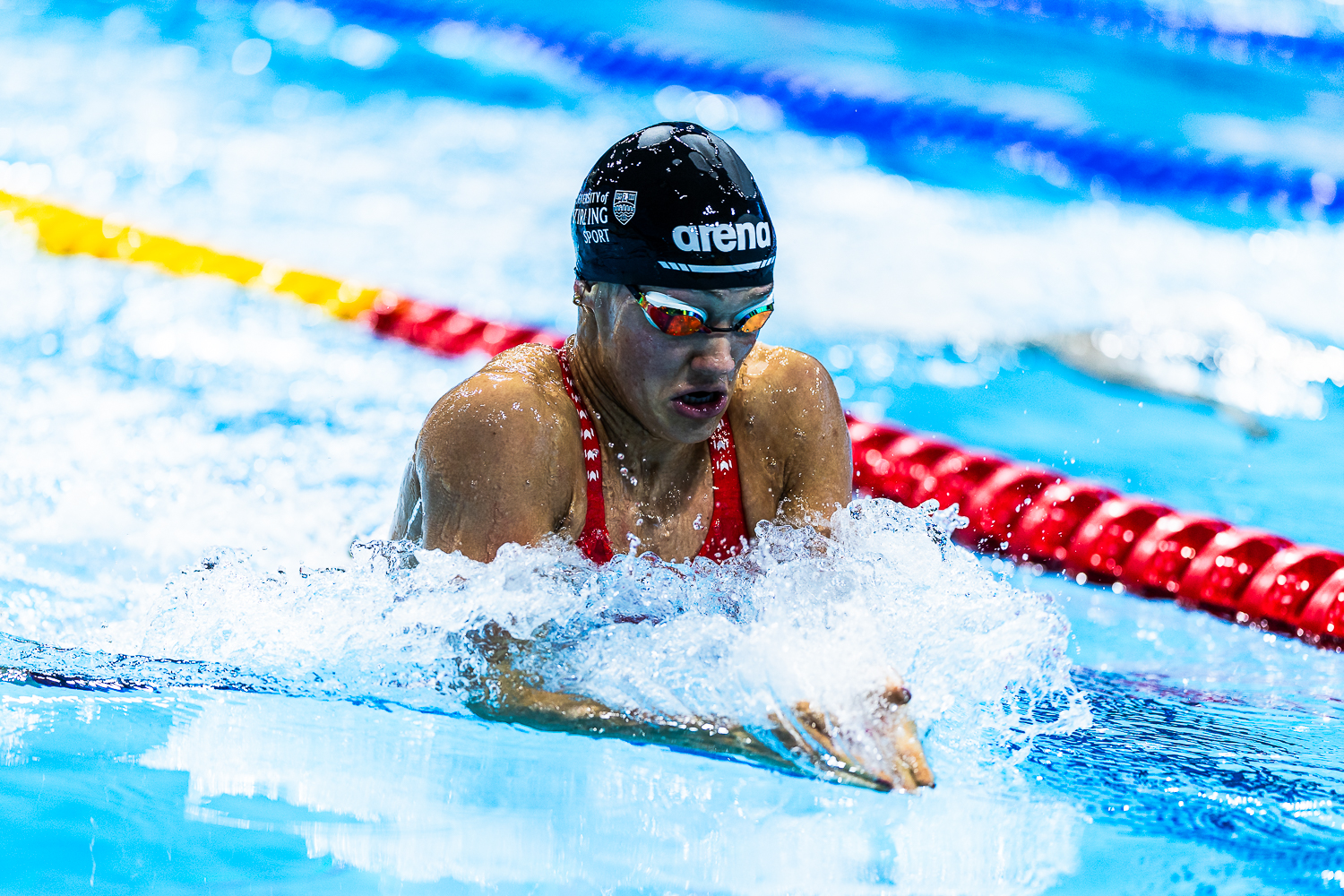
2026 Commonwealth Games
- July 24 – 29, 2026 (pool swimming)
- Glasgow, Scotland
- Tollcross International Swimming Centre
- LCM (50m)
- Meet Central
- Preview Index
- Entries
WOMEN’S 4×100 Medley Relay – By the Numbers
- World Record: 3:49.34 – USA (Smith, Douglass, Walsh, Huske), 2025
- Commonwealth Record: 3:51.60 – Australia (McKeown, Hodges, McKeon, Campbell), 2021
- Games Record: 3:54.36 – Australia (Seebohm, Bohl, McKeon, B. Campbell), 2018
- 2022 Champion: Australia (McKeown, Hodge, McKeon, O’Callaghan) – 3:54.44
Only six nations competed in the event four years ago, with Australia taking the win comfortably ahead of Canada and England. While the Australians are favored to win again, they have been hit by some retirements and late withdrawals, meaning that the team is going to be looking very different this week in Glasgow.
The Australian quartet of Kaylee McKeown, Chelsea Hodges, Emma McKeon and Mollie O’Callaghan posted a time of 3:54.44 to take the win in Birmingham, coming just .08 off their Commonwealth Games record set four years prior. Both McKeown and O’Callaghan were slated to return, and as two of the fastest in their respective disciplines, the pair could easily lead their relay to victory. However, McKeown withdrew from all her competitions for the foreseeable future, citing a diagnosis of glandular fever. O’Callaghan, as well, has been waylaid by injuries, revealing a back issue of late.
And yet, such is the depth of their nation, especially among backstrokers, that both Iona Anderson and Hannah Fredericks are the top seeds in McKeown’s absence. Anderson, the lone entrant seeded under 59 seconds in the individual 100, could give her nation over a second advantage over the field. A 2024 Worlds silver medalist in the 100 back, Anderson currently sits 8th in the world rankings this year with her 58.60 from the Australian Trials, a time that is perilously close to her two-year-old PB of 58.43 from the 2024 Olympic Trials.
The Australians, always strong in the backstroke, have of late struggled to find a consistent breaststroker, but the emergence of Sienna Toohey may be turning things around for the Aussie. The 17-year-old, who burst onto the national scene last year, hit a new personal best last month, going 1:05.97 to win the event at Trials to rank as the 5th fastest in the world this season.
Alex Perkins (Photo Credit: Delly Carr/Swimming Australia)
Despite the back issue, Australia’s last two legs are unmatched in the field as Alexandria Perkins leads the 100 fly field with her seed time of 56.19. While that time dates back to her semifinal performance last summer, a swim that set her up for a bronze medal at Worlds, Perkins has already dipped under the 57 barrier this season, going 56.88 to win the individual event last month. At that meet, she also set a new personal best of 53.33 in the 100 free, placing 4th behind the winner, O’Callaghan. Her compatriot took the win exactly one second ahead of her, posting the 3rd fastest time in the world this season. If her back injury is too much, or if the coaching staff is looking to play it safe and manage her workload, Meg Harris with a season best of 52.56 or Shayna Jack with a season best of 52.96 are more than adequate replacements, as they are the only two other swimmers under the 53.00 barrier.
The trio of freestyle options, ranked 3rd. The 5th- and 8th-ranked in the world this season are joined on that list by England’s likely anchor Eva Okaro, who sneaks in as the 25th-fastest in the world this year with her 53.75 from April’s Aquatics GB Championships. The University of Texas rising sophomore, now the 4th-fastest Brit ever, has been indoors in the event, as that swim was her first time under the 54-second barrier.
Okaro’s speed on the last leg is matched by England’s speed on the front half as Lauren Cox looks to keep England in the medal hunt. The 4th seed in the 100 back, Cox will have to keep Anderson of Australia within striking distance as well as keep an eye on Canada’s backstroker, whose entry time of 59.50 is just .09 ahead of Cox’s. The Englishwoman’s seed time is from last year’s performance in Singapore. Still, the 2023 World bronze medalist in the 50 back has already bettered that mark this season, setting a new PB of 59.45 at a meet in Manchester in March, and was just off that time at her nation’s championships, where she was 59.66.
England, lacking the full talent of the other nations that compose Great Britain, struggles in the middle two legs to keep things somewhat relatively close to Australia. They have just one swimmer in the 100 breaststroke, with the 18-year-old Gabrielle Idle-Beavers entered with a seed time of 1:07.69. The University of Kentucky incoming first-year student just represented Great Britain at the European Aquatics Junior Championships, where she took 7th in the final with a time of 1:09.37. Their butterfly leg, likely Emily Richards, has a seed time (and PB) of 58.45 and was just off that mark three months ago, taking 5th in 58.72.
Just because Idle-Beavers is their lone entrant doesn’t mean England will necessarily use her in the relay. Imogen Clark, who is swimming the 50 breaststroke, holds a personal best of 1:07.35 from three years ago, but in the three times she has contested the event this season, she has never been under 1:10.
World Aquatics Championships
Fukuoka (JPN)
14-30 JULY 2023
While the Australians and English have a bevy of swimmers to pick and choose from, the Canadian team finds itself in a little bit of a bind. Pre-naming a team back in October, the Canadian women number just six and have a heavy tilt towards the backstroke events but lack butterfliers. Five-time Olympic medalist and nine-time Commonwealth Games medalist Kylie Masse will look to repeat as a medalist in this relay, having helped the Canadians to silver four years ago. Masse, who took a break from swimming, is the 3rd seed in the 100 back, coming in with a seed of 59.50, but owns a PB of 57.70 and earlier this month produced the 13th fastest time this season, going 58.87 at her nation’s swimming trials. Like four years ago, Masse will hand things off to Sophie Angus. Angus is seeded in the individual event dangerously low with a time of 1:08.38, but was 1:07.06 last November and recently took 2nd earlier this month at the Canadian Swimming Trials, going 1:07.08 in prelims and 1:07.22 in finals.
With a strong front half, Canada could be close to Australia, but they lack not only the firepower of Perkins, but they also lack a swimmer. They have no entrant in the 100 butterfly, but have one in the 50 fly and one in the 200. Masse has a seed time of 27.05 and is a strong 50 swimmer, but hasn’t competed in the 100 in over two years and would be removing their best backstroker. Their likely option then is to pull Ella Jansen down from her 200 fly. The Tennessee-based swimmer is coming off a strong year in the NCAA and owns a personal best of 58.74, though it dates back to the 2023 World Junior Championships. She did not compete in it at her recent nationals but did race the 100 fly at a meet in mid-June in Tennessee, going 59.50. With half the team accounted for already on the front three legs, the last spot likely falls to Delia Lloyd. A strong backstroker, Lloyd is entered in the 100 free with a seed time of 55.69, nearly a second clear of her teammate Madison Kryger.
| Australia | Canada | England | |
| BK | Anderson – 58.60 | Masse – 59.50 | Cox – 59.59 |
| BR | Toohey – 1:05.97 | Angus – 1:08.38 | Idle-Beavers – 1:07.69 |
| FL | Perkins – 56.19 | Jansen – 59.50 (TNAQ June Invitational) | Richards – 58.46 |
| FR | O’Callaghan – 52.33 | Lloyd – 55.69 | Okaro – 53.75 |
| 3:53.09 | 4:03.07 | 3:59.49 |
Note: All times used are seed times unless noted otherwise
Compared with four years ago, the Australians are a full second ahead of their gold-medal performance of 3:54.44, and this aggregate relay doesn’t include McKeown. Much of this difference is attributed to Toohey, as her seed time is nearly a second faster than Hodges’s 1:06.68 from four years ago. Anderson, too, is seeded ahead of McKeown’s 58.79 lead-off leg from Birmingham. Canada, with a small squad this year, was bound to be hard-hit, slipping nearly seven seconds back; much of that can be attributed to losing Maggie MacNeil (56.59 – Fly) and Summer McIntosh (53.33- Free). However, on paper, the Canadians are much more likely to be close to 4:01, as Masse and Angus have been notably faster this season than their seeds. England, hosts four years ago, look to be in a good position to medal as they head north to Glasgow. In Birmingham, they hit the wall in 3:59.44, claiming the bronze. Anna Hopkin had a strong anchor split of 53.15, but Okaro, with a relay start, could get close to that.
Of the other three returning nations, only two were around the 4:00-minute mark, with South Africa just .19 off England’s bronze-medal time and Scotland over the mark at 4:04.83 (Guernsey finished 6th in 4:23.37). South Africa’s time of 3:59.63 was a national and continental record, but they have since lowered it to 3:59.47, doing so in the heats at Worlds last year. That quartet of Olivia Nel (1:00.33), Rebecca Meder (1:07.63), Erin Gallagher (57.31) and Aimee Canny (54.20) are all making the trip to Glasgow, but the relay may have a different make-up.
Aimee Canny (photo: Jack Spitser)
Nel looks to be a lock for the backstroke leg, with the fastest seed time and a national record of 1:00.33, and won the event at Nationals in 1:00.83. Gallagher, too, is an obvious pick for the fly leg. A semifinalist at Worlds last summer, she owns the continental record of 57.32 and was just .04 off that mark, winning the event at nationals. Canny, a versatile swimmer, is a very strong freestyler, but has been making inroads in the 100 breaststroke this season. She won the event at her nation’s trials, going 1:06.57, before exploding two months later into the world’s top ten, tying Toohey for 5th place with a new PB of 1:05.97.
Gallagher (55.12) and Nel (55.17) topped the field in the 100 free at Nationals, so if they do slide Canny to the breaststroke, then Caitlin de Lange (4th-55.51) could get the nod. Jessica Thompson, a UVA commit, could get the nod as she beat de Lange in the final by .01, but de Lange’s prelims time of 55.48 is faster. With the relay being contested on the final day, South Africa will have plenty of information to determine the best order, as Meder or 2025 200 breaststroke Worlds medalist Kaylene Corbett could produce a time in the 100 breaststroke that makes leaving Canny on free more worthwhile.
Whereas the South Africans have plenty of options on breaststroke, the Scots only really have one, albeit a very, very strong one. After a stellar performance in London at the 2026 Aquatics GB Championships, Angharad Evans returns to her nation as the new national record holder in the 100 breaststroke, having posted a mark of 1:04.96, a time that not only leads the world this season, but makes her just the 10th swimmer in the event ever to pierce the 1:05 barrier. She hasn’t had the greatest of luck on the international stage, failing to make the semifinals in Singapore, but her recent run of form could change Scotland’s chances in this relay. From one British champion to another, Evans makes way for Keanna MacInnes, who produced a personal best of 57.57 to win the 100 butterfly in April. MacInnes was a member of this relay four years ago, then splitting 1:00.07. Still, the four-time British champion and Olympic semifinalist has shed time in the intervening years, now sitting in the top five among all British performers and 19th in the World this season.
With a strong middle, Scotland will be hoping for a strong opening and closing leg to help them secure a good finish. Katie Shanahan, an excellent 200 backstroker, has a seed time of 1:00.03 in the 100 back, but that time dates back to last spring’s nationals. This year her best sits at 1:01.10. However, she is still likely her nation’s best option, as Holly McGill, who has a seed time of 1:00.70, also produced that time in April of 2025 and didn’t race the event this summer at the selection meet. As for the anchor, Evelyn Davis locked up that spot with a very strong performance at the Aquatics GB Championships, where she joined Okaro under the 54-second barrier, going 53.99.
| South Africa | Scotland | |
| BK | Nel – 1:00.33 | Shanahan – 1:00.03 |
| BR | Canny – 1:05.97 (Indy PSS) | Evans – 1:04.96 |
| FL | Gallagher – 57.36 | MacInnes – 57.57 |
| FR | de Lange – 55.48 | Davis – 53.99 |
| 3:59.14 | 3:56.55 |
Note: All times used are seed times unless noted otherwise
On paper, Scotland looks staggeringly fast; their middle two legs are both very fast. Evans is atop the world this season, and while MacInnes is ranked 19th, it is 4th among entrants in the meet and less than a quarter of a second behind Gallagher, who sits 12th in the world. Shanahan being a little off form could be a worry, but with Davis a full second ahead of both Canada’s and South Africa’s likely anchor, the Scot could find themselves on the podium in front of their home crowd.
After the strong top five, it’s difficult to predict which other nations will fill out the final. The Welsh women have some strong swimmers, but not the necessary depth. Bex Sutton (1:01.90) is their lone entry in the 100 back, but they could call upon Medi Harris to fill the spot. She owns a personal best of 59.24, but was 1:01.79 in London this past April and hasn’t broken the 1:01 barrier since the Paris Olympics. Theodora Taylor is their fastest 100 freestyle entrant (54.20), but she is also their fastest 100 breaststroker (1:08.12) and the only woman swimming a butterfly event, taking on the 50. She did swim a 59.88 last month in Cardiff, so may be preparing for the relay.
Northern Ireland, too, has some strong swimmers. Lottie Cullen‘s 1:00.35 entry time in the 100 back, while Ellie McCartney is seeded right next to Evans in the last heat of the 100 breaststroke prelims with a seed time of 1:06.97. Things start to fall off from that strong start as their last two legs have seed times of 1:00.15 and 54.80. Still, those times should be enough to earn them a spot in the final, and when doing the math puts them ahead of Canada, but the Canadian’s aggregate time is not reflective of Angus’s season bests, which are nearly two seconds faster than her seed.
It’ll be a battle for sure for the minor medals, but this should be Australia’s rather handily, as their dominance in all but the breaststroke makes them the heavy favorites. If Scotland can get a solid swim from Shanahan, their last three legs should make it a “Stirling” silver performance for the host nation. After that it’s a toss-up between South Africa and England. England has a strong lead-off in Cox and a great anchor in Okaro, but Canny and Gallagher in the middle could be enough to give the South Africans enough of an edge to take the bronze.
SwimSwam’s Picks
| Place | Nation | Aggregate Time | 2022 C.G. Finish |
| 1 | Australia | 3:53.09 | 1st |
| 2 | Scotland | 3:56.55 | 5th |
| 3 | South Africa | 3:59.14 | 4th |
| 4 | England | 3:59.49 | 3rd |
| 5 | Canada | 4:03.07 | 2nd |
| 6 | Northern Ireland | 4:02.62 | N/A |
| 7 | Wales | 4:06.03 | N/A |
| 8 | Guernsey | 4:25.99 | 7th |
