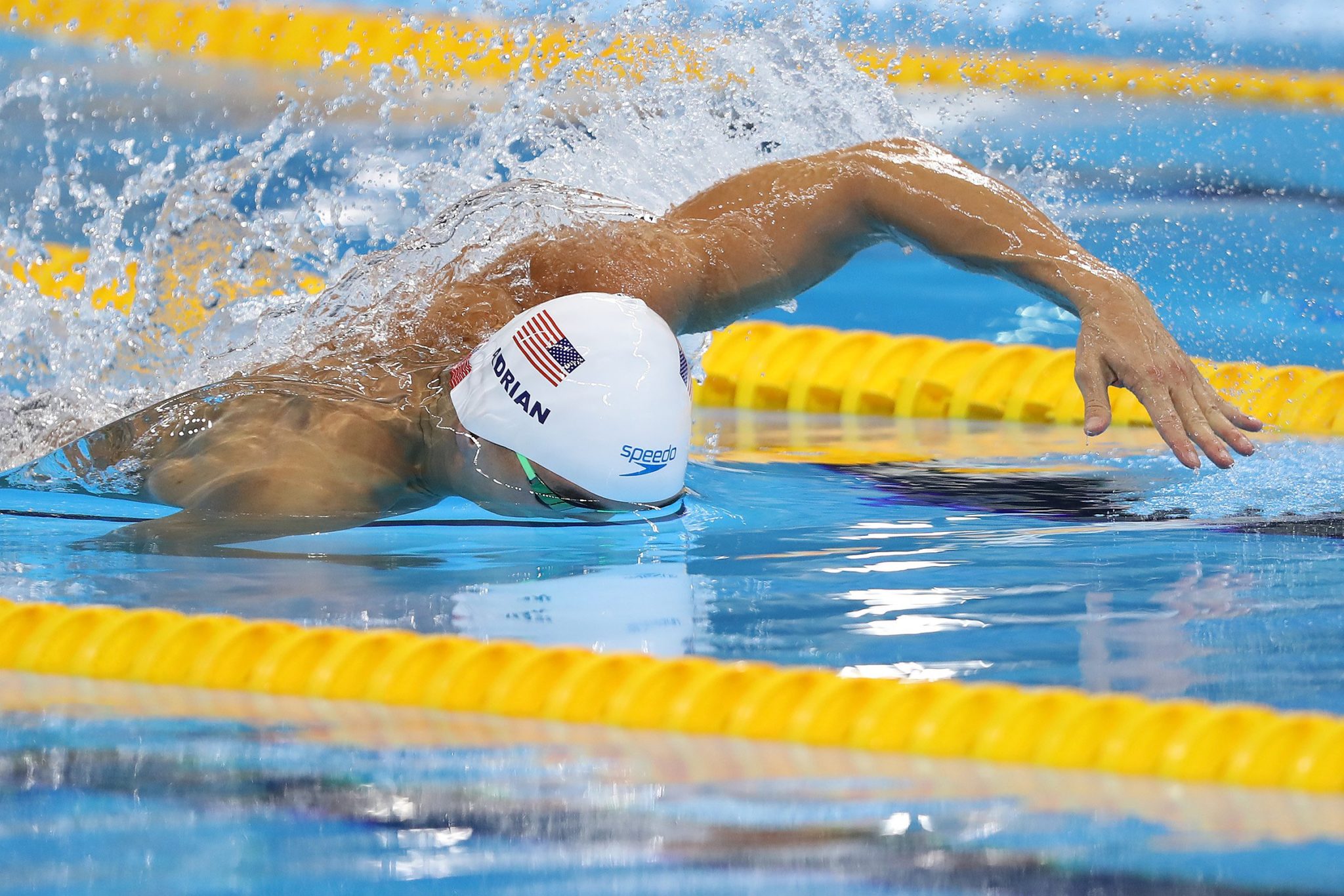
Watch a sprint freestyler closely and through all of that splashing you’ll see it almost immediately: they ride higher in the water.
The body is elevated and aggressive, the stroke is white-water violent and purposeful, and the head position is really high, nearly clearing the water. This isn’t just the result of trying harder or spinning the arms faster.
Sprint freestyle is a very different stroke from your regular freestyle. We aren’t 2xing our middle distance stroke.
As swimmers shift into sprint mode:
- They jack up the stroke rate
- Speed up shoulder roll velocity (not more rotation, but faster rotation)
- Flatten hip roll, increasing torso twist
- Spend far less time in the hand entry and stretch phase
And that last point—the disappearing entry and glide phase—is where we get the special sauce for high body position when sprinting.
The Disappearing Glide
At sprint speeds, swimmers dramatically cut down the entry and stretch phase of the stroke. And it’s not subtle.
A study by Samson et al. (2015) put some numbers on it. Phase durations by velocity:
- Sprint: 0.20s
- Middle distance: 0.31s
- Long distance: 0.46s
The hand entry phase is 55-130% longer in middle- and long-distance freestyle compared to sprinting.
Instead of reaching forward and gliding, the sprint freestyler almost immediately moves down into the catch, and they do so using much more force.
Less Glide = More Lift
Now we get to the money part—how the sprinter gets vertical on the water. When swimmers (mostly) eliminate the glide, and combine that with the increased arm speed, they end up pushing down on the water with way more force.
And the water ain’t a pushover, it shoves back, creating vertical lift that raises the upper body.
Samson et al. gave us more concrete numbers to work with, showing that vertical lift forces jumped substantially at sprint speeds:
- Sprint: ~40 N upward
- Middle distance: ~21 N upward
The sprint swimmer creates nearly twice as vertical lift during the hand entry of the stroke.
Why a High Head Position Matters
The added vertical lift elevates the upper body of the swimmer, creating that sprint “attack” position as they charge up the pool.
This doesn’t just look cool, but supports sprint performance by:
- Allowing for that fast shoulder rotation
- Supporting increased stroke rates
- Reducing speed-killing frontal drag
- Creating space for thoracic roll into the entry and catch
- Getting swimmers to the propulsive phase of the stroke faster
The higher body position in freestyle sprinting isn’t just an “oopsie.”
It’s a direct result of sprint mechanics, including reduced glide, higher force, and increased vertical lift.
The Bottom Line
Body position, and in this case head position, is the result of sprint mechanics. By reducing/eliminating the glide, our head pops out of the surface like a cork, and we feel like we are skimming across the surface of the water.
The key thing to remember is that this happens naturally because you are using a stroke technique that is optimized for speed and power. It emerges naturally when we go from long-and-smooth to short-and-thunderous.
If you find that your head is snowplowing the water and not getting much height when sprinting, it may simply be that you are gliding too much when trying to sprint.
Happy sprinting!
ABOUT OLIVIER POIRIER-LEROY
 Olivier Poirier-Leroy is a former national level swimmer, 2x Olympic Trials qualifier, and author of several books for swimmers, including YourSwimBook, Conquer the Pool, The Dolphin Kick Manual, and most recently, The 50 Freestyle Blueprint.
The book is a beastly 220+ pages of evidence-based insights and practical tips for improving freestyle sprint speed.
It details everything from how to master stroke rate, technique, build a thundering freestyle kick, improve your start and underwaters, and much more.
The 50 Freestyle Blueprint also includes 20 sprint sets to get you started and a bonus guide on how to master the 100 freestyle to complete your sprint preparation.
👉 Learn more about The 50 Freestyle Guide today.

Was this inspired by Cams recent Instagram post about trying to keep as much of his back out the water as possible on some rack sets?
I think it is important to differentiate between high head position being the result of stroke mechanics and power lifting the upper body higher in the water, rather than causing it by tilting your head up so that you are looking forward. The latter is super counterproductive because it turns your head into a snowplow and drops your hips, which wrecks your hydrodynamics and slows you down.
100% Agree
Helpful to a guy returning to freestyle sprinting after a 25 year absence. A lot has changed. Pls address any stroke implications/modifications for the bottom half of the stroke. Thank you.
I think this can be tricky, because tilting your head up can give you more leverage when your hand is outstretched in front of you (right after it enters the water), so you may be getting more power in exchange for any extra drag. That tradeoff seems less beneficial the longer the race, but for a sprint, it’s conceivably worth it for certain swimmers.