
USA Swimming has published the draft of its meeting minutes from the September 25, 2025 Board of Directors meeting. That included a significantly-reduced projection for membership and membership revenue for the 2025 calendar year.
In the budget section of the attachments (page 90 of the document), USA Swimming reports a figure 3.8% unfavorable to budget, with a projected $941,685 shortfall ($23.9 million vs. $24.9 million). Membership dues historically are the largest single line item in USA Swimming’s budget.
A comment to that line item notes: “Premium Athlete memberships down 5,000 year over year, budgeted premium athlete post-Olympic bump of 9,000 members did not materialize. All other categories slightly exceeded budget.”
USA Swimming, like other Olympic sports organizations, have historically and culturally waved-away membership decreases, counting on a significant bump after the publicity of the Olympics to replenish, and grow, membership.
In 2024, USA Swimming saw a small +0.13% growth in total membership, though the number was still well below the pre-pandemic levels (411k vs. 376k).
A note in the minutes of the meeting report that: “Mr. (Joel) Shinofield provided a year-to-date membership update, indicating that membership is currently stable with an upward trend in coaches and increases in Flex and Outreach membership through investments in initiatives such as Block Party, Community Swim Teams, New Club Success, and Coach Education.”
That wasn’t the only bad news in the budget update. The next line item, Partnership Marketing, was expected to be the second-largest bucket of revenue for USA Swimming. There, though, the organization reported a similar amount unfavorable to projection of $958,600.
The comments on that line item say that “One budgeted new partner pushed to 2026, four budgeted partners lost, all totaling $850k.” The negative-to-projection implies that further plans to expand partnership revenue didn’t materialize.
This has resulted in a total $1.8 million unfavorable-to-budget projection for the year and a -$414,752 operating deficit (off a $99,532 projected gain).
A Performance Monitoring Report signed by Bob Vincent, then interim CEO, and dated September 17, 2025, says that USA Swimming has been able to offset these unfavorable revenue results by reducing expenses in some areas.
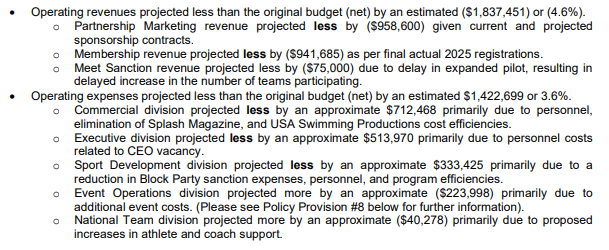
Other disclosures in the minutes report that the 2025 Pro Swim Series is projected to be $124,346 over budget in expenses “primarily due to increased actual vendor costs, based on the locations of the markets.” To the positive, in that same disclosure, the National Championships/World Championship Trials program was only over $12,000, less than a previously-approved overage.
All-told, the budget does not paint a rosy financial picture for USA Swimming, though the organization is coming off a year of record revenue.
Most of the decisions impacting the budget shortfalls or over-expenditures happened before the new USA Swimming leadership team of CEO Kevin Ring, National Team Director Greg Meehan, and Board of Directors President Brent Lang were installed in their roles, though the problems could be partially-blamed on an extended leadership gap as the organization took a full year to find its new full-time CEO.

Cut staff members who seemed completely disengaged from their roles. During both Summer Juniors and Summer Nationals, many USA Swimming staff carried themselves as if attending the events was a burden rather than a responsibility. They appeared indifferent, showed minimal enthusiasm, and rarely engaged with athletes, coaches, or attendees. This lack of initiative and professionalism created a noticeable disconnect and detracted from the overall experience of the events.
Who approved a $450k payout for the retiring CEO? Was it contractually required?
Kevin Ring has his work cut out for him. Yes, cute social media moments and his generally down to earth persona may help with the obvious “Colorado Springs vs. All of You” perception, dude still has to do something about budget, membership and the biggee: sponsorship
It’s really disappointing that their plan is to hope for an Olympic bump in enrollment
We. Need. To. Do. Better.
Swimming has too many cost-for entry barriers- it doesnt help that we add others
Club memberships, an anual membership, paying to go to meets.
I think they would generate more revenue if:
People could come try without needing to put down a lot of money first
People didnt have to be affiliated with a team to participate
If events themselves could absorb some of that membership cost then I’m sure you would see more people pop in just like you see people pop in for a 5k.
You need to make access easy otherwise people will just go without it.
If you ask USA Swimming board members this question, they respond like this (AND I THINK THEY ARE OUT OF TOUCH): “Swimming, as a value proposition, is actually on pair or cheaper than other sports, and swimming’s retention is actually robust compared to other sports.” That response is tone deaf. And, most board members are financially in a stratosphere where they simply do not understand or sympathise with middle-class families working and striving to maintain their children in our sport. I do. I grew up poor. My sister and I were swim club charity cases. We lived and trained on the good graces of other swim families willing to support us on the club. And, it was still a struggle… Read more »
Slowly dying is a good way to put it Mel. Death by 1000 paper cuts.
Agreed….death by 1000 other options to spend your families time and money on.
Agree. We need to focus less on adding 3k-5k kids who want to swim 700-1000 hours a year
Focus should be on adding 100k kids who want to swim 30-150 hours a year.
Those kids will be extremely sensitive to both cost and the amount of enjoyment/fun a child has
A lot of big teams roll up 100s of swimmers who swim once or twice a week after lessons, and they do convert them to the 5-6 per week team. That intermediate step is the sweet-spot. We want them.
This is the Nitro model, right?
The Nitro model isn’t about growing the sport. It’s about making as much money as possible. That making that money happens to be in pushing as many of the sweet spot kids through is almost coincidental. If the money was in the elite level kids, that is where Nitro would put their focus. I’m not even sure they care about their national team program anymore, although they would never admit that publicly.
We have dedicated 5 spots in our top group for those that need scholarship assistance. We partnered with one of our facilities and their school district where 75% of kids get financial assistance and they’re advertising for our program.
The cost is disabling. The cost ruins the joy you have for your child’s success. The cost challenges the ability to pay for meets your child has earned the right to compete in. (Summer Juniors in one location, on one side of the country) The cost that you swallow and hide from your child to shield them from the sick feeling of financial pressure. C.R.E.A.M, Wu-Tang said it best.
I asked ChatGPT to compare costs of year-round USA Swimming vs. travel baseball and travel soccer teams.
The outcome was basically the same, with the variance coming down to how many tournaments/meets out of town you might expect.
The cost of youth sports has gotten way too high, but that’s not a problem that’s unique to swimming.
If you haven’t already, consider listening to Playing To Win by Michael Lewis, on Audible, I highly recommend it. It’s a great lesson on youth sports.
I asked that question too. Notably, it doesn’t say anything about wearing a $400 suit a handful of times and then having to replace it.
The cost of youth sports is absolutely too high. But here’s the problem: the members want full-time coaches, fast inexpensive meets, instant response to phone calls/emails/text, palatial facilities, lots of lanes, all-star teams with relays at Junior/National meets, etc.
Those realities are in conflict. Until THAT conflict gets resolved (parent desires vs. practical cost realities of their expectations), this conundrum will never be fixed. Never.
I don’t think there is any interest in bringing costs down. When I was running a club, I was actively trying to keep costs down and at the very least remain competitive with other clubs. I also locked in prices for two years. I got questions from my board about this, and at least one of my coaches went to the board many times to complain that I was leaving loads on money on the table, telling them my rates were $100 a month less than others were charging (they absolutely weren’t). He thought even the littles should be paying $200 a month for swimming. It was all about making more money. After I left the club, they increased fees.… Read more »
Clubs need money to satisfy their customers (parents) desires. Without money to pay for goods and services, that they want, members go elsewhere.
Most teams already offer a tryout period and don’t require participation in meets, so newcomers can get a sense of the sport without full commitment. However, those who choose not to affiliate with a team still expect access to coaching, pool time, and other resources—resources intended for members who have invested their time and effort. Additionally, insurance coverage through USA Swimming only applies to registered athletes, so allowing non-affiliated participants could create liability issues and additional risk for both the team and the facility.
???
Cheaper water. Have any of you tried to start a team? It’s very hard to find pool space. Then if you can, the insurance costs high schools and others pay and pass on to clubs has soared. Cheaper water means more swimmers. Expensive water means less teams, less pool space, less swimmers. The operations of USAS can be fixed in no time. The growth of the sport of swimming is constrained by the availability of cheaper water.
And when you do find cheap water, you then have to worry about a bigger team bidding on your pool time, raising prices for everyone!
As someone who now runs a pool (former club coach of 16 years) and rents to two local clubs in my area, I try to maintain as fair a deal as I possibly can for them and we’re a bargain at $35/hour a lane, but the cost of chlorine alone is astronomical and other maintenance costs as well. At some point unfortunately, my company’s CFO is going to eventually say “we need to increase our rental fees and I will argue back with “we’re going to scare off our renters”…oy. It’s all expensive
Actual membership numbers have little to do with the National hierarchy..most kids and their parents don’t care who is the CEO of USA swimming..They care about the cost, time commitment, and is training fun and rewarding. It would be interesting to show where membership is dropping, Geographically, and at what age. Local LSCs carry most of the burden regarding meets, and communication, but the clubs themselves carry the responsibility of growing and maintaining membership..
Susan: I would even like to know the geographical drops vs increases in memberships? How has the economy, politics over the last 4 years impacted where families are moving.
At the national level, let’s see more responsible spending in all areas. I would say the c-suite is making too much for too little return.