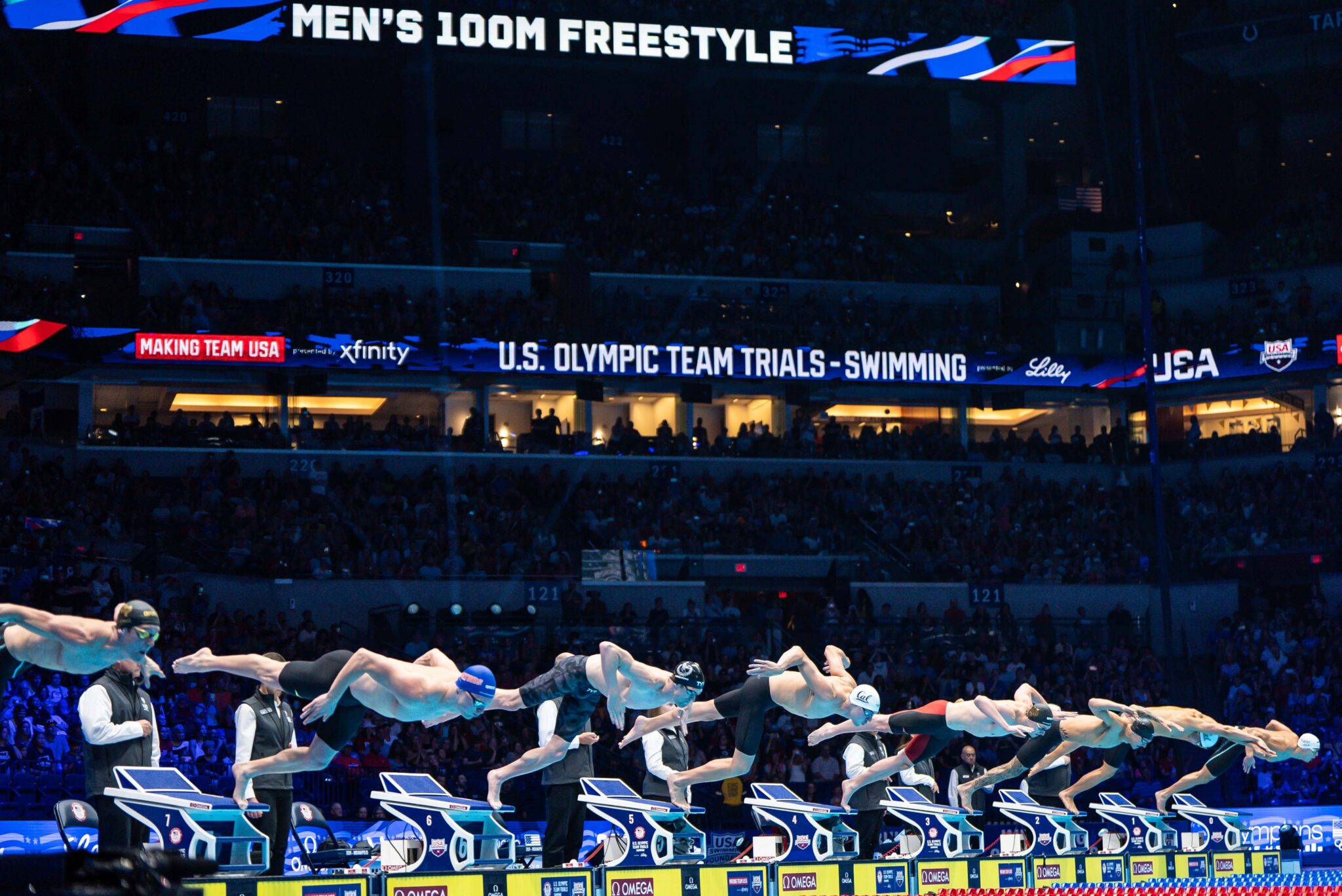
Courtesy: Chris Da Sie
Every swimmer has stood behind the blocks and felt it.
Not just nerves. Something heavier. Like the air got tighter. Like your chest got louder. Like your mind started sprinting before the race even started. You look down at the lane, you hear the starter, and suddenly the simplest parts of your swim feel like they might betray you.
Most swimmers think that feeling means something is wrong. And most of the advice they get reinforces it. “Relax.” “Calm down.” “Don’t think about it.” The goal becomes trying to feel normal again.
That’s the trap because pressure is not a malfunction. It’s a signal. It’s your system switching into performance mode. The problem is not that it shows up. The problem is what your brain decides it means.
The race where my body did exactly what my brain told it to do. I learned this as a teenager at a major championship meet, about to swim the 200-meter backstroke.
I was ready. Training had been solid. I was seeded well. This should have been one of those races where you feel sharp, fast, and free. But behind the blocks, the story in my head shifted from “let’s race” to “don’t mess this up.” That sounds small, but it changes everything. My breathing got shallow. My thoughts narrowed. I could feel myself trying to control the swim before it even started.
Halfway through the race, my stroke unraveled. One arm stopped recovering properly and I finished the race essentially swimming one-armed, confused and embarrassed.
For a long time, I thought that race proved I was weak under pressure. That I couldn’t perform when it truly mattered.
Now I know the truth.
My body wasn’t broken. It was obedient. It followed the meaning my brain assigned to that moment.
Here’s the science swimmers can actually use
Pressure turns the volume up on your nervous system. Heart rate rises, adrenaline increases, senses sharpen. That activation is not random. It’s designed to prepare you for output. But your brain has to label what’s happening.
If your brain labels the moment as danger, you get a threat response. Not always conscious fear, but protective tightening. Breathing gets shorter. Your muscles stiffen. Fine control gets worse. Attention turns inward. You start monitoring yourself instead of moving.
In swimming, that inner monitoring is poison.
When you “watch” your stroke in your head, rhythm disappears. When shoulders tighten, the catch slips. When breathing shortens, timing collapses. When you try to force the water, the water wins.
If your brain labels the moment as a challenge, the exact same activation becomes an advantage. Focus narrows onto relevant cues. Coordination stays intact. Movement becomes more automatic. You don’t lose the energy. You harness it.
Same body response.
Different label.
Different race.
This is why the “calm down” advice fails.
You don’t need less activation. You need a better interpretation.
Pressure is not something you solve. It’s something you train.
The biggest shift I try to give swimmers is this
You will never win a fight against pressure by trying to get rid of it.
You win by giving it structure.
That’s where routine becomes a performance skill, not a superstition. Routine is how you teach your brain, “This is familiar. This is controllable. This is what we do.”
Over years of coaching, I built a simple framework for this that I now teach to athletes at every level and share in my book, Pressure To Podium. It’s called RACE, because when pressure hits fast, you need a sequence you can run without thinking.
RACE: the anti-spiral routine
R is for Routine
Routine tells your nervous system, “We’ve been here before.” Same breathing pattern. Same physical anchor. Same order of steps. When the environment feels chaotic, routine becomes your anchor point. It doesn’t remove the surge. It gives the surge a lane to swim in.
A is for Adaptation
This is the mental pivot. You stop treating activation as a warning. You relabel it as readiness. “This is fuel.” “This is my system turning on.” Swimmers don’t need a new personality behind the blocks. They need a new meaning.
C is for Confidence
Not hype. Evidence. Confidence becomes stable when it’s built on receipts. A set you nailed. A pace you held. A skill you sharpened. Under pressure, your brain will search for danger. You train it to search for proof instead.
E is for Execution
Pressure narrows attention. That’s normal. The mistake is letting your attention scatter across ten thoughts. Execution is one job. One cue. One command your body can obey. “Fast hands.” “Long first 25.” “Explode underwater.” Then you let your training swim the race.
The 90-second version swimmers can use today
Routine: three controlled breaths + one physical anchor you repeat every race.
Adaptation: one sentence that relabels the surge. “This energy is fuel.”
Confidence: two facts from training that prove you belong here.
Execution: one cue for the first 15 meters.
That’s it.
Not motivational. Mechanical. Repeatable. Trainable.
The deeper reason this works
Racing is not just physical performance. It’s identity under stress.
Pressure doesn’t only test your fitness. It tests what you believe about yourself when the moment gets loud. That’s why two swimmers with the same training can look completely different in finals. One gets tight. One gets free. One tries to survive the moment. One steps into it.
When swimmers learn to interpret pressure as a performance signal instead of a danger sign, they stop fearing the exact moments they used to shrink in. They stop treating nerves like a flaw. They start trusting that the surge means they care, and they’re ready to use it.
Pressure doesn’t decide who gets the breakthrough swim.
The meaning you attach to pressure does.
And that meaning can be trained.

Excellent article !!
I’ve found for myself, and counsel swimmers, to use that moment when you’re immersed in the water at the start to find calm. The noises muffle as the water fills your ears. You’re in the environment of water now—embrace it. Meld your mind with the water. Just for that fraction of a second. Find the calm and let your body go. All the practices and your hard work will take over. And you go.
wish i got better at this. during my hs swimming career my tapered time in my best event (100fly) was only like 1 second faster than my best dual meet time, and like 2 seconds best than my best end of practice off the blocks time. alwyas got so into my own head.
Loved this article. Sure wish I’d had a resource like this back in my racing days.
Not sure why this is getting downvoted, GPTzero says it’s 100 ai generated.
Pleeeease tell me that you are purposely being ironic.
Definitely agree with a lot of the article. I had a few coaches that really pushed the ‘racers mindset’ of just go out there with a desire to win, but I found that got really distracting. I improved a lot when I figured out the ‘taking the pressure and not letting it become stress’ portion of swimming.
As a mid-distance guy, I found that different responses to pressure helped for different races. The clearest to me was the gap between the I.M.s. In the 400 I benefitted from keeping it ‘academic’ and being very execution focused. I also think that telling myself to ‘relax’ actually could help with that race as long as I did the physical actions to go… Read more »
If you’ve read any of his articles you’ll know this is his writing style.
I like this article.
I like it a lot.