2025 World Championships
- July 27 – August 3, 2025 (pool swimming)
- Singapore, Singapore
- World Aquatics Championships Arena
- LCM (50m)
- Meet Central
- Live Results
- SwimSwam Preview Index
With the Singapore World Championships fast approaching and speculation over relays building, what have the finals for each relay looked like over the last decade?
That takes into account eight world-level international summer meets, and we’ll take a look at the men’s 4×200 free here.
As a preview of what is included here, we’ll go through:
- Which nations have been in the final each year
- The nations with the most appearances
- How the final time for each finals position has changed
- How the finals time compares to that countries cumulative time heading into the meet
- How Swimswam’s predictions have fared over the years
We’ll also take a look at the continuity of each final – for a recap of how we calculate this take a look at the methodology explained in this previous article.
The Data
The cumulative times are taken from the calendar year best heading into the World Championships or Olympics of the top four individuals for each nation.
The calendar year best here is used for convenience. Far more of the data processing required here was manual than in an ideal situation, and finding season bests would slightly more than double that.
Additionally, there would come the decision on how to define when the season ends. For Asian nations this is often into the early-to-mid autumn, especially in an Asian Games year, compared to pretty much immediately after the summer meet for European and American swimmers. Using the calendar year best is a cleaner delineation, and the times should be more pertinent to the summer relays as well than those at the start of the season.
These may not necessarily be the swimmers that swim in the relay, and the drops may be due not only to internal improvement but a new swimmer or two.
Additionally, the data here is not 100% complete. The World Aquatics results database used is probably the best for blanket global coverage to the depth required each year, but there are gaps. Most major and national meets are captured, but results from medium to small meets are generally not.
For example, Carson Foster’s 4:08.46 400 IM that he swam at the 2021 Southern Sectionals is not in the database, despite it being the fastest 400 IM time in the world that year.
The result of this is that the cumulative data here is not quite perfect – there are likely a few of the cumulative times that would be slightly faster due to a swim that we’ve not managed to find.
However, with the volume of data and the fact that we’re looking to make general rather than specific conclusions, this should not have a material effect on what we see.
The Finalists
This relay has seen three clear powerhouses in Great Britain, Australia and the U.S., with no one else really establishing themselves either behind them or as a threat to the podium. Brazil’s four-final run from 2019 to 2023 was the longest by another nation, although Korea have made three in a row and have added Kim Youngbeom to a strong core.
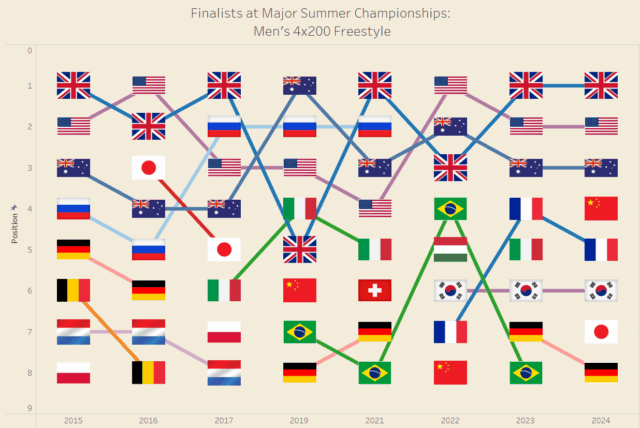
Germany have perhaps surprisingly been in six of eight finals over the last decade, driven by a star in 2015 & 2016 (Paul Biedermann) and 2023 & 2024 (Lukas Martens), with an egalitarian approach also putting them in the top eight in 2019 & 2021. That is the fourth-most finals of anyone in this period.
| Country | Finals Appearances 2015-2024 |
| USA | 8 |
| AUS | 8 |
| GBR | 8 |
| GER | 6 |
| RUS/NAB | 5 |
| ITA | 4 |
| BRA | 4 |
| NED | 3 |
| KOR | 3 |
| FRA | 3 |
| CHN | 3 |
| JPN | 3 |
| BEL | 2 |
| POL | 2 |
| HUN | 1 |
| SUI | 1 |
| ISR | 1 |
How Have The Finals Times Changed
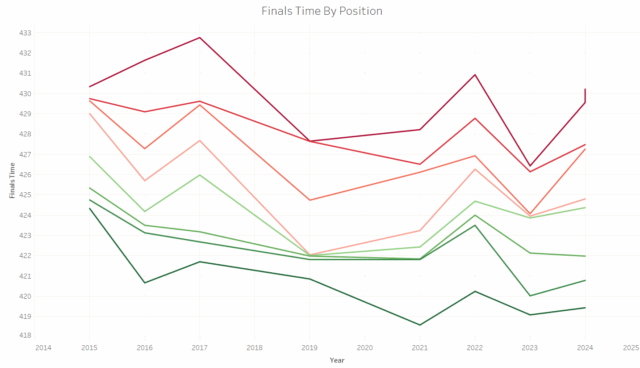
*Germany and Israel tied for 8th in the heats, so there were nine teams in the 2024 final.
The times have yo-yoed somewhat, but it has generally been the case that when the final is faster, the whole final gets faster. After razor-thin battles for silver in 2019 and 2021, the top few positions have stratified themselves in the last two years.
The time each relay team drops in the final compared to their pre-meet add-up can be seen below.
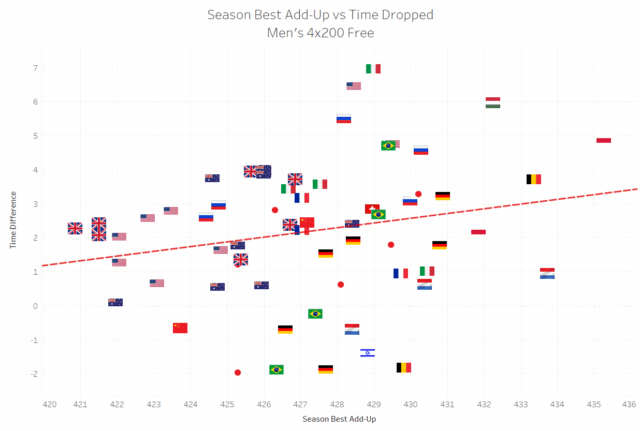
We can see a slight trend, but given how spread the data is it’s statistically insignificant. THe majority of teams drop between one and three seconds, although some have dropped huge amounts – Italy in 2019 were nearly seven seconds faster as they set their national record of 7:02.01.
What might 2025 Look Like?
For 2025, the add-ups for some of the countries aiming to be in the final this year are as follows. It took a time of 7:08.43 to make the final in Paris – there are nine teams with an add-up faster than that this year.
| Country | Cumulative add-up (2025 Calendar Year Bests) |
| USA | 6:58.78 |
| GBR | 7:01.91 |
| AUS | 7:02.29 |
| CHN | 7:05.44 |
| GER | 7:05.51 |
| KOR | 7:06.59 |
| JPN | 7:07.09 |
| ITA | 7:07.14 |
| LTU | 7:08.19 |
| FRA | 7:08.58 |
| RUS/NAB | 7:09.84 |
| ISR | 7:10.40 |
| BRA | 7:10.56 |
Continuity and SwimSwam’s Predictions
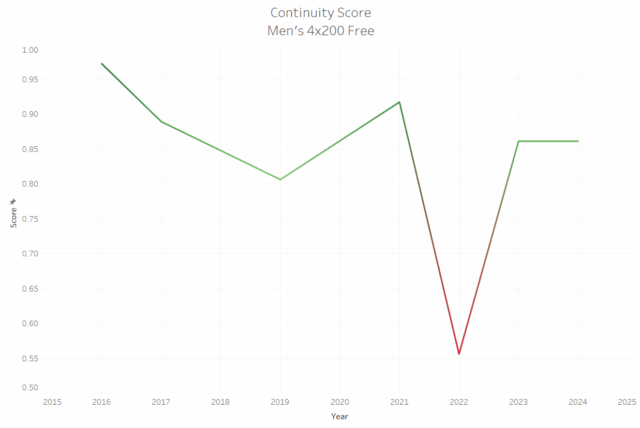
No Russia, and Italy missing the final in 2022 play a big part in the low score that year, but the final has seen a fair churn below the top three. Great Britain, the U.S. and Australia have been mainstays in the top four but the fortunes of other nations have ebbed and flowed, even if they have made it back to the final consistently.
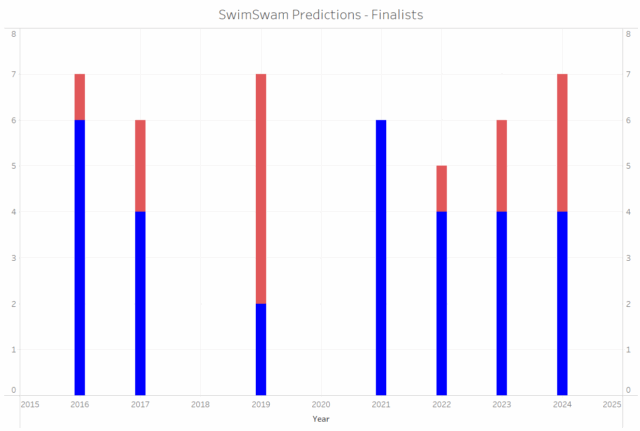
Finally, here’s how our predictions have fared. Blue marks the countries where we were within a single position in our predictions, with red denoting those that made the final but where our predictions were slightly further away.
We did not have a full set of relay predictions in 2015, so this year has been omitted

USA 🥇
GBR 🥈
AUS 🥉
GB had a minimun of two opportunities to lower the WR while all four legs were in their prime. Those opportunities have passed.
Overdue for a world record
I feel as though the first graphic undersells just how dominant GB has been.
Dominant is relative. I would call the US winning this relay by like a 25 during the majority of the Phelps – Lochte era dominant.
Team GB has won the relay 5 of 8 times. That number would also be 4 of 8 if Phelps wasn’t suspended in 2015 where the margin was .42 for GB.
Even in 2022 when the shoe was on the other foot for GB they were 3rd 3.8 seconds back of the US. Combine all the best splits of GB from the World Championships and commonwealth games – including Dean’s 1:43.5 and Scott’s 1:44.4 and they still add up to a slower time than the US by half a second. 7:00.79 to 7:00.24 for… Read more »
A bit sus to contextualise RE Phelps suspension in 2015, then cite the US’ winning margin in 2022 without contextualising with the fact GB swam without Richards and Scott.
GB certainly haven’t dominated since 2015, but they’ve been by some way the best quartet over a sustained period and it’s a shame that many US fans have been unable to give them their props year after year.
You obviously didn’t read the entire post, I did contextualize it.
Include Richards and Scott’s splits from commonwealth games in 2022 and GB is still 2nd best.
For the size of nation that the UK is, they sure can produce a 4×2.
Fun fact, James Guy has been on every single one of those 4 x 2s
More we can produce this 4×2, pre 2015 we really didn’t have any great pedigree in it.
Interesting to see if this has now been so long lasting it inspires a new generation to focus on the 200 free
The USA dominance in this relay will be staggering for many years.
Like GB has been ?
Calling GB dominant for winning 5/8 in this is hilarious.
I wouldn’t call the US men’s 4×100 “dominant” over the same stretch and they have won 6/8. Neither team broke the WR or the Olympic record either.
Australian women 4×1 is what I would call “dominant”. Destroying the field and the record for basically every major championship since 2015.