
Wyoming’s Simon Casey was once told that he would never qualify for an NCAA Championships meet.
Casey spent his first two seasons at LSU, where he felt like he couldn’t communicate with his coaching staff and it was “their way or the highway.” He says he was pulled off NCAA-qualifying relays before SEC Championships. And despite being the Tigers’ fastest returning 200 backstroker following the 2024-25 season, he was cut from the roster, pulling the plug on his time in Baton Rouge.
Following that cut, Casey didn’t know if he’d swim again. But thanks to a myriad of changes in college swimming, as well as dramatic improvements in his primary events, he was standing behind the blocks at the 2026 NCAA Men’s Division I Championships as one of Wyoming’s first three representatives at the meet since 2015.
“It honestly just felt like a dream come true,” Casey said of qualifying for NCAAs. “Thanks to the new rules — which, make what you make of those — I was able to make it, and look at the people that told me I wouldn’t be here in the face and say, ‘I made it.'”
Casey’s NCAAs berth with Wyoming is a product of two things. First is the new NCAA championships automatic qualification rule, which allows individual conference champions to swim at the meet as long as they get under a certain qualification time. Second are the roster limits implemented by the 2025 House v. NCAA Supreme Court ruling, which restricted men’s teams to just 30 swimmers.
The House ruling prompted many cut Power Four swimmers across the NCAA to transfer to mid-major schools. Because of AQs, 34 swimmers from 20 different mid-major schools qualified for men’s NCAAs when they wouldn’t have under the old system. Casey was one of them — In his first season as a Wyoming Cowboy, he made the meet by virtue of winning the MPSF title in both the 200 free and 200 back. In both events, he improved almost two seconds from his best times at LSU.
These changes have put mid-major schools — specifically, their swimmers who transferred from Power Four schools — under a spotlight at NCAAs. But they don’t come without controversy. In college swimming’s first season post-House, roster cuts are still a sore subject. And automatic qualification means that 34 men who would have qualified under the old system wouldn’t this year, with the majority of them being Power Four swimmers.
But for the mid-majors racing at NCAAs, they’re blocking out the noise and making the most out of their opportunity.
New Beginnings
Casey isn’t alone as a former Power Four swimmer who achieved newfound success at a mid-major school.
Towson junior Jed Garner was also amongst the automatic qualifiers at NCAAs, racing the 100 and 200 breast at the meet after winning the events at the CAA Championships. Despite making NCAAs with Tennessee last season, he didn’t get his scholarship renewed post-House and transferred to Towson over the summer of 2025.
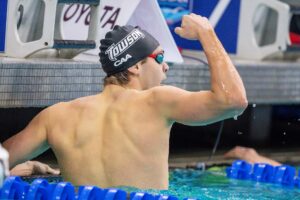
Jed Garner (photo: Jack Spitser)
At Towson, Garner had the opportunity to move closer to his hometown and train with alum Brian Benzing, the 2024 NCAA runner-up in the 100 breast and one of the most successful mid-major swimmers of the decade. Garner credits Benzing for helping him with his front-half speed, while Garner helped push Benzing on his back half. The improvements are evident — throughout the 2025-26 season, Garner improved 0.28 seconds in his 100 breast and over two seconds in his 200 IM.
“Racing him during practice just gives me confidence,” Garner said of Benzing. “The closer I am to him, the closer I’m going to be where I want to be at the end of the year.”
Jed Garner, Pre and Post-Transfer Best Times:
- 100 breast: 52.40 –> 52.12
- 200 breast: 1:52.30 –> 1:52.45
- 200 IM: 1:47.18 –> 1:45.08
IU-Indy junior Yassin Abdelghany wasn’t cut by Louisville after two season with the Cardinals, but shoulder injuries he suffered during his freshman and sophomore years there cut both of his seasons there short. Abdelghany then realized that Louisville wasn’t a good fit, and after receiving advice from his best friend who swam at IU-Indy, he transferred to become a Jaguar.
Jaguars head coach Damion Dennis, who said that Abdelghany’s times coming into his junior year were “exciting for a program like [IU-Indy],” noted that traits like academic focus, good character and strong communication were important for the Jaguars program. The coach said Abdelghany struggled in those areas at Louisville, but exhibited them at his new program.
“Under our umbrella and some of our program stuff, we’ve been able to help him blossom and take off in a lot of ways,” Dennis said. “There’s a particular kind of person we are looking for, and he seemed to have all those things for us.”
Abdelghany continued struggling with injuries at IU-Indy, dislocating his shoulder in November 2025 and January 2026. But Dennis’s staff was able to navigate that through catering dryland drills for him, while also giving him tailored support and feedback. Dennis also praised Abdelghany for being diligent in his rehab.
And when Abdelghany was finally fully healthy, he won Horizon League titles in the 50 free, 100 free and 100 fly while setting lifetime bests, successfully qualifying for NCAAs even without the AQ boost. He became the third-fastest mid-major ever in the 50 free, and the second IU-Indy men’s swimmer to ever make the meet after teammate and 200 breast NCAA All-American Logan Kelly.
Yassin Abedlghany, Pre and Post-Transfer Best Times:
- 50 free: 19.30 –> 18.91
- 100 free: 43.48 –> 42.28
- 100 fly: 46.30 –> 45.23
“I think everybody can say their team culture is great, but I would argue, look at where our athletes start and where they end.” Dennis said. “Team culture is a big part of it too. [Yassin] was at other schools and he swam exceptionally well before, we put together the program that got him to be the third-fastest mid-major freestyler ever.”
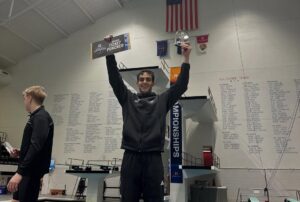
Yassin Abdelghany IU Indy from IU Indy Athletics
For Casey, a big part of why Wyoming fit better than LSU was because he felt like everything was more of a learning experience than a competition. He also credits his strong relationships with head coach Dave Denniston and recruiter Jonathan Reeder for making his experience in Laramie better.
Denniston believes these relationships are possible because a smaller team and pool of resources makes it easier for each swimmer to get individualized attention.
“We have to be in tune with everything that is going on from nutrition, mental health, class, stress, practice schedule, how they’re going to improve in the water,” Denniston said. “We’re a lot more hands-on in all those aspects, where a lot of those bigger schools have people in mind to say ‘hey, go talk to so and so and make sure that’s taken care of.'”
Additionally, Casey benefitted from the Wyoming’s altitude training, which makes him feel “superhuman” when he’s competing at a normal level (he dropped time from MPSFs to NCAAs in both of his events). The Cowboys are also getting a new state-of-the-art facility that will open in May, another draw for new recruits.
Simon Casey, Pre and Post-Transfer Best Times:
- 50 free: 20.42 –> 19.89
- 200 free: 1:35.40 –> 1;33.70
- 200 back: 1:43.78 –> 1:41.38
Mid-major schools have given swimmers like Casey, Abdelghany and Garner a chance to start anew. But they’re also making history for their schools in the process, and want to use their success as a launchpad to take it to new heights.
“We’re always fighting for something bigger. That comes with having a chip on our shoulder,” Dennis said. “From going to never making NCAAs, making NCAAs to having our first All-Americans — I keep taking steps forward…where do we go, and how do we continue our program that is a mid-major program and make them a prominent, nationally recognized program that’s competing with Power Fours?”
Looking Ahead
Not every P4-to-mid-major success story involves AQs or the House settlement, but both changes help with making mid-majors more nationally recognized. That doesn’t mean mid-major swimmers and coaches agree with all the changes being made.
For starters, Dennis believes that the AQ time standard needs to be faster than what it is now, and that the gap between the AQ time and the invite time is too large. Casey agrees that the AQ cuts might be “a little bit off.” But likewise, they’ll still take the chances the rules give them — Garner, who notably was just one spot below the non-AQ invite line, notes that “taking away the bottom couple spots” wouldn’t affect the meet’s end results that much.
“They have us in the back here. We get articles posted about us being weird mid-major schools of breaststrokers,” Garner said. “We’re just taking it all in. I think it’s a great experience regardless of how we’re looked at.”
Likewise, mid-major coaches understand the drawbacks of the House settlement, but want to take advantage of it to recruit swimmers that they may not have gotten otherwise. And sometimes, like in the situations of Casey and Garner, said swimmers become better than they were at Power Four institutions.
Additionally, Denniston notes that swimming programs (specifically men’s swimming) across the country are being cut as a result of the House settlement. With new rules allowing Wyoming to become nationally prominent, he can be more confident that the Cowboys won’t suffer the same fate.
“There’s a lot not to like about it, but I think any coach that’s been doing this for a while is going to seek out any opportunity to make their team better,” Denniston said of the House settlement. “It’s not the best way for it to come about, but it was an opportunity that we needed to seize if we were going to be relevant.”
But regardless of whether the automatic qualification rules are “right,” and whether spreading the wealth as a result of the House settlement is good for swimming, the reality is that the team makeup of NCAAs has become more diverse. Mid-major swimmers and coaches want to embrace that diversity and bring more publicity to their program — whether it be Casey and his teammates representing Wyoming after a decade-long drought, Abdelghany making IU-Indy sprint history, or Garner following in Benzing’s footsteps.
More than anything, though, they want to prove they belong and are here to stay.
“I don’t think there should be a distinction that mid-majors are stealing these sports, per se, because I think there are a lot of athletes that are deserving that don’t get those chances on both sides of the equation,” Dennis said. “Instead of pointing fingers and being like, ‘Oh, those are the little guys,’ let’s support the athletes that are here. Just go fast and have fun, put on a show, and we’ll figure out the details later.”

Missing IU transfer Harry Herrera— breaststroker.
Reminds me of when Ivan Puskovitch was cut from USC, then qualified for the Olympics two years later
Thosbos the way it should be. I’m tired of seeing the same swim (and football) factories import swimmers at the expense of competition
In the meantime, let’s make the show really hard to access and watch for the viewers. Also with no B finals less exposure for programs out of the top 10 , etc.
Go Pokes
Great article
Yassin!! So happy seeing this guy doing well and in a good place.