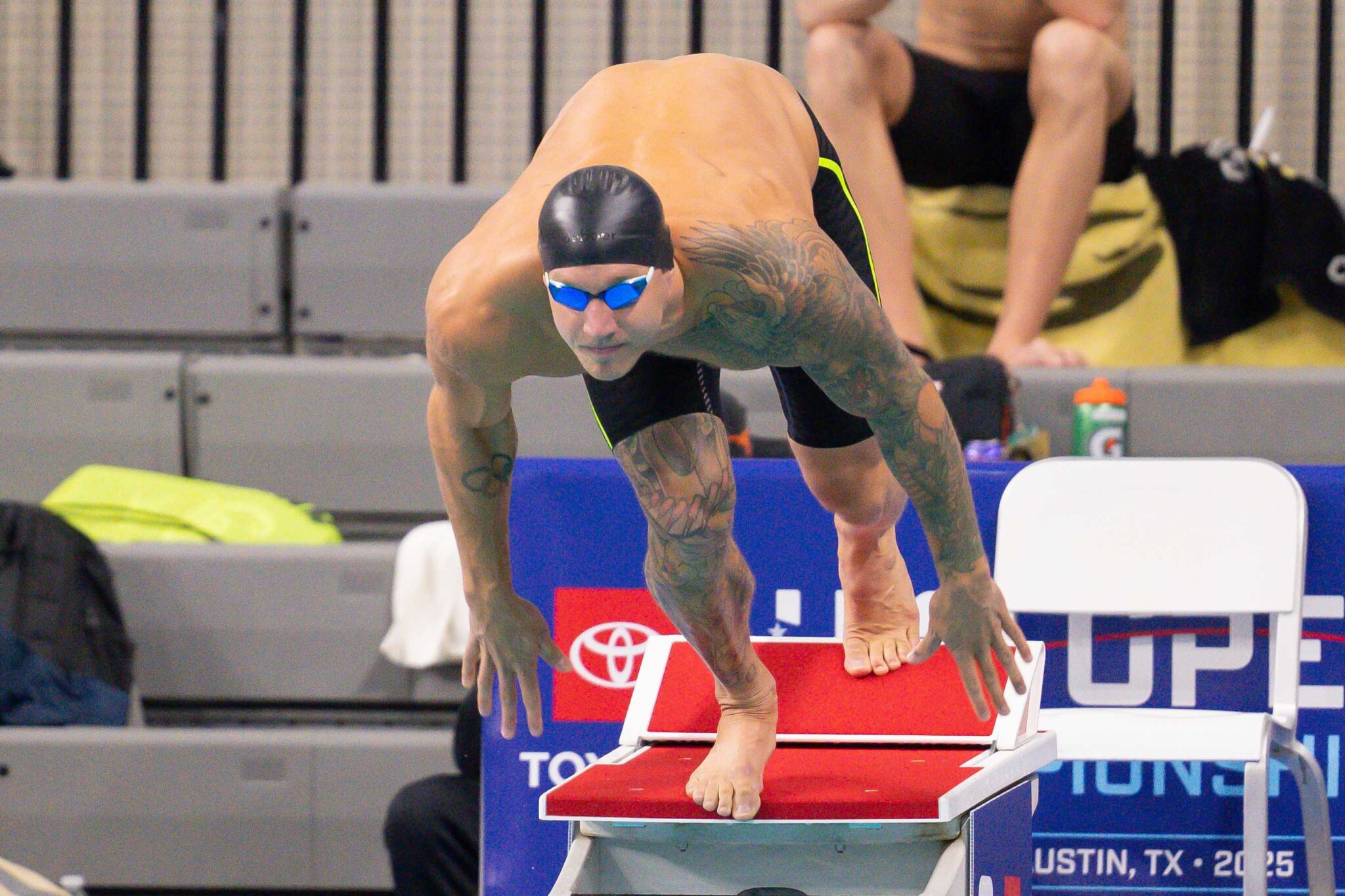
Races are often won and lost at the start. So swimmers do what swimmers do and fixate on their reaction time—how long it takes from the starter’s beep to leave the block—to judge how good their start is.
But reaction time doesn’t tell the whole story.
As it turns out, it’s less important for an explosive start than most swimmers think. A 0.60 up on the scoreboard certainly looks awesome, but it doesn’t really tell us how fast the start is.
Here’s what matters for a truly kaboom swim start.
The Impact of Reaction Time on Sprint Performance
A 2017 study published in the Journal of Physical Education and Sport looked at the start performance of 50m and 100m finalists over seven World Championships (2003-2015).
Differences in reaction time were large enough to potentially flip final placings in 4.25% of 50m events.
And when we look at the start performance of the two 50m freestyle winners at the 2024 Paris Olympics—Cam McEvoy and Sarah Sjöström—they both had the fastest reaction times among the finalists.
So yes, reaction time can certainly have an impact. But reaction time (which reflects the time spent during the block phase of the overall start) is just one piece of the puzzle.
Time-to-15m – The Metric That Matters
A better metric than reaction time for measuring start performance is time-to-15m. It better reflects all of the stuff that goes into a fast start, well, fast.
A study (Thng et al., 2020) looked at the starts of 152 high-performance (elite or national-level) swimmers to see which on-block factors predicted faster 15m times.
In other words, what are swimmers doing on the block that cranks out a fast 15m split?
Four things that stood out:
- How much total work the swimmer produced on the block
- How much power they generated
- How fast they left the block horizontally
- How quickly they accelerated
Reaction time was also measured, but it was not one of the main predictors of who reached 15m fastest.
And this is just the on-block phase of the overall start—we haven’t even considered what swimmers are doing in the air, their trunk angle at take-off, entry position, glide depth, underwater velocity, and all the other things that take them to 15m.
The swimmers who reached 15m fastest produced more force, directed more of it horizontally, and converted it into take-off velocity.
Sequenced Block Phase > Fast Reaction Time
A powerful block phase is also properly sequenced. We aren’t sacrificing an effective start just to be more fleet-footed. When the starter’s beep goes off, there is a coordinated pattern of force production that fuels maximum take-off velocity.
Thng et al. (2021) broke down the block phase into four distinct mini-phases. Here’s how this is mapped out based on a reaction time of 0.70s:
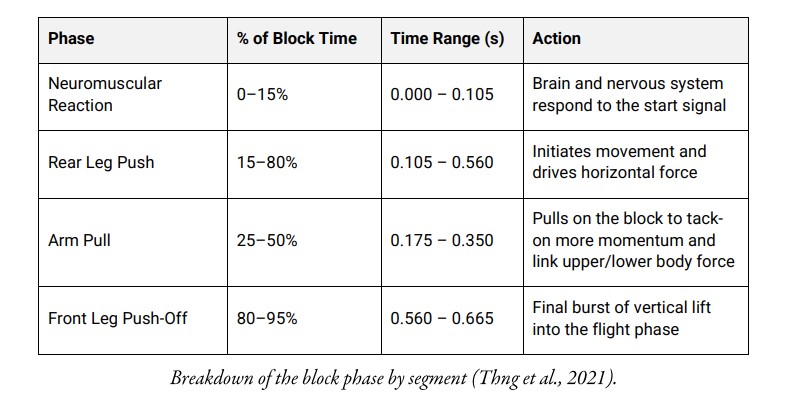
Force production follows a coordinated pattern:
- Rear leg initiates force (~15% of block time)
- Upper body “grab” forces contribute next (~25–50%)
- Rear leg horizontal peak occurs (~60–80%)
- Front leg horizontal peak occurs late (~88–95%)
This little song-and-dance sequences force production in a way that generates as much horizontal take-off velocity as possible, the thing that truly matters for a fast start.
Reaction Time vs Start Performance
Looking at the Paris Olympics again, we see how reaction time didn’t mean faster times to 15m. In both the men’s and women’s events.
Cam McEvoy had the fastest reaction time, but he was not first to the 15m:
| RT | 15m Split | |
| Caeleb Dressel | 0.63s | 4.97s |
| Cam McEvoy | 0.56s | 5.11s |
Same story in the women’s event.
Sjostrom was off the block first but Gretchen Walsh more than made up for a slower reaction time with her underwaters:
| RT | 15m Split | |
| Gretchen Walsh | 0.75s | 5.88s |
| Sarah Sjostrom | 0.61s | 6.00s |
Reaction time is one component of what happens on the block, but time-to-15m is more important when it comes to assessing whether a start is fast or not.
So, How Important is Reaction Time?
How long it takes for you to react on the blocks matters to an extent—you don’t want to spend five seconds on the block, charging up your legs, after all—but it’s not what is decisive for a fast start.
At best, it’s a rough proxy for how quickly you can generate force. It doesn’t tell us the important stuff, like how much force is generated, how quickly swimmers leave the block, or how effectively you carry that speed to 15m.
For the enterprising sprinter looking for a more explosive start, stop chasing a twitchy 0.60s reaction with no power behind it, and focus on:
- Producing more force on the block
- Directing that force horizontally
- Leaving the block with lots of velocity
- And crucially, carrying that speed through the entry, underwater, and breakout
Focus on those things, and a high-performance reaction time and increased power off the block will be the natural result.
Happy sprinting!
ABOUT OLIVIER POIRIER-LEROY
 Olivier Poirier-Leroy is a former national level swimmer, 2x Olympic Trials qualifier, and author of several books for swimmers, including YourSwimBook, Conquer the Pool, The Dolphin Kick Manual, and most recently, The 50 Freestyle Blueprint.
The book is a beastly 220+ pages of evidence-based insights and practical tips for improving freestyle sprint speed.
It details everything from how to master stroke rate, technique, build a thundering freestyle kick, improve your start and underwaters, and much more.
The 50 Freestyle Blueprint also includes 20 sprint sets to get you started and a bonus guide on how to master the 100 freestyle to complete your sprint preparation.
👉 Learn more about The 50 Freestyle Blueprint today.

Punchy is rowding the air rn
https://www.researchgate.net/publication/5511475_Front-_or_rear-weighted_track_start_or_grab_start_Which_is_the_best_for_female_swimmers
What is rear weighted vs front weighted mean in terms of track start?
Putting “some extra” weight on the back foot.
The Race Club has some data suggesting more weight needs to be put on the back foot on the wedge than some have previously thought. Which would align with this.
Now if we can also get age group coaches to understand the stronger leg should be the back foot, we’ll get somewhere….
And this was done before the wedge right?
Rowdy’s head might implode if he reads this. What else is he going to talk about for the first 90 seconds of a race?
The problem here is we call it reaction time, but as demonstrated in the article, what we humans consider to be reaction time (the time between the signal and the start of the body’s starting motion) is really just the neuromuscular reaction. There is no way to easily measure that from the starting block, so instead we measure when the swimmer leaves the block. We should probably call it block departure time or similar, since reaction time is only a small part of it. We don’t know the actual reaction times based on what is reported at the meets. I am sure high speed cameras could capture the movements of each of these swimmers to tell us exactly what the… Read more »
In the 50 meter free, even more important than time to 15m is time to 50m.
Which is being smart alecky but also speaks to and against the premise. Once they leave the block are they doing nothing else until 15m? We assume they are doing something. So that needs to be looked at to help evaluate the importance of reaction time.
Don’t lump all of us rational folk in with Rowdy Gaines
Doesn’t really matter in a 1500 or 1650.
Both Gretchen Walsh and Cate Campbell, being very tall, regularly have the slowest RT, but they regularly were the first to 15m
And your resident ” expert” commentator, Rowdy, still hasn’t learnt that after 40 years.