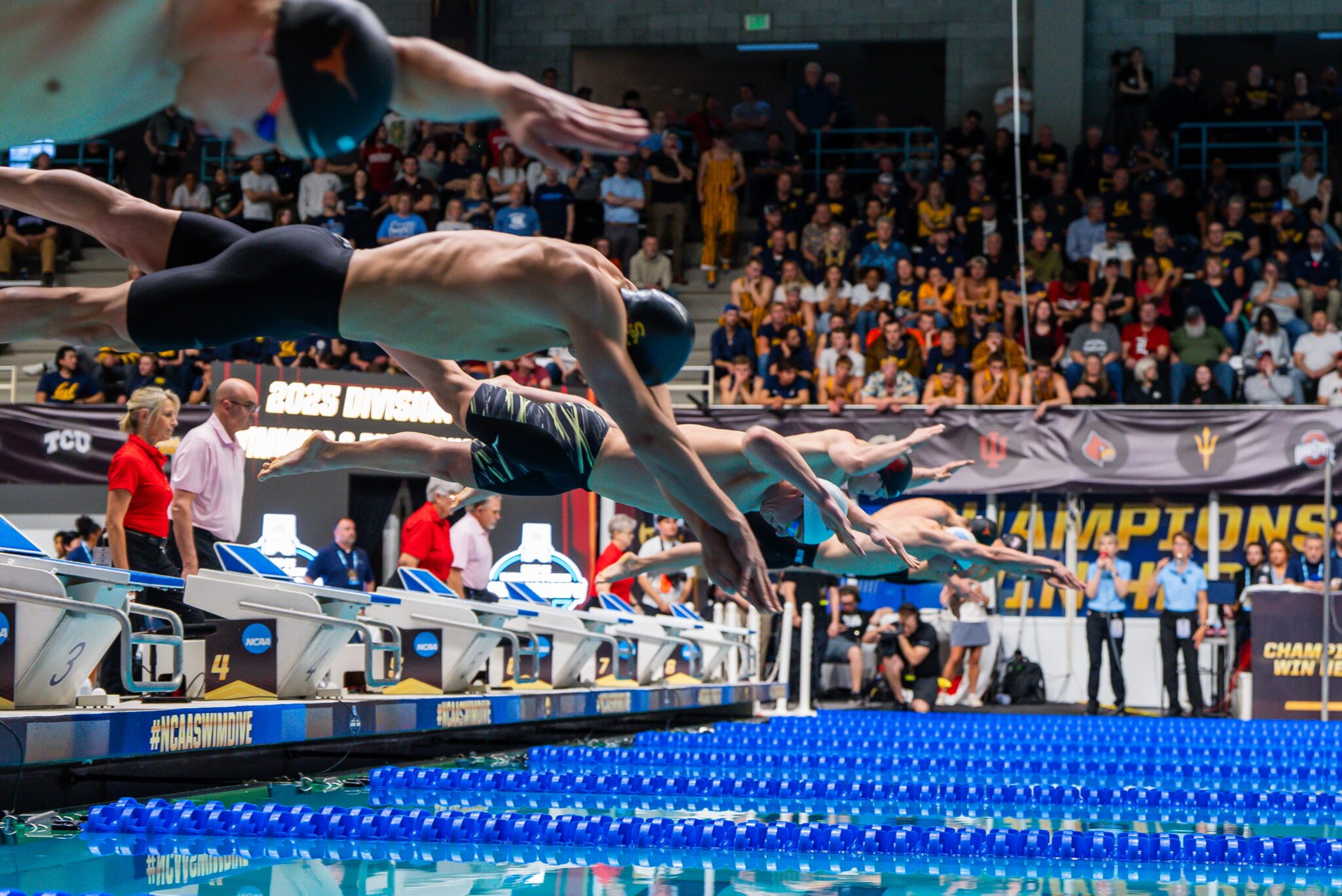
Using the power rack to build sprint speed? Here is a power rack set for building power that translates into race day speed.
Sprinters like to go all out and all the time when it comes to developing power in the water.
Buckle up to the power rack, spin up the arms, and unlock the power (and by extension, speed off the block).
That approach can work, but it’s not the only way. It may not even be the best way.
Most swimmers/coaches tend to go with max resistance on every rep on the rack. A different strategy is using a flat pyramid design to vary the load while keeping effort fast and aggressive.
You are still sprinting with each repetition. The difference is that the amount of resistance changes.
By intentionally increasing and decreasing load, your body experiences different levels of resistance at full speed, with plenty of rest (important!) between reps to keep output nice and high.
Before You Start
Determine your “1RM” on a rack—the heaviest you can pull while still moving forward through the water.
The Set
6×12.5m max effort on the power rack
Rest 3-5 minutes between reps
- 1 repetition at 50% 1RM.
- 1 repetition at 60% 1RM.
- 2 repetitions at 70% 1RM.
- 1 repetition at 60% 1RM.
- 1 repetition at 50% 1RM.
Why This Set Turns on the Lights
A study (Gonzalez-Rave et al., 2018) with 16 national-level swimmers compared this type of pyramid design against constant heavy loading (6×12.5 all at 70% 1RM) over six weeks.
The pyramid group came out ahead in several important ways:
- Big increase resisted swimming strength. The pyramid group improved maximum drag load by nearly 14%, while the steady-state group showed no meaningful improvement. This was the biggest difference between groups in the study.
- Avoided strength decline. The steady-load group actually saw a decline in force production. The pyramid group maintained or slightly improved force output. Varying load helped preserve strength.
- Better carryover to 50 performance. When both groups swam timed 50s after the six-week intervention, the pyramid group trended towards improvement (-0.32% change in times) while the steady group trended the other way (+2.59%). Not significant but suggested negative transfer in the steady group.
- Better neuromuscular adaptations. The study authors noted that the flat pyramid likely produced better nervous-system adaptations. Basically, your body learns to organize powerful, fast movements under slightly different resistance levels instead of repeating the same load over and over.
- Trains power that works on race day. Even in the 50 freestyle, power output declines over the course of the race. Swimmers aren’t using “peak power” from start to finish. Force and velocity drop, even when effort is red-lined. Sprinting under different loads better matches what actually happens in a race.
The Bottom Line
The power rack is one of the best resisted swimming tools that swimmers have at their disposal.
From using it to build better stroke coordination habits (ahem reducing that gallop), to building faster underwaters, to boosting power in your stroke, the rack has a lot to offer.
But like most tools, how it’s used is where the chlorinated rubber meets the road.
Repeating the same load over and over might feel like you are giving ‘er on the rack and developing nuclear levels of explosiveness. But varying load while sprinting offers is a smarter alternative for building a stronger, more explosive stroke that actually shows up on race day.
Happy sprinting!
ABOUT OLIVIER POIRIER-LEROY
 Olivier Poirier-Leroy is a former national level swimmer, 2x Olympic Trials qualifier, and author of several books for swimmers, including YourSwimBook, Conquer the Pool, The Dolphin Kick Manual, and most recently, The 50 Freestyle Blueprint.
The 50 Freestyle Blueprint is a blueprint that breaks down how elite sprinters generate speed, from stroke rate and kick power to starts, underwaters and the right dryland, all using evidence-based insights that actually transfer to race day.
If your goal is a faster 50 freestyle, this is the playbook.
The digital book also includes 20 sprint sets to get you started and a bonus guide on how to master the 100 freestyle to complete your sprint preparation.
👉 Build a faster freestyle–starting today.

I like this. I think you could transfer this logic over to high school aged athletes for teams without a tower by going:
1×20 Max
1×15 Max Red chute (lighter)
2×12.5 Max Blue chute (Heavier)
1×15 Max Red chute (lighter)
1×20 Max