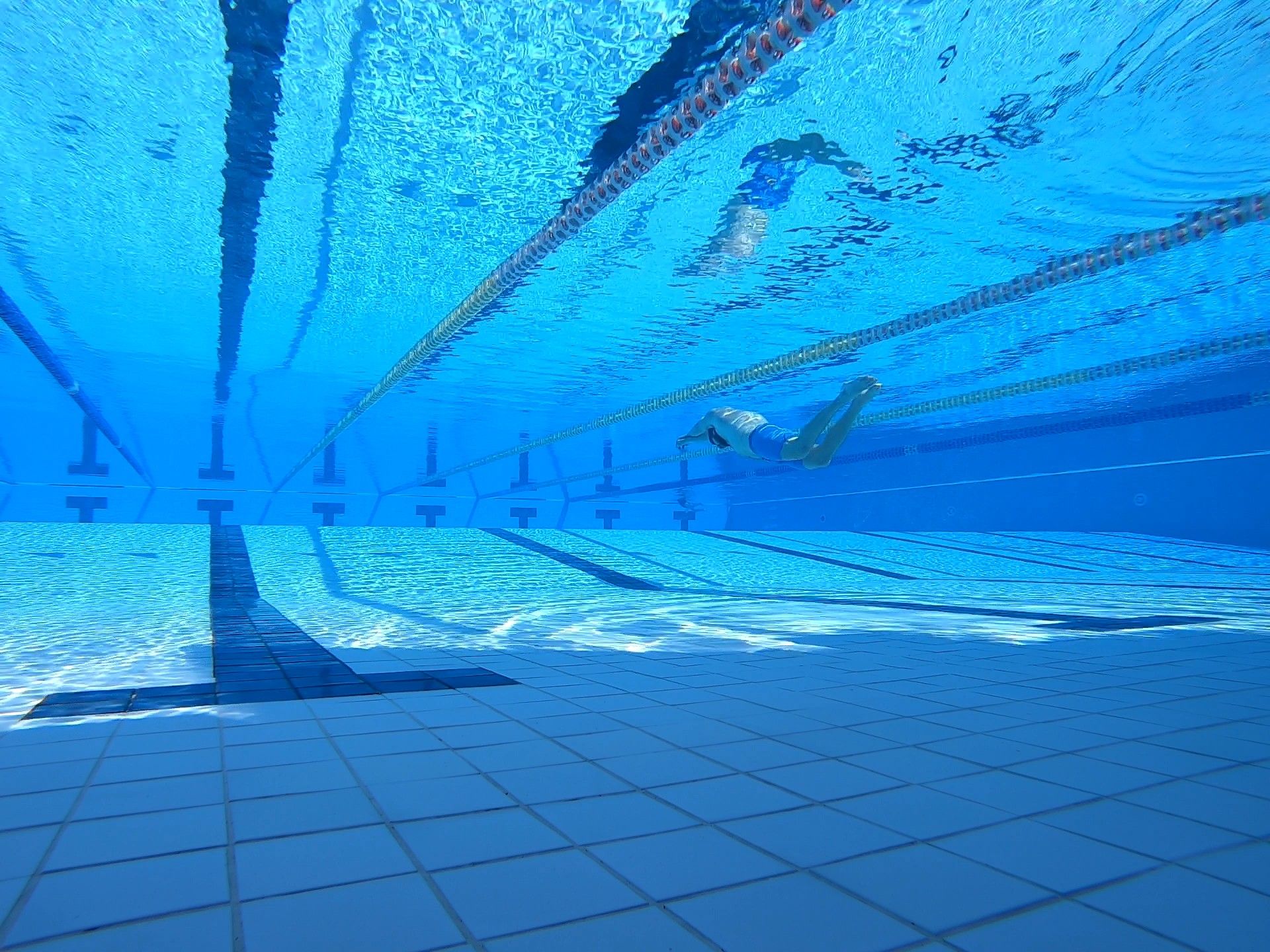
Hip rotation is one of the lesser discussed parts of an elite underwater dolphin kick. Here’s what swimmers and coaches need to know about fully using the hips when dolphin kicking.
The underwater dolphin kick is a crucial part of fast swimming on race day, regardless of your event distance.
Sprint masters like Gretchen Walsh and Caeleb Dressel use their underwater dolphin kicks for golden and explosive breakouts.
Even middle distance swimmers use the dolphin kick to devastating effect—France’s Leon Marchand dolphin kicked over 14m (!!!) on his final turn of the 400m individual medley at the Paris Games.
Improving the underwater dolphin kick usually involves increasing ankle strength, ankle flexibility, building more powerful legs in the gym, and simply kicking a little further out with each chunk of training.
But there’s one part of fast dolphin kicking most swimmers overlook, and that’s hip rotation.
It’s subtle. Sneaky. Hard to see. And rarely talked about.
But it’s one of the most important components of clean, powerful dolphin kicking.
What Is Hip Rotation in Dolphin Kicking?
Swimmers rightfully think about the hips powering the up-and-down movement of the dolphin kick. We start the undulation in the trunk, and by thrusting the hips, we add velocity to the body wave traveling down the torso and legs, leading to a thundering dolphin kick.
But the hips aren’t only moving up and down (although it certainly feels like it). When you dolphin kick, you are also rotating the hips, like turning a doorknob attached to your legs.
This rotation, which happens both internally and externally during different phases of the kick, adds a spiraling motion to your kick.
It might seem minor, but it makes a big difference in how your feet move through the water and how much thrust you can generate.
How It Works in the Kick Cycle
Here’s how hip rotation fits into your underwater dolphin kick:
- At the start of the down-kick, the hips rotate inward (internal rotation), driving the legs down and snapping the feet and toes together. Midway through the downkick, the hips shift to external rotation, turning the knees and feet slightly outward to displace more water.
- During the upkick, as your feet come back up towards the surface, the hips begin in external rotation, with feet apart, improving the angle of the insteps against the water. Toward the end of the upkick phase, the hips rotate inward again, drawing the legs together and restarting the kick cycle.
More simply:
- Internal rotation at the beginning of the downkick
- External rotation halfway through the downkick
- External rotation at the beginning of the upkick
- Internal rotation at the end of the upkick
This twisting action makes the kick more fluid, positioning the feet so that they can displace more water and generate more kicking kaboom.
Why Hip Rotation Matters for a Faster Dolphin Kick
Alrighty, so we have a sense of what the hips are doing when we dolphin kick. But how exactly does it affect UDK speed?
Glad you asked!
Hip rotation:
Improves vortex strength.
At higher speeds, as we kick our little hearts out, the external rotation at the end of the downkick increases the spin on the vortex we create behind us.
These little whirlpools are what drive us forward. The faster that vortex spins, like a high-powered washing machine, the more thrust you get from each kick cycle (Nakazono et al., 2024).
Better foot positioning.
One of the biggest advantages of hip rotation is that our feet get into the right position to displace water like a boss.
When the hips rotate outward during the upkick, the tops of the feet angle backward and upward, increasing the surface area that pushes against the water.
That rotation helps the feet grab more water during the often criminally neglected upkick phase of the dolphin kick.
Vortex recapturing.
Hip rotation also helps with something (very) cool called vortex recapturing. When you kick, you create small whirlpools (vortices) in the water. Efficient kickers are able to reuse parts of these vortices for the next kick cycle.
Hip rotation helps here too, reusing water flow for an added boost of propulsion. Smooth internal-external transitions shorten the dead spots in the kick cycle where vortices are prone to shedding off.
Hip rotation reuses the momentum of previous vortices, avoiding the temporary velocity drop that happens when vortices decay and spin off into the depths of the pool.
Control water.
Proficient hip rotation slightly increases the length of the kick cycle. This sounds like it would be a bad thing, but in proficient kickers, it means they are controlling the water longer and displacing more water.
Think of it this way: instead of slicing the foot vertically through the water, hip rotation allows swimmers to grip and hold more water and displace more of it. Hip rotation is a way to better control the water.
Increases in importance.
Studies with elite dolphin kickers show that range of motion in the hip joint significantly increases along with velocity. A study by Matsuda et al. (2021) noted that elite swimmers had both a greater range of motion in hip rotation and faster hip rotation speeds.
When swimmers shifted from 70% to 90% velocity, the speed at which the hips rotated ramped up big time:
| 70% of Max Velocity (°/s) | 90% of Max Velocity (°/s) | Velocity Increase (%) | |
| Hip Internal Rotation Velocity | 182 | 251 | 38% |
| Hip External Rotation Velocity | 219 | 309 | 41% |
The faster you go, the more your hips need to rotate smoothly and powerfully to maintain control and efficiency.
How to Improve Hip Rotation in Your Dolphin Kick
The good news is that hip rotation can be improved. Like anything else in the water, it can be developed with some basic self-awareness, technique, and some dryland exercises.
Here are a few ideas:
Film yourself underwater. Look for signs of rotation. Do the hips rotate inward on the way down and outward on the way up? Are your feet snapping together and then separating slightly? Film from the pool bottom and kicking away from the camera to get a better sense of how your hips and feet are moving and rotating.
Work hip mobility. Stiff hips can serve as a parking brake for efficient rotation. Spice up your stretching and mobility routine with movements that target internal and external hip rotation. Seated hip switches or 90/90 stretches are two great examples, helping give you the range of motion needed to rotate effectively.
Strengthen your hips and core. A strong, stable core lets you rotate powerfully without losing alignment or corkscrewing the hips out of position. Movements like lateral medicine ball throws and anti-rotation core exercises like the Pallof press train stability and power in the hips.
The Bottom Line
Hip rotation is one of the sneakier parts of a booming underwater dolphin kick. Done properly, it positions the feet to push more water, creates a smoother and more fluid kick cycle, and even lets you tap into the water momentum you’ve already created.
If you’re serious about improving your underwaters, effective hip rotation is a small but powerful detail that can lead to propulsive gains when focused on and improved.
Happy kicking!
Level Up Your Underwater Dolphin Kick
Olivier Poirier-Leroy is a former national-level swimmer, 2x Olympic Trials qualifier, and author of several books for swimmers, including The Dolphin Kick Manual: The Swimmer’s Ultimate Guide to a Fast Underwater Dolphin Kick.
 The book is a beastly 240+ pages of actionable insights and research into elite dolphin kicking technique and performance. It details everything from mastering undulation to vortex recapturing to structuring a dryland program for dolphin kicking success.
The Dolphin Kick Manual combines evidence-based insights with a collection of 20 ready-to-go sets and a 6-week Action Plan to help swimmers set a course for dolphin kicking success.
Train smarter and kick faster.
👉👉👉 Learn more about The Dolphin Kick Manual
