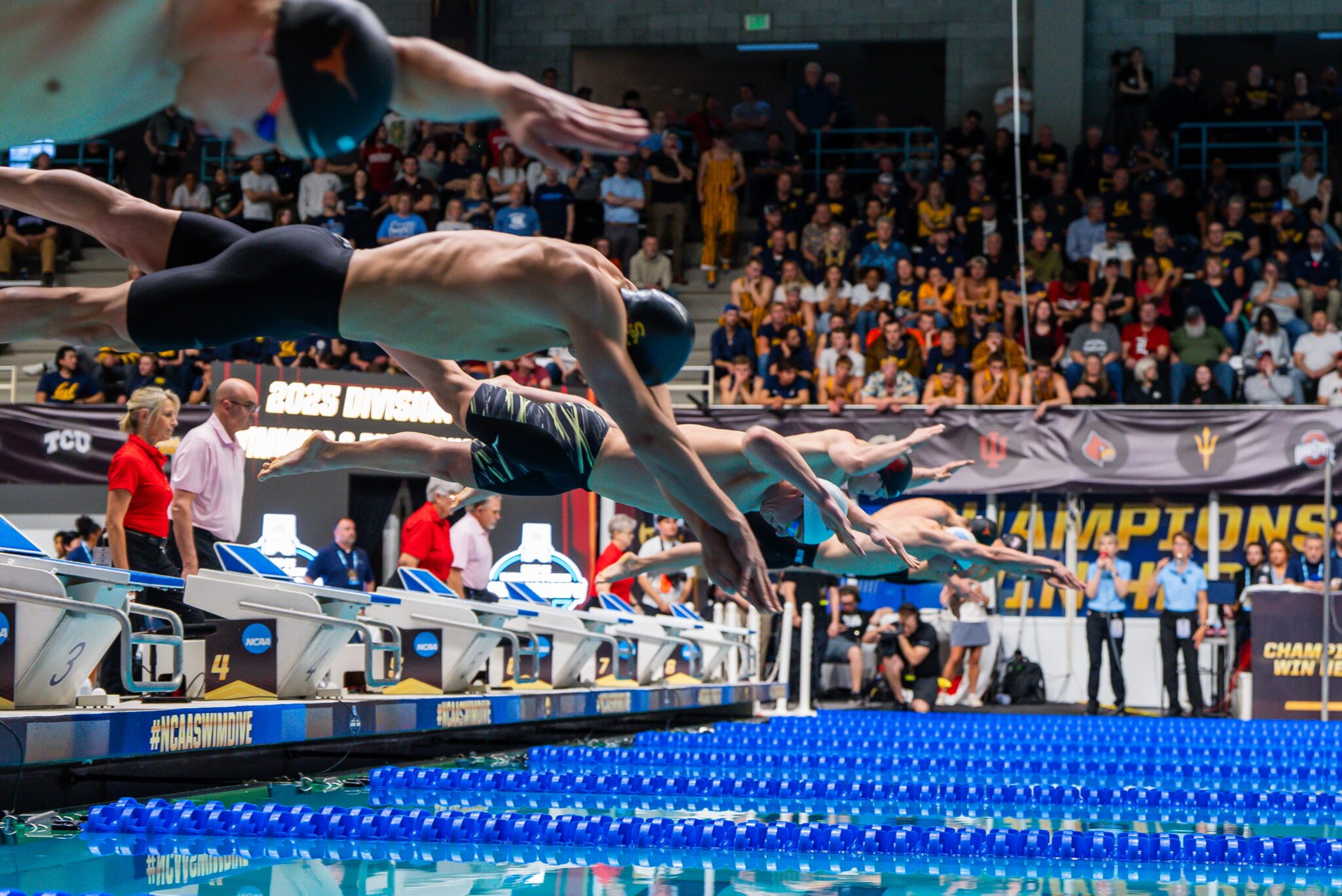
Courtesy: Stacy Henderson
For those of us who love competitive swimming, it can be both perplexing and frustrating to watch the sport plateau, or even decline, as the rest of the sports world continues to grow. Despite incredible athletes, record-breaking performances, and thrilling races, swimming hasn’t reached the audience it deserves.
While the action in the pool is as exciting as ever, the way the sport is promoted hasn’t kept pace with modern fans, social media trends, or the opportunities to grow engagement year-round.
If we want our sport to thrive – not just every four years at the Olympics – we need fresh ideas, new energy, and a stronger connection to the fans who already love it.
Why Swimming Struggles to Compete With Other Sports
Other sports succeed not just because of competition, but because they create an experience. Football, basketball, and baseball thrive on atmosphere: chants, school spirit, and an always-on media presence. Swimming, despite its athletes’ talent, hasn’t built that same culture of community and entertainment.
We have the athletes. We have the fans. What we don’t yet have is the energy and creativity to bring it all together.
The Sports Growth Triangle: Football vs. Swimming
Think of sports growth as a triangle.
At the base, community and youth participation fuel local excitement. As athletes progress, school and college programs (should) build larger audiences. At the top, professional and elite levels generate massive national interest.
For football, each level feeds the next – pee wee to high school, to college, finally reaching the NFL – creating a self-sustaining cycle of attention and revenue. Friday night lights draw hundreds, college rivalries fill stadiums, and the NFL captures millions weekly on TV.
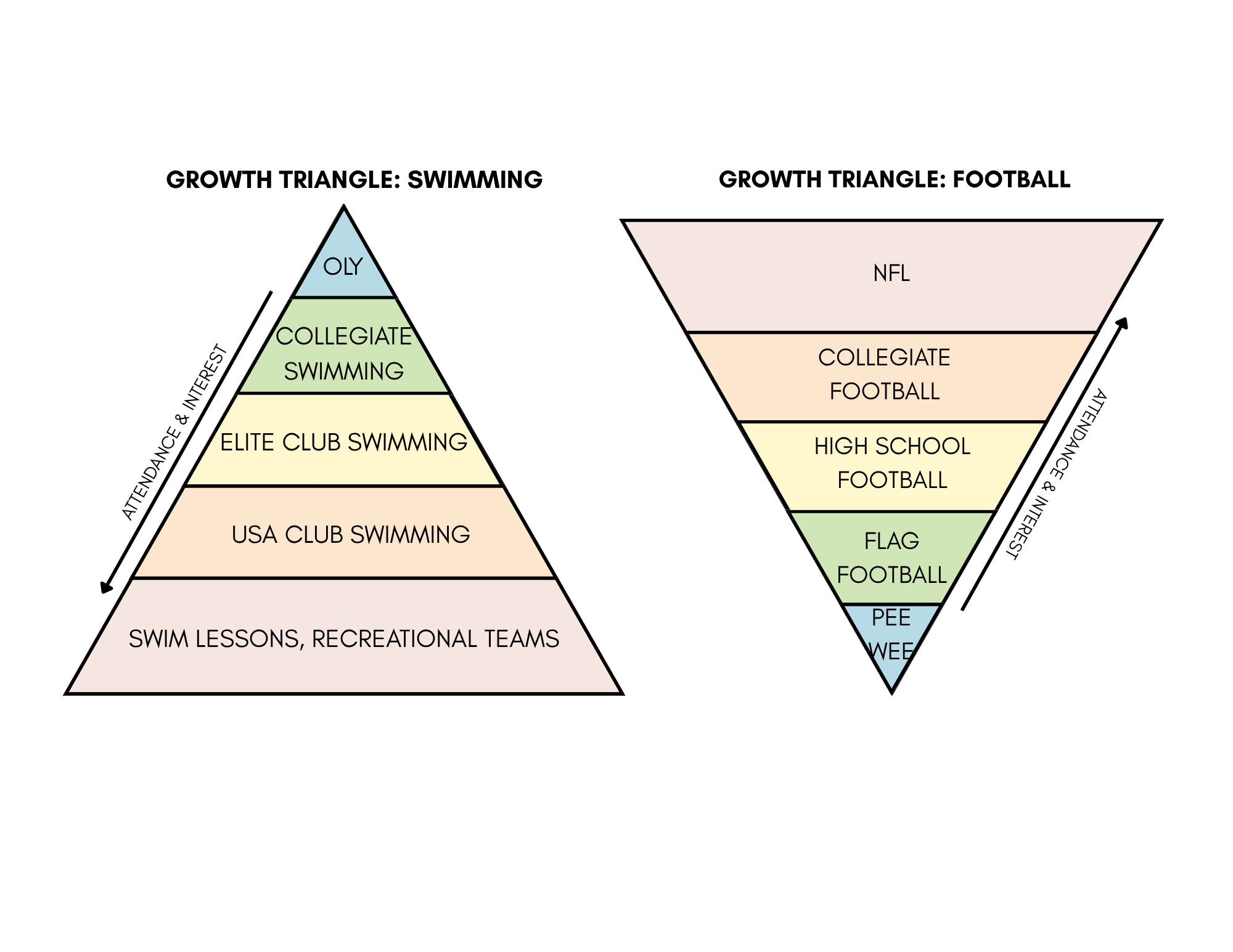
Swimming’s triangle, by contrast, narrows at the top. While youth meets are packed with parents and local pride, interest fades as athletes advance. Elite competitions are often inaccessible or under-publicized, and national meets rarely break through mainstream media. While the Olympics draw millions of viewers, most elite swimmers still struggle to earn a livable salary or attract meaningful brand deals outside of Olympic years.
The takeaway is clear: the money, media, and attention follow the fans. Swimming has the participation base, but it hasn’t figured out how to grow and retain fan interest as athletes advance.
As the saying goes, the money goes where the eyeballs are.
Strategies to Grow Swimming’s Popularity
If swimming is going to grow, we can’t wait for the Olympics every four years. We need bold, modern marketing tactics to engage new audiences, create stars, and reimagine what it feels like to be a swimming fan
1. Swimming and Social Media: How to Reach New Fans
The digital space offers swimming a unique opportunity to expand its reach, but reaching that potential will require fresh, innovative thinking.
Look at the NFL: teams regularly post funny, trending challenges, behind-the-scenes clips, and maintain their own YouTube pages packed with highlights and fan content. Swimming can do the same.
A strong social strategy could include:
- Viral Swim Challenges: Take a page from other professional teams, which regularly post funny, trending challenges that fans love to share. USA Swimming needs to stay on top of social trends, and encourage our top athletes to participate.
- Dedicated Team Video Channels: Like NFL teams’ YouTube pages, swimming programs could have their own channels for highlights, interviews, and fan content.
- Podcasts and Social Conversations: While a few swimming podcasts and social channels exist, we need more ongoing content to keep fans talking, sharing, and connecting with the sport outside the pool.
2. Building Swimming Stars Beyond the Olympics
Michael Phelps and Ryan Lochte gave us a golden era, but waiting for the “next Phelps” isn’t sustainable. Swimming doesn’t need once-in-a-generation icons – it needs relatable, consistent personalities.
Take LSU gymnast Livvy Dunne. Without Olympic medals or a national governing body’s support, she leveraged TikTok and Instagram to become the most-followed NCAA athlete and a NIL powerhouse, boosting attendance for her sport almost single-handedly. Swimmers don’t need a shelf full of Olympic medals to build a following – they can do the same right now.
3. Revitalize College Swimming — Growth Potential on the Line
Some of the world’s best swimmers are competing right on your campus—but too often, college meets feel quiet and under-attended. That’s a missed opportunity, because college swimming is one of the sport’s biggest areas of growth potential. At the same time, it’s also one of the most fragile parts of the sport, with roster limits tightening and programs being cut nationwide. If we don’t invest in making meets more exciting and accessible, we risk losing one of swimming’s most important platforms.
To reverse the trend, college swimming must embrace the event mindset:
- Think Bigger Venues: Use football stadiums, outdoor pools, or other large venues to create a big-event feel, similar to how some volleyball and wrestling programs draw huge crowds in unconventional arenas.
- Show off the Stars: Olympians and top collegiate swimmers are already on campus – let fans know they’re watching world-class talent live!
- Make it an Experience: Pump in music, crowd interaction, fan giveaways, and school spirit. Turn every meet into a social, high-energy event, not just a competition.
- Sell Season Tickets to Create a Loyal Fan Base: Package access to all home meets, with perks like reserved seating, swag, or exclusive team experiences. Season tickets build a committed audience, boost attendance, and create a consistent, energetic atmosphere.
The Future of Swimming: From Every Four Years to Every Day
The future of swimming isn’t out of reach – it’s right in front of us. By giving college meets the spotlight they deserve and showing off the personalities that make this sport special, we can turn swimming into something fans follow all year long.
We don’t need to wait for the next Michael Phelps moment – we can create the next chapter ourselves.
The water is ready. All that’s left is for us – the swimmers, coaches, parents, and fans – is to dive in together.
 ABOUT STACY HENDERSON

Stacy Henderson is a dedicated swim coach and the author of Pool School, a children’s book series that teaches kids the four swim strokes through fun, story-based learning. A former competitive swimmer, she is passionate about sharing her love for the sport with the next generation. Learn more about Stacy and her books at poolschoolswim.com

Why don’t they just market the athletes the problem swimming has is no one other than swimmer know who the top swimmers are why don’t the companies like Speedo Arena etc create events for younger swimmers and have them show up at the events and meet the kids? Look at the AJGA for kids golf and you will see a lot of events like the Dustin Johnson Invitational he actually shows up and interacts with the kids that is how you build a fan base maybe if people got to see and interact with the top swimmers they would be more inclined to watch instead of 2 weeks every four years
We went to Singapore for WC’s it was just incredible inside the aquatic center, outside was just average.
It’s a real production to put these on, but man we are ready to go again.
Hoping the new CEO has some tricks up the sleeve.
For decades, World Aquatics has sacrificed better marketing, promotion, and development of the sport to a corrupt system copied from FIFA: the inclusion of irrelevant federations (from the perspective of elite professional sport) in every event (especially the Olympic Games), at the expense of federations that have functioning elite sports structures.
In return, these federations (mostly from developing countries) keep a corrupt and incompetent World Aquatics leadership in power.
This is made possible by World Aquatics’ completely outdated and inefficient bylaws, in which US Swimming has as much voting power as Bangladesh.
It’s as if a neighborhood football team has as much influence on NFL decisions as the Kansas City Chiefs – is that how good decisions… Read more »
A pro league, where you find out how often they can do meets in a year. Each meet moves you to the next meet, until the world championship at the end of the year where it’s just the top 8. Make it a spectacle. It would replace college tho as the athletes would be pro. Could try and figure out a draft I guess so it’s mandatory college
I think there are some club teams who have a powerful presence on social media. @southweststarsswimclub is a great example, they lean into trends, show their talent and we get a glimpse of how fun of a team they are. @bolles_swim_school has a strong presence but focuses on tips and tricks!
I remember my AAU coach Pete Higgins telling me that “until the Speedo becomes fashionable there will be no money in swimming.”
Swimming’s “every four year popularity” is very similar to most olympic sports like figure skating, speed skating, xcounty skiing, skiing, snowboarding, curling, surfing, track and field, gymnastics, rugby, triathlon, sailing, volleyball weightlifting and others. (Is there a Skiskier.com website having the exact same discussion now?). I am a swim fan and I think it is okay that swimming will always be well below other sports in popularity.
Here’s my reasoning:
1. Apples to Oranges
Swimming and NFL are not comparable.
Before WWII the sports popular in the US were: Boxing, Horse Racing, MLB and College Football. Today we have MMA, NBA/WNBA, MLB, NHL, NFL, College Football and Soccer. NBA/WNBA, NHL, MMA and NFL were created and/or grown as professional money… Read more »
When I talk to people who aren’t interested in watching swimming during the Olympics, it’s because they find it boring. You can’t see the competitors’ faces, most of the time. The toughest action is all happening beneath the surface, while everything looks calm and relaxed on the top of the water. It doesn’t have that immediate drama that a lot of other sports have. It’s not like running where you can see the facial expressions and the muscles straining. Not to mention, no one’s going to get a foul (basketball), no one’s at any physical risk (gymnastics), there’s no racket to throw down in a huff (tennis). As a former swimmer, I know how hard those arms are working under… Read more »