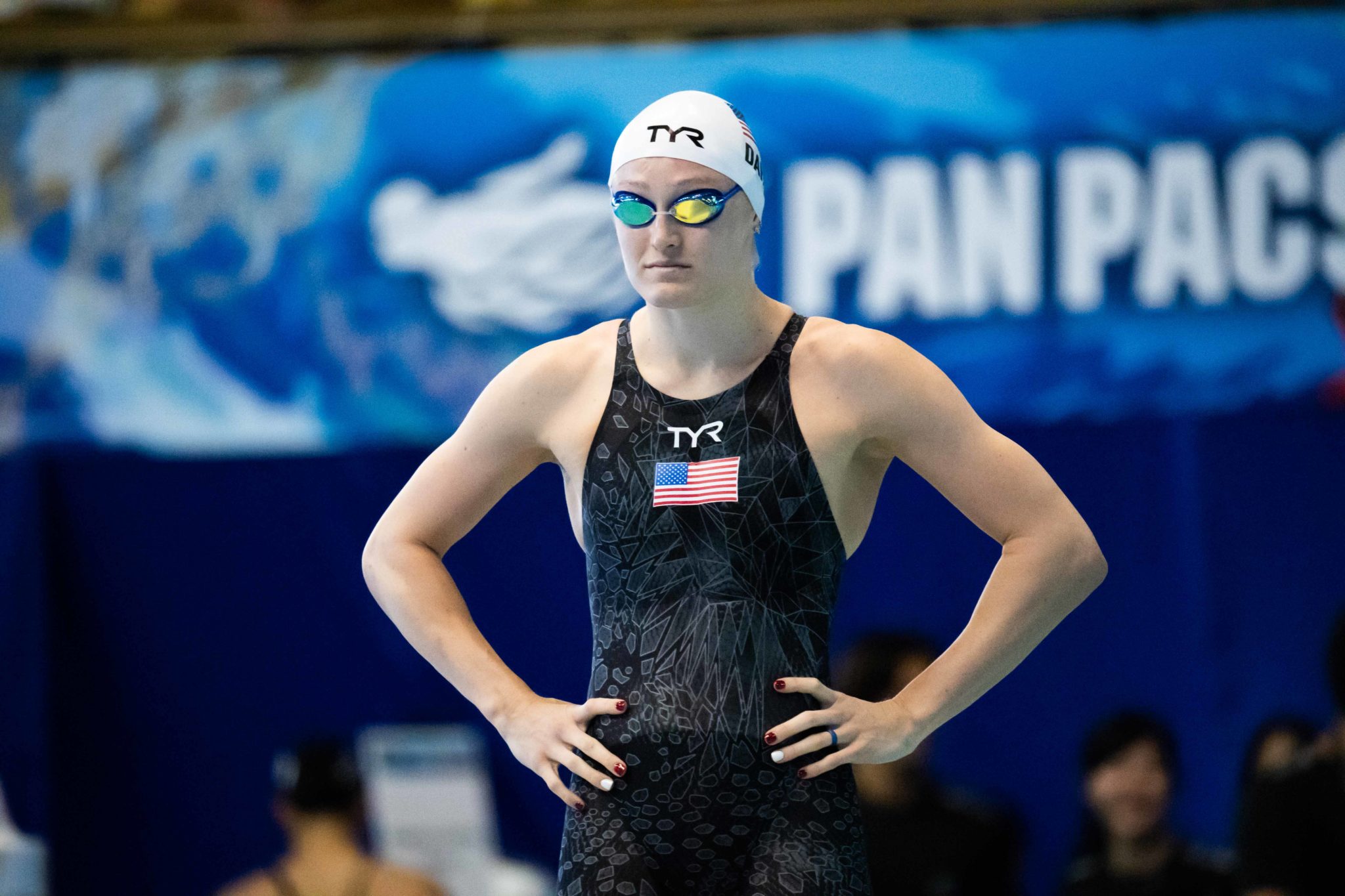
A group of more than 100 U.S. Olympians, Paralympians and Team USA athletes have signed a letter urging Congress to support the Protect College Sports Act.
The group includes a wide-ranging group of swimmers ranging from fixtures on the U.S. national team in the 1970s to a trio of recent Olympians.
Two-time Olympians Jimmy Feigen (2012, 2016) and Gunnar Bentz (2016, 2021) signed the letter, as did Kelsi Dahlia, who won gold as a member of the U.S. women’s 4×100 medley relay at the 2016 Olympics in Rio.
Also signing the letter were 14 other swimmers with decorated resumes from the 1960s, ’70s and ’80s, including Olympic gold medalists Theresa Andrews, Mary Wayte, John Naber and Chris von Saltza Olmstead.
Other Olympic medalists included Gary Hall Sr., Bobby Hackett, and Wendy Weinberg Weil.
Full List of Swimmers Who Signed The Letter (College Affiliation)
- Therese Andrews (Florida)
- Gunnar Bentz (Georgia)
- Kimberly Carlisle (Stanford)
- Kelsi Dahlia (Louisville)
- Jimmy Feigen (Texas)
- Gary Hall Sr. (Indiana)
- Bobby Hackett (Harvard)
- Bob Jackson (Arizona)
- John Moffett (Stanford)
- John Naber (USC)
- Ron Neugent (SMU)
- Sandy Nitta
- Chris von Saltza Olmstead
- Lary Schulhof (Indiana)
- Kathy Thomas Young
- Mary Alice Wayte (Florida)
- Wendy Weinberg Weil (UNC)
Over 100 U.S. Olympians, Paralympians, and Team USA athletes signed off on a letter urging Congress to support the bipartisan Protect College Sports Act.
Perhaps it’s time to listen to the athletes—the voices that matter most here… pic.twitter.com/VPBwAtWdqT
— NIL 𝘯𝘰𝘵 NLI (@NILnotNLI) July 16, 2026
The bill had previously earned public support from the United States Olympic & Paralympic Committee (USOPC).
FULL LETTER
We write as proud U.S. Olympians, Paralympians, and Team USA athletes who benefited directly from the collegiate sports system, and who remain committed to ensuring that future generations of athletes have the same opportunity to compete at the collegiate level and represent Team USA on the world stage.
As the Senate considers the Protect College Sports Act, we respectfully urge you to support this critical bill, providing necessary opportunity safeguards for women and men competing in collegiate Olympic and Paralympic sports.
For decades, college athletics has served as the primary pathway for Team USA athletes and the backbone of record-setting U.S. Olympic and Paralympic teams. Thanks to the success of college football and basketball, Olympic and Paralympic sports have been able to thrive. However, without meaningful guardrails, there is a risk of unintentionally eliminating these critical opportunities for broad-based student-athletes.
The Protect College Sports Act recognizes the importance of Olympic and Paralympic sports and includes several provisions that provide meaningful stability for student-athlete opportunities in Division I sports and the collegiate pipeline that supports Team USA.
The Protect College Sports Act would help ensure that athlete opportunities in collegiate Olympic and Paralympic sports are not reduced as the college athletics model continues to evolve.
To preserve America’s global leadership in sport and ensure broad-based access for student-athletes, we respectfully support the following elements of the legislation:
- Scholarship and roster protections for large athletic departments. For institutions with annual athletics revenue above $80 million, the bill maintains 2024–25 scholarship and roster levels for Olympic and non-revenue sports, with economic hardship waivers that require cuts to revenue-generating sports’ coaching compensation before cutting scholarship and roster levels for women’s and men’s collegiate Olympic sports.
- Transitional protections for mid-sized athletic departments. For institutions with annual athletics revenue between $50 million and $80 million, the bill maintains 2024–25 scholarship and roster levels for four years, providing important near-term stability for Olympic and non-revenue sports.
- Division I sport sponsorship protections. The bill preserves the current 16-sport minimum for FBS institutions and 14-sport minimum for FCS institutions, while prohibiting the NCAA or any successor governing body from lowering Division I sport sponsorship or minimum participant requirements.
- Paralympic walk-on opportunities and student-athlete representation. The bill clarifies that collegiate athletic programs may continue to accept walk-on Paralympic student-athletes without counting them toward roster caps.
- Athlete representation in intercollegiate governance. This legislation mandates that athletes have a seat at the table in NCAA (or successor institution) governance bodies, helping elevate the athlete voice in decision-making affecting their futures.
Together, these policies are not only critical to the Olympic and Paralympic movement and Team USA athletes—they also reflect longstanding bipartisan priorities to promote gender equity and support student-athlete development across all sports.
At a time of significant change in college athletics, these safeguards are necessary and will help protect scholarships, roster spots, sport sponsorship, participation opportunities, and athlete representation that are essential to sustaining the next generation of collegiate student-athletes, including those aspiring to compete for Team USA.
We encourage Congress to support the Protect College Sports Act and to ensure athlete opportunities for current and future generations of women and men’s scholarship-supported collegiate sports are not jeopardized.
We stand ready to work with you and your colleagues as the legislation advances to promote our shared commitment to opportunity, excellence, and continued American leadership in sport on the global stage.
Thank you for your consideration and your leadership on this important issue.
The support from the large group of athletes comes after the College Swimming and Diving Coaches Association of America (CSCAA) expressed support for the Protect College Sports Act earlier this month. The support came after revision was made to the bill adding safeguards to help protect women’s and Olympic sports.
After the landmark bipartisan bill was introduced by Senators Ted Cruz and Maria Cantwell in May, a markup was made in mid-June that requires schools generating at least $80 million in annual athletic revenue to maintain current scholarship and roster levels for non-revenue sports.
This was a notable change from the original version of the bill, which tied schools’ requirement of maintaining current scholarship and roster numbers in non-revenue sports to whether or not they opted in to pooling media rights. If a school did not opt into pooling media rights, they would’ve had the ability to drop scholarship and roster levels in non-revenue sports like swimming & diving.
Under the new language, any athletic department generating at least $80 million in annual revenue would be required to maintain the scholarship and roster levels for non-revenue sports that it had in 2024-25, regardless of whether media rights are pooled.
The bill was created to establish national standards for athlete transfers, player eligibility rules, NIL enforcement and revenue sharing while also providing the NCAA with limited antitrust protection, shielding it from constant legal challenges over eligibility and transfer disputes.
After the Senate Commerce Committee approved the bill by a 19-9 bipartisan vote on June 18, the Protect College Sports Act now moves to a full Senate vote.

There are a lot of swimming Olympians, yet only a few signed it. Were others not asked or did they not want to for whatever reason?