
2026 Women’s NCAA Swimming and Diving Championships
- March 18-21, 2026
- McAuley Aquatic Center — Atlanta, Georgia
- Short Course Yards (25 yards)
- Championship Central
- Psych Sheet
- Live Results
Women’s 50 Freestyle — By The Numbers
- NCAA Record: 20.37 — Gretchen Walsh, Virginia (2024 & 2025)
- American Record: 20.37 — Gretchen Walsh, Virginia (2024 & 2025)
- U.S. Open Record: 20.37 — Gretchen Walsh, Virginia (2024 & 2025)
- Championship Record: 20.37 — Gretchen Walsh, Virginia (2024 & 2025)
The race for gold in the women’s 50 freestyle is all about one woman the past two seasons: Virginia’s Gretchen Walsh. However, with her graduation last May, this event has become one of the most hotly-contested in the NCAA.
The Sub-21s
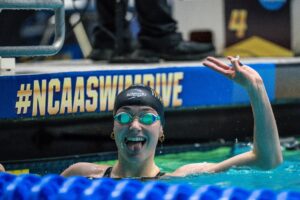
Camille Spink (Photo Credit: Jack Spitser)
Tennessee junior Camille Spink enters the meet as the top seed in any event, having blasted a personal best of 20.87 to win the SEC title last month, a massive 0.38 improvement from her previous best of 21.25 set at the CSCAA Dual Meet Challenge in November.
The one caveat with Spink is that she typically swims her fastest times of the season at SECs rather than NCAAs, and this year’s SEC Championships were particularly special for the Vols as they hosted the meet at their home pool. Does that mean she can’t drop another PB and lock down the title? Absolutely not. But with another swimmer having gone sub-21 and several others right on her heels, there will be no room for error in the deepest field in the event’s history.
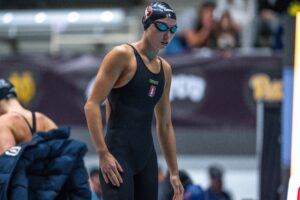
Torri Huske (Photo Credit: Jack Spitser)
Though she’s never swum the event at the NCAA Championships before, Stanford senior Torri Huske is one of two swimmers in this year’s field to have ever broken the elusive 21-second barrier.
Huske was one of the victims of the new NCAA event schedule, though it was something of a blessing and a curse for the versatile Cardinal. In her previous three NCAA appearances, she consistently opted to swim the 200 IM on day two, the 100 fly on day three, and the 100 free on day four, with the 200 IM and 50 free always presenting a back-to-back conflict. With the new order of events, however, she’ll swim the 100 fly on day two, the 50 free on day three, and has opted for the 100 free over the 200 IM in a new day-four conflict. While not entirely shocking, the fact that she is the defending champion in the 200 IM could signal she is really honing in on the shorter events this season.
Huske blasted her current lifetime best of 20.92 leading off Stanford’s third-place 200 free relay at last year’s Championships, and given she has placed considerable emphasis on this event throughout her collegiate career, she is one of the most likely candidates in the field to have the biggest time drop at the meet. She has consistently peaked at NCAAs, going eight-for-nine in setting personal bests in her individual events across her three appearances at the meet, making her a very hard woman to pick against. She is seeded just five hundredths behind the top seed, who has historically struggled to replicate her season bests on the sport’s biggest stage.
Potential Spoilers
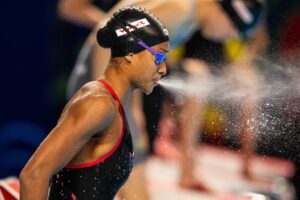
Sara Curtis (Photo Credit: Jack Spitser)
UVA first-year Sara Curtis has been on a rampage for the Cavaliers and her Italian national team over the past few months, whether it be finding a new talent in the fly events, breaking World and European Records at the European Championships, or breaking an NCAA relay record. This event, on paper, is arguably her best, though it’s a fairly close call with the 100 free. Given she’s very new to the short course pool, it would be fair to argue that she probably has the highest ceiling for a drop this year, having only swum the individual event on eight occasions. She’s already been 21.09 in 2026, which she swam to win the ACC title, so she certainly can’t be discounted.
Prior to the NCAA announcing a schedule change, prior to Spink dropping nearly half a second from her best time, and prior to Curtis’ arrival with the Cavaliers, many people thought Louisville senior Julia Dennis was one of, if not the, clear favorite to win this event come March. Dennis owns a best time of 21.08 and has been within striking distance of that this season, courtesy of the 21.21 she produced to take runner-up honors at ACCs. She’s known to peak in the post-season, typically at NCAAs, but last season her best time came at the ACC meet. If she can not only reach her personal best but also dip under 21, the title isn’t out of reach.
The third and final swimmer in the 21.0-range this season is Michigan senior Brady Kendall, who swam a Big Ten Record of 21.09 to take the B1G title just a few weeks ago. Though she swam great at B1Gs, she has posted a personal best in the 50 free at NCAAs each of the past two years, a promising omen for the returning ‘B’ final winner, who finished seventh in 2024.
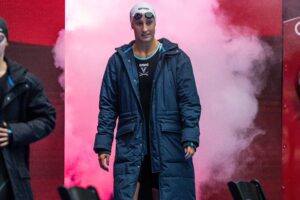
Anna Moesch (Photo Credit: Jack Spitser)
Another name to keep an eye on is Virginia sophomore Anna Moesch at 21.22. She’s more suited toward the 100 and 200, especially in the short course pool, but she’s dropped over half a second in the event this season going from 21.73 to 21.22, and last season was right on her season bests in the sprints at NCAAs. She seems a fair pick for a championship final berth after finishing 20th a year ago.
Stanford freshman Annam Olasewere‘s best times in the short course pool were never quite on par with her long course times, until this season. The Cardinal has been on an absolute tear, dropping from 21.99 to 21.46 at seemingly every meet she lined up behind the blocks at. Not only is this a good sign for long course season given she owns a personal best of 24.62, but matching her season best should see her into the final as a freshman.
Fellow freshman Liberty Clark of Indiana has seen an even sharper improvement curve. She entered the season with a best time of 22.45 and has since lowered it to 21.47, ranking her 10th coming into the meet. Like Olasewere, she seems to go a best time nearly every time she touches the water, and like Moesch, is more geared toward the 100 and 200, making her a strong ‘A’ final threat in those events while still very much in the mix here.
Rounding out the names to watch, Texas first-year Eva Okaro has been 21.26 so far this season, a time that should easily make the ‘A’ final at NCAAs if replicated. The Texas sprint freestylers have historically been hit or miss at the NCAA meet in terms of matching their times from earlier in the season, though like Curtis, the British swimmer is very new to the short course pool having only nine individual swims under her belt. That inexperience cuts both ways, as it also makes her another strong candidate to drop time with more experience in yards.
SwimSwam Picks
| Rank | Swimmer | Team | Season Best | Lifetime Best |
| 1 | Torri Huske | Stanford | 21.01 | 20.92 |
| 2 | Sara Curtis | Virginia | 21.09 | 21.09 |
| 3 | Camille Spink | Tennessee | 20.87 | 20.87 |
| 4 | Julia Dennis | Louisville | 21.21 | 21.08 |
| 5 | Brady Kendall | Michigan | 21.09 | 21.09 |
| 6 | Eva Okaro | Texas | 21.26 | 21.26 |
| 7 | Anna Moesch | Virginia | 21.22 | 21.22 |
| 8 | Annam Olasewere | Stanford | 21.46 | 21.46 |
Dark Horse: Cadence Vincent (Alabama) – The 15th-seeded junior has been 21.58 so far this season, a time she clocked for fourth at SECs while also posting best times in the 100 and 200 at the meet. She also clocked her current event best of 21.57 at last year’s NCAAs. If she can inch toward a sub-21.5 swim, a spot in the final is not out of the question. Vincent is remarkably consistent between prelims and finals; she went 21.59 in prelims at SECs before the 21.58 in the final, and her personal best came from prelims at NCAAs last year as well. She knows how to swim fast in the morning, and if one or two of the 21-low seeds have an off swim, she looks primed to strike.

Anyone else read the title and thought for a sec it was two sub 21s for 50fr LCM by men , and wonder how much in swimming he’s missed somehow
I mean, respectfully the title says “W. NCAAs”
Dennis has been 21.21 three times this season. Once on Halloween and twice (prelims and finals) at ACC’s.
She’s also been 21.36, 21.43, 21.46, 21.47, 21.54, 21.55, (and 21.78 and 21.86 at in training dual meets in January). Last year her best time before ACC’s was 21.61.
There’s a very similar pattern in the 100 free.
Sure, Dennis may have had a couple of days of meet prep before ACC’s, but I think that she (and Gorbenko and Larsen) haven’t had a full cycle of meet preparation yet.
She also swam the 200 free twice at ACC’s the day before the 50. That won’t be happening at NCAA’s.
Julia Dennis is going to drop some time and take this one home
Julia Dennis for the win.
another dark horse- Bryn Greenwaldt
without having to shuttle across the city for a high jump event and back to the pool like last year
with a taper she could drop her PB 21.51 and make the final!
B. Greenwaldt didn’t look too hot at the 2026 ACC Championships, one of the few Virginia Cavaliers on the women’s side.
A wild take: Huske, Moesch, Curtis, Clark.
If moesch goes sub 21 I’ll scream
If she’s sub 21 her 200 will be 1:38 low!
That’s two for Virginia and one for Texas.
The Longhorns just can’t win.
It’s just a matter of time before the Longhorns fan base goes nuclear.
Random question: does anyone know if Curzan will swim another year in college? She technically has another year of eligibility
Why would she not
She’s listed on UVA’s roster as a junior and I think the plan was always for her to swim 3 years after her redshirt. It would be a huge deal if she graduated this year and left, although I wouldn’t be surprised if she finished her bachelor’s and started a grad degree.
I’d be surprised if she didn’t do another year
I’d be absolutely shocked. UVA is clearly working out for her, she just had the short-course meet of her life. And why not get another year of free education at a great school?
assuming Claire swims her senior year and then stays on to train with the UVA pro group for LA28
She didn’t participate in their “senior day” recognition, so I assume she is continuing.
With NIL there is no reason to leave and go pro anymore