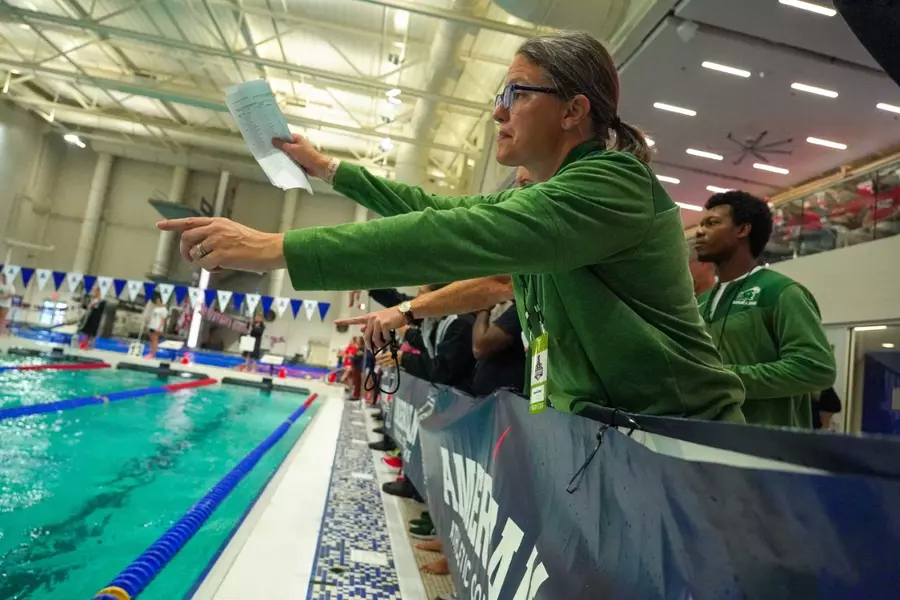
The Tucker Center for Research on Girls & Women in Sport at the University of Minnesota has released its annual Women in College Coaching Report Card. The report is the 14th annual edition that strives to quantify the number of women coaching at the highest levels of women’s collegiate athletics.
The report, reflective of the 2025-2026 season saw the percentage of women’s head coaches for NCAA Division I women’s teams across seven major conferences decrease slightly to 47.5%. That is the first decline in this metric in 13 years.
The 94 institutions included in the report employed 1,057 head coach positions for women’s teams. 481 of those positions were held by women, which was a .2% decline from last year’s report.
The Report Card saw a steady increase since 2021 after almost a decade of smaller increases. In the 2020-2021 season, 42.5% of women’s sports head coaches were held by women.
Prior to last season, about 10.2% of the positions surveyed turned over: 54 women and 54 men. Only 52 of those positions were filled by women.
The report also breaks down the data by conference and sport. Swimming saw an increase in women’s swimming head coaches in the 2024-2025 season to 29.2%. This season, that number declined to 27.7% (18/65), which retained a “D” rating on the report card. Swimming received an “F” the year prior with just 23.9% of women’s programs in the measured sample being led by women head coaches.
The number of swimming programs that are combined under a single head coach for men’s and women’s teams are a likely driver of the lower numbers. Track & field (18.3%), triathlon (33.3%), rifle (37.5%), cross country (21.3%), and diving (16.4%), sports with similar co-ed structures, all were below average.
Sports receiving “A” ratings last season include acrobatics & tumbling (100%, less than 10 schools), wrestling (100%, less than 10 schools), lacrosse (94.3%), field hockey (87%), softball (78.5%), equestrian (75%), and golf (73.5%).
Gymnastics, where the women-head-coach rate fell from 71.4% to 64.9%, was one of the primary drivers of the overall decrease.
Michigan State had the highest percentage of women head coaches of women’s teams at 81.8%. They were one of seven institutions that earned “A” grades, down from eight last year. Other schools to earn “A” ratings include Cincinnati, UCLA, Central Florida, Penn State, University of Washington, and DePaul.
Only three of those programs have swimming & diving teams, all of which were led by women last season (Cincinnati, UCLA, and Penn State). Cincinnati head coach Mandy Commons-Disalle retired at the end of the 2025-2026 season and was replaced by a male head coach.
The premise of the report, which is released annually, is to measure the number of women who are head coaches of women’s teams. From the Center’s report:
What we want to emphasize is the underrepresentation of women is not the problem, it is a symptom of the problem. The real problem is a culture, both societal and within sport, that does not value or support women or give them the opportunities they deserve.
Conferences evaluated for the report are the American Conference, the Big Ten, the Pac-12, the ACC, the Big East, the Big 12, and the SEC. The report will likely undergo significant shifts next season with seven new teams joining the Pac-12 Conference that were previously not included in the report: Boise State, Fresno State, Colorado State, Gonzaga, San Diego State, Texas State, and Utah State.

I would argue that female coaches are given more of a leg up than their male counterparts in our sport early on. Look at how many female assistants get their start in a Power 4 job right after graduation than a male coach with 3+ years of experience.
This study seems to forget that men are more apt to take risks with a family in tow than a woman. I’ve seen male coaches move to the opposite coast for a job that pays $35k.
I like Margo a lot, but you can’t tell me her resume at the time she was elevated to HC rivaled all the other applicants.
Margo is amazing, talented, insightful and a powerful intellectual force – She is deserving of any position for which she applies.
Cool, but at the time of her being named the head coach at Bama she had 0(zero) coaching experience
Brother, what? Wrong take. Look at how many women are on P4 staffs, hopefully 1, sometimes none, and if you’re extremely lucky: 2. And very rarely, are they Head Coaches. Swimming has long done a poor job of work life balance, that goes for both men and women. There are so many layers as to why there is a lack of women coaches, if you read the report, you’ll learn them & hopefully gain a broader perspective the barriers they face. The Tucker Research Center has done a phenomenal job over the years of collecting the data and stats, a drop in Women Head Coaches is disheartening and discouraging.
To your second point, coaching any sport at any level calls for the sacrifice of work-life balance. Men are more likely than women to assume that risk and burden.
There aren’t actual barriers in 2026 for female coaches, “researchers” use bias to “prove” their opinions. No amount of analytics can overcome human nature.
When you speak of women coaches, you only speak of them in regard to women’s teams. Is there a reason for that? Are there no female coaches of men’s teams?
The study is about women coaching women’s teams, so that’s what the data reflects.
In swimming there are women coaching women’s teams, but I think the premise of the study is “if women can’t make headway in coaching women’s teams, they’re never going to make headway coaching men’s teams.” Swimming & diving is fairly unique in female head coaches of men’s teams, so the data nationally across sports wouldn’t be that interesting overall.
W/L record for M vs W?
Oh no you just crossed the line with this request! NEVER attempt to contrast or compare the vaunted female against the aggressive, mean, win crazed male!
A terrible trend of metrics for women coaches.