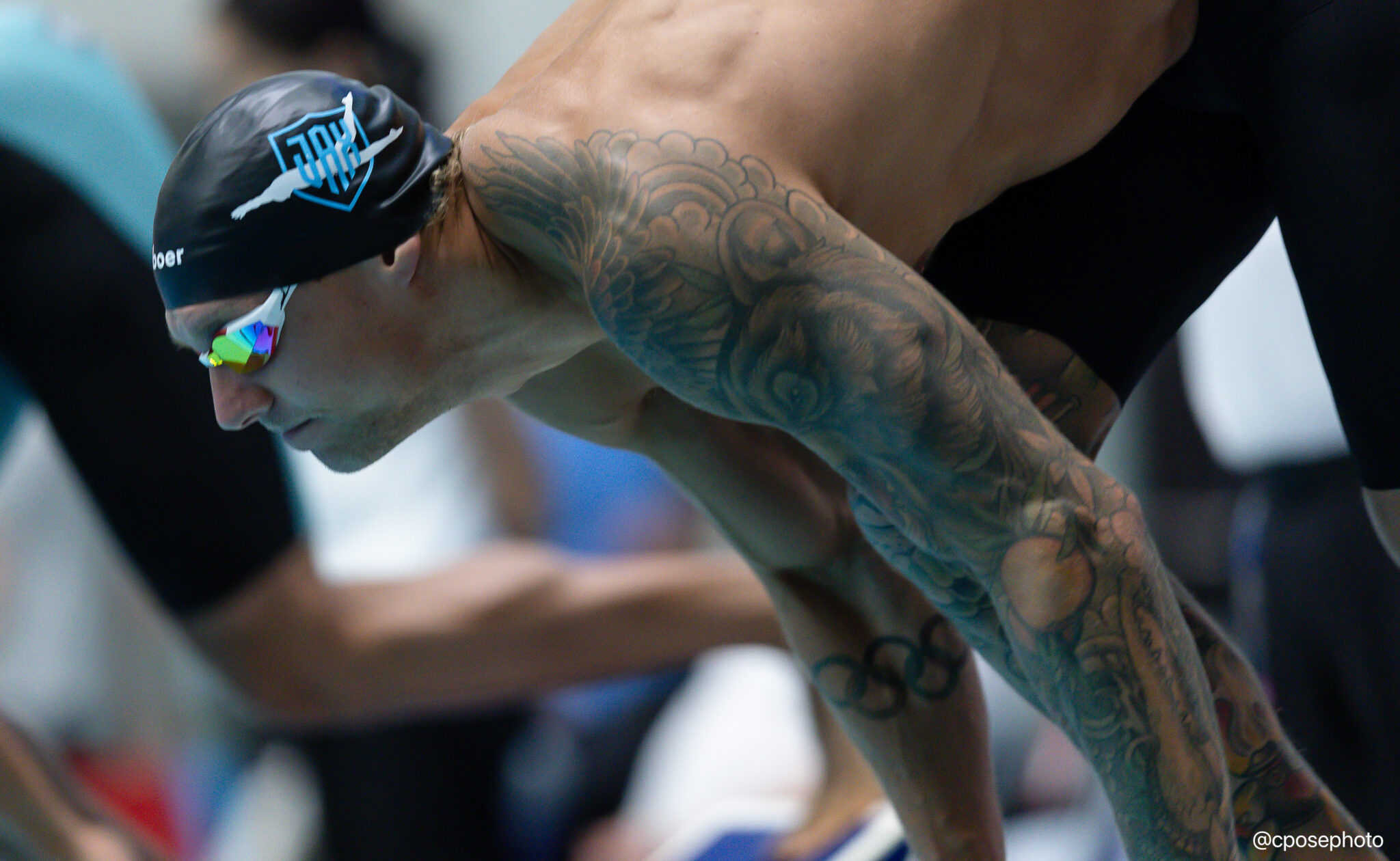
What do Daniel Jones, Lucien Chan, and Surfiel Santiago have in common with Caeleb Dressel, Maximus Williamson, and Grant House?
Sure, they’re all swimmers. But on Friday, at two meets separated by more than 1,000 miles and vastly different qualifying standards, they found themselves in the exact same situation: stepping onto the blocks for a three-way swim-off to break a tie in the 50 meter freestyle.
At the Swim Fort Lauderdale Speedo Summer Classic, Daniel Jones, 17, of Fort Wayne Swim Team, Lucien Chan, 16, of Asphalt Green Unified Aquatics (AGUA), and Surfiel Santiago, 18, of Saint Andrew’s Swimming, all stopped the clock at 25.75, creating a three-way tie for 22nd place and forcing a swim-off for the coveted position of second alternate.
When the trio took their marks in the triple showdown, Jones took the first touch in 25.24, followed by Chan in 25.39 and Santiago in 25.41. All three improved considerably over their prelims performances, posting times that would have comfortably qualified for the B final had they been recorded earlier in the day.
While none of these athletes ultimately advanced to the final, all three took advantage of one of swimming’s greatest gifts: a second race and a new personal best.
Parallel (Lane) Lines
Meanwhile, as the three teenage club swimmers were battling for an alternate position in Florida, a remarkably similar drama was unfolding at the TYR Pro Swim Series in Indianapolis.
Olympic gold medalist Caeleb Dressel found himself in a three-way swim-off with Maximus Williamson and Grant House after all three posted an identical time of 22.48 in prelims of the men’s 50 meter freestyle. The result was a 3-way tie for 15th place, forcing the world-class competitors to face off in a high-stakes showdown, seeking to secure the last two spots in the B final.
Dressel dominated in the swim-off, decisively taking the top spot in 21.84, a time that would have sent him solidly into the A final. Williamson touched second in 22.27, while House hit in 22.31, landing him in the C final.
That night, when the trio took their marks, Dressel delivered again, taking the B final in 21.85. Williamson went 22.28, which ironically tied him for 11th place with Mikel Schreuders. House hit the wall in 22.44 to claim 18th place overall.
The Math Behind the Madness
At first glance, ties in swimming may seem incredibly unlikely. After all, what are the chances that one swimmer finishes in exactly the same time as another, with results measured to the hundredth of a second?
Yet the 50 freestyle may be swimming’s most “tie-friendly” event. Large fields of competitors, a relatively short race distance and tight finishes create ideal conditions for matching performances.
“That’s the curious thing about swim offs,” said Rodolfo Manrique, Certified USA Swimming, US Masters Swimming, NCAA and FHSAA Swimming Referee, who has been involved in the administration of many swim off situations. “A tie can happen between any swimmer in any heat of an event, and the more heats you have, the more likely it is that a tie will happen,” the veteran official explained. “And that’s when the administrative team needs to step in and consult all of the involved parties, to come up with a solution that is fair to all of the swimmers involved.”
The Birthday Paradox in a Swim Cap
For the “math-letes” in the crowd, here’s another explanation for why the sport produces more ties than you might expect: A famous probability concept known as the birthday paradox refers to the surprising fact that in a room of just 23 people, there’s about a 50% chance that at least two will share the same birthday. With 75 people in the room, those odds climb to roughly 99.7%.
Similarly, the more swimmers there are in a race, the more possible pairings exist, and therefore the greater the chance that two (or even three!) athletes will land on the exact same number.
“It’s the birthday paradox in a swim cap, folks,” said Kenny Testa, who holds a master’s degree in applied math and statistics from Johns Hopkins University.
“A three-way tie in one race is genuinely uncommon, but that’s the wrong frame,” Testa explains. “Swimming runs thousands of these races a season, each timed to the hundredth. Across that many chances, the question isn’t whether a freak coincidence happens, it’s when. Two on the same day, a thousand miles apart, is just what ‘rare but inevitable somewhere’ looks like.”
Whether you’re an athlete, a “math-lete” or just a fan of the sport, swim-offs have long proven to be one of swimming’s funnest, fastest and most exciting spectacles.
And while Friday’s simultaneous three-way swim-offs may have been unusual, they also serve as a reminder. In a sport measured by hundredths of a second, a tie can happen to anyone, whether you’re an age group swimmer, an Olympian or anywhere in between. No matter how fast or how old you are, when the touchpads can’t settle the score the first time, sometimes the only solution is to step back up to the blocks and race again!
On Friday, in two pools more than 1,000 miles apart, six sprinters did exactly that.

It’s interesting how all the swimmers seem to improve their times in a swim off. Maybe we need a sports psychologist to explain this phenomena!
We need Kenny to weigh in on the odds of this too!
My opinion on this: in addition to the psychology of the race changing (some swimmers can do better “under pressure”), a 50 freestyle is also an event that can be repeated with some level of frequency and improved. While 22 seconds isn’t necessarily going to fatigue you as much as, say, swimming off for a 400 IM, you can learn from your first swim and make the corrections for the second round without wearing yourself out.
Adrenaline
Crazy odds
Not really. Times are only measured to two decimal places. And it’s only a short race.