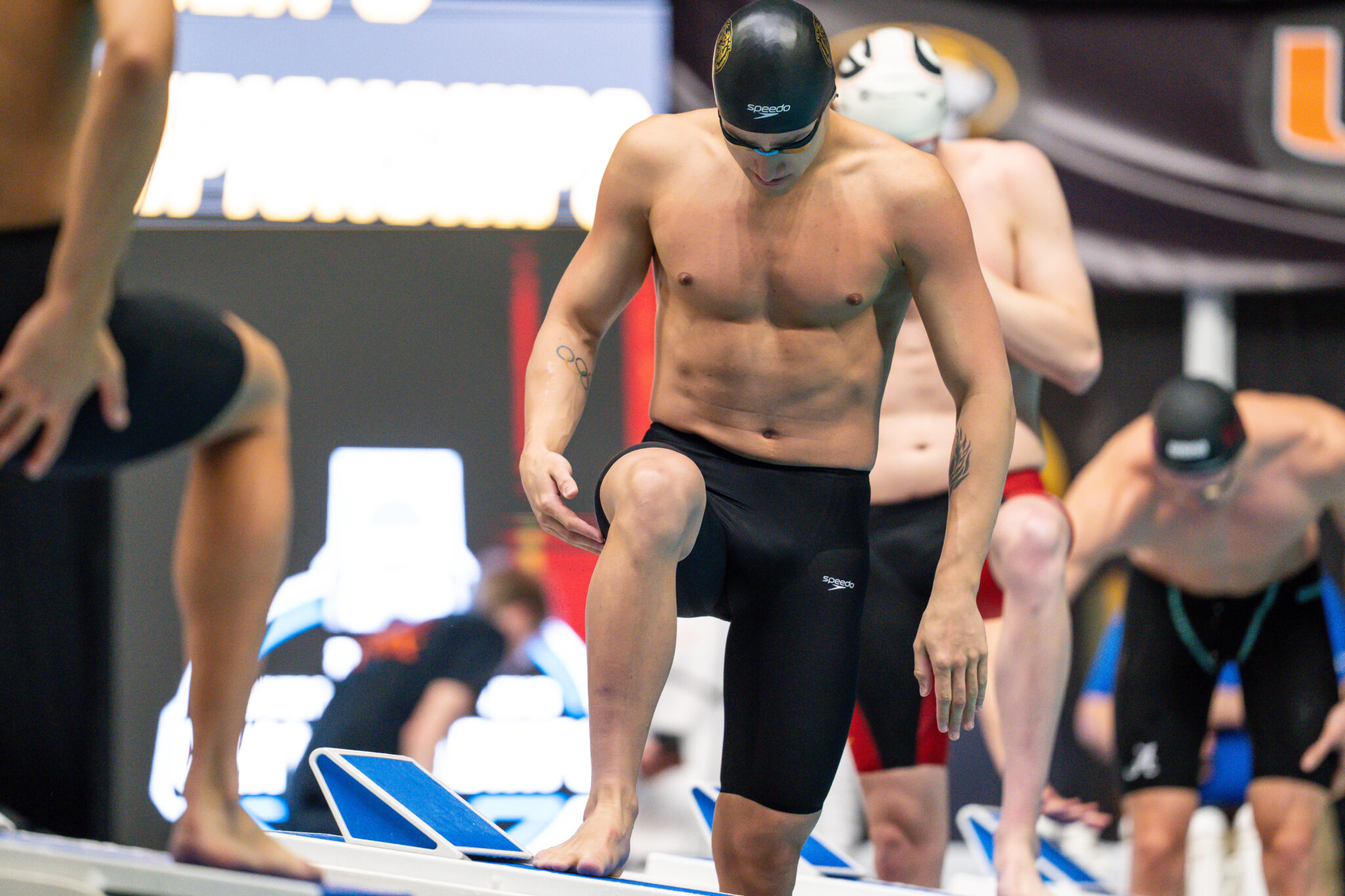
In contrast to the women’s side, the men’s NCAA meet sees a relatively abrupt change in the first year of the new qualification system. There will be 34 swimmers at the meet who qualify only due to the auto-qualification avenue – 14.5% of qualified swimmers and more than double the 16 on the women’s side.
That means that more swimmers who would have qualified in previous years will not make the meet – especially so given that there are no schools which appear to need to cut a swimmer.
There is one school that would have had a qualifier under last year’s qualification system that does not get one this year: Columbia, who had Joshua Corn finish 3rd at the Ivy League Championships in the 200 breast. He clocked 1:52.34, a new best time, but missed out by 0.05 seconds, with the final qualifier in the 200 breast sitting at 1:52.29.
While Columbia miss out, there are 20 schools who only have swimmers at the meet this year thanks to auto-qualifiers, led by Wyoming with three.
- Wyoming (3)
- South Dakota (2)
- UNLV (2)
- Hawai’i (2)
- Drexel (2)
- Air Force (2)
- Towson (1)
- FAU (1)
- CSUB (1)
- Georgetown (1)
- UW-Milwaukee (1)
- Cornell (1)
- BYU (1)
- Oakland (1)
- George Washington (1)
- Davidson (1)
- GCU (1)
- Miami (Ohio) (1)
- Missouri State (1)
There are 34 conference champions who would not have made the meet under the old qualification system.
| Name | School | Event | Time | Row |
| Nick Rounds | South Dakota | 100 back | 45.21 | 30 |
| Jed Garner | Towson | 200 breast | 1:52.45 | 30 |
| Daniel Laureyssens | FAU | 200 free | 1:32.42 | 30 |
| Chase Maier | Navy | 1650 free | 14:54.68 | 31 |
| Ben Irwin | Navy | 200 back | 1:39.93 | 34 |
| Dean Jones | Navy | 200 fly | 1:41.85 | 34 |
| Bryson Huey | UNLV | 50 free | 19.02 | 36 |
| Jackson Kogler | Wyoming | 200 IM | 1:43.70 | 40 |
| Vili Sivec | CSUB | 200 fly | 1:42.37 | 43 |
| Evan VanBrocklin | Utah | 200 IM | 1:43.80 | 43 |
| Karol Ostrowski | Hawai’i | 50 free | 19.13 | 45 |
| Tom Thalau | Hawai’i | 200 IM | 1:43.93 | 47 |
| Alexander Metzler | Wyoming | 500 free | 4:16.20 | 53 |
| Sam Lorenz | UW-Milwaukee | 100 back | 45.75 | 52 |
| Eli Rolfsen | Miami (Ohio) | 1650 free | 15:04.27 | 52 |
| Carter Perkins | La Salle | 100 free | 42.37 | 53 |
| Alex Parkinson | South Dakota | 1650 free | 15:04.40 | 53 |
| Owen Watkins | Georgetown | 50 free | 19.17 | 54 |
| Blake Conway | Cornell | 100 back | 45.77 | 56 |
| Dylan Felt | Davidson | 200 free | 1:33.46 | 56 |
| Sebastian Smith | Drexel | 100 fly | 45.63 | 57 |
| Tanner Nelson* | BYU | 400 IM | 3:44.46 | 58 |
| Tanner Wilson | Air Force | 100 breast | 52.19 | 58 |
| Ian Bellflower | UNLV | 200 fly | 1:43.45 | 58 |
| Chris Palvadre | Oakland | 100 breast | 52.20 | 59 |
| Joseph Busic | UNCW | 200 fly | 1:43.52 | 59 |
| Simon Casey | Wyoming | 200 back | 1:41.55 | 63 |
| Holden Thomas | GW | 100 back | 45.99 | 66 |
| Ben Denman-Grimm | Navy | 50 free | 19.28 | 67 |
| Kade Snyder | Delaware | 100 back | 46.00 | 67 |
| Carter Dooling** | GCU | 200 breast | 1:54.56 | 73 |
| Theodoros Andreopoulos | Drexel | 200 back | 1:42.00 | 76 |
| Kiefer Roemer | Missouri State | 100 breast | 52.56 | 78 |
| James Winterfield | Air Force | 100 fly | 46.06 | 79 |
*Tanner Nelson sits on line 55 in the 1650 free in 15:05.30, one spot higher than in the 400 IM, but did not win the event at Big 12s.
** Carter Dooling sits on line 67 in the 100 breast in 52.37, six spots higher than in the 200 breast, but swam this time at the GCU Last Chance Meet.
This is a first NCAA Championships for all of these swimmers bar three- Hawai’i’s Karol Ostrowski, who qualified in the 50 free last year in 18.99; Navy’s Ben Irwin, who placed 20th in the 200 back in 1:39.79 last year; and Towson’s Jed Garner, who was 18th in the 200 breast in 2025.
There were a total of 120 auto-qualification spots taken by the men, although several of those are from swimmers doubling up – those are swims qualified, not swimmers. A total of 84 swimmers locked up their spots by winning their conferences in a time under the auto-qualification mark, 35.7% of the total qualifiers.
Of those 120 conference-winning swims, 72 were faster than the cutline under the old qualification system, bang on 60%.
As expected given there are 34 swimmers who only made it in thanks to the auto-qualification, there are 34 men who would have qualified under the old system but instead miss the meet. That includes some big names, including one world finalist and an 18.83 swimmer in the 50 free.
*Priority is for this list, not for the list of alternates, which is due to the differences between the two systems
| Name | School | Event | Time | Row | Overall Priority* |
| Ethan Harrington | Stanford | 50 free | 18.83 | 22 | 1 |
| Rian Graham | Louisville | 100 fly | 44.93 | 24 | 2 |
| Charlie Jones | Wisconsin | 200 fly | 1:40.84 | 25 | 3 |
| Garrett Gould | Texas | 50 free | 18.89 | 25 | 4 |
| Filip Senc-Samardzic | ASU | 100 fly | 44.95 | 25 | 5 |
| Matthew Bittner | Penn State | 100 back | 44.98 | 26 | 6 |
| David Schmitt | Harvard | 200 fly | 1:40.87 | 26 | 7 |
| Shane Eckler | Notre Dame | 50 free | 18.89 | 26 | 8 |
| Aiden Musso | Louisville | 100 fly | 44.97 | 26 | 9 |
| Brayden Taivassalo | ASU | 200 breast | 1:52.33 | 26 | 10 |
| Ryan Healy | Michigan | 400 IM | 3:41.40 | 26 | 11 |
| Alexey Glivinskiy | Texas | 200 free | 1:32.23 | 26 | 12 |
| Pedro Sansone | Tennessee | 100 free | 41.83 | 26 | 13 |
| Jacob Pishko | LSU | 1650 free | 14:52.88 | 26 | 14 |
| Sanberk Oktar | USC | 200 IM | 1:42.78 | 26 | 15 |
| Drew Salls | NC State | 50 free | 18.89 | 27 | 16 |
| Connor Johnson | VT | 200 back | 1:39.64 | 27 | 17 |
| Joshua Corn | Columbia | 200 breast | 1:52.34 | 27 | 18 |
| Juan Mora | Navy | 100 breast | 51.58 | 27 | 19 |
| Antoine Sauve | Michigan | 200 free | 1:32.26 | 27 | 20 |
| Mason Edmund | OSU | 1650 free | 14:52.97 | 27 | 21 |
| Jake Wang | Yale | 200 IM | 1:42.86 | 27 | 22 |
| Cole Witmer | Alabama | 200 back | 1:39.64 | 28 | 23 |
| Ryan Branon | Texas | 200 fly | 1:41.14 | 28 | 24 |
| Ksawery Masiuk | Texas | 100 fly | 45.02 | 28 | 25 |
| Joe Polyak | Minnesota | 200 breast | 1:52.39 | 28 | 26 |
| Josh Parent | UNC | 400 IM | 3:41.58 | 28 | 27 |
| Junhao Chan | USC | 100 breast | 51.62 | 28 | 28 |
| Alec Enyeart | Texas | 1650 free | 14:53.38 | 28 | 29 |
| Daniel Eichel | Minnesota | 500 free | 4:14.33 | 28 | 30 |
| Omer Wiener | Stanford | 200 IM | 1:43.09 | 28 | 31 |
| Andrew Shackell | Indiana | 200 fly | 1:41.26 | 29 | 32 |
| Sam Powe | Georgia | 200 back | 1:39.69 | 29 | 33 |
| Lucien Vergnes | ASU | 100 breast | 51.65 | 29 | 34 |
With no teams having more than the maximum 18 swimmers qualified, we are unlikely to see much movement due to swimmers being cut. The only team with a real possibility of that are Indiana, who have 16 swimmers qualified but also have a strong diving program. If they have more than four divers qualify at Zones, there will be a decision to make.
No other school has more than 13 swimmers qualified, and only five in total have ten or more – Indiana, Texas, Cal, ASU, and Florida.
Texas are the team to miss out most this year, as they have five fewer qualifiers under the new system. They have just 13 men who made the meet this year, down from 18 last year, and have five swimmers who would have made it under the old system. They are not alone – among the top ten teams by swimmers qualified, all bar Cal have at least one swimmer fewer under the current system.
Michigan had three big international commits last season, and two of those just missed out – although one of those swimmers is now at Texas. Alexey Glivinskiy is the first alternate with his 1:32.23 in the 200 free, while Antoine Sauve is one spot behind him in 1:32.26. Michigan is likely to take Sauve as a relay-only swimmer, but Glivinskiy only swam individually at SECs and could be left at home for Texas.
Other big names to miss out are Texas’ Ksawery Masiuk, who was 45.02 in the 100 fly to rank 28th nationally but was a tenth outside of qualifying, his teammate Garrett Gould who has been 18.89/41.86 in the sprint freestyles this year, and Indiana’s Andrew Shackell who was 1:41.26 in the 200 fly.
The only returning ‘A’ finalist who missed the meet is LSU’s Jovan Lekic, who was 4:08.55 in prelims of the 500 free at NCAAs last season but has only been 4:14.50 this year. He is not a casualty of the new system though – he would have been the second alternate for the meet based on the old qualification system, 0.17 seconds behind the final qualifier in the event.
NC State’s Kyle Ponsler, the 400 IM ‘B’ final winner last year, is in the same boat. His highest ranking comes in at 33rd in the 400 IM, from the 3:41.88 he swam to win the ‘C’ final at ACCs, nine spots behind the final non-conference champion qualifier this year and four behind the final qualifier under the old system.
His teammate Drew Salls also misses out after scoring last year. He was 16th in the 50 free after placing 13th in prelims, and misses out despite setting a new best time of 18.89 this season. Alecksas Savickas, a ‘B’ finalists in both breaststroke events, would not have made the meet under either qualification format.
There are several events where the cutline is much faster this season, and the presence of auto-qualifiers is not the sole reason. There are 35 men who have broken 1:40 in the 200 back this season, so that even under the old system Filip Kosinski‘s 1:39.72 wouldn’t make the cut.
There are four events in which scoring times at 2025 NCAAs were not fast enough to even qualify for the meet in 2026: the 50 free, 100 fly, 200 fly, and 100 back. Notably, scoring times in the 50 free and 100 back would still have been left at home under the old system.
Swimmers Who Would Have Scored In 2025, But Do Not Make The Meet In 2026
Name, [time] (prelims place, finals place)
50 free:
- Ethan Harrington, 18.83 (10th in prelims, 12th in finals)
- Garrett Gould, 18.89 (12th in prelims, 12th in finals)
- Shane Eckler, 18.89 (12th in prelims, 12th in finals)
- Drew Salls, 18.89 (12th in prelims, 12th in finals)
- Charlie Crush, 18.92 (16th in prelims, 15th in finals) – WOULD NOT HAVE QUALIFIED UNDER OLD SYSTEM
100 Fly:
- Rian Graham, 44.93 (16th in prelims, 16th in finals)
200 Fly:
- Charlie Jones, 1:40.84 (15th in prelims, 15th in finals)
- David Schmitt, 1:40.87 (16th in prelims, 15th in finals)
100 Back:
- Matthew Bittner, 44.98 (15th in prelims, 13th in finals)
- Kalle Makinen 45.22 (16th in prelims, 16th in finals) – WOULD NOT HAVE QUALIFIED UNDER OLD SYSTEM

The NCAA does this in basketball also, what gives. The March Madness isn’t the best 64 teams, some of the conference winners have no right to be there when higher ranked teams are home. This is just like that. Faster swimmers are home while these conferences champions who beat a certain time are in. Why would they do this. They need to stop giving automatic births in basketball, the 11th best team in the ACC, should get in and not the Missouri Valley Conference champion. Same here
Do you hear yourself? Or is this sarcasm? The 11th best ACC team is SMU. YAWN! We would all rather watch a plucky upstart team on a hot streak than a team that couldn’t beat .500 in its own conference.
My favorite part about you is that you keep leaving the same comment over and over again as if you’re some kind of expert…but don’t realize that the NCAA tournament field is 68 teams lmao.
I get why some people are frustrated with the new NCAA qualification system; no one likes seeing strong swimmers miss out. But the ‘slower swimmers getting in’ narrative misses the whole point. My son is one of those automatic qualifiers. He won his conference event and hit the qualifying standard in the final (something his prior times alone wouldn’t have done- in fact he only had one other opportunity to swim that event this season due to a limited number of meets and conflicts due to event order). Yet in that exact race, he beat three swimmers who had already qualified for NCAAs based purely on their previous best times. This isn’t an exception; it’s happening all over. Many auto… Read more »
I’m trying to follow your logic here on this, but I don’t quite get it. Take the 50 free for example–There are guys who consistently swam low 19s all season and at their conference swam 18.85 who aren’t getting in because of a 19.43, 19.28, 19.17, 19.16….. I see the importance of having conference winners get an invite, but two things need to happen: 1. The cut times need to be faster especially in the men’s. It should be more like the 50th fastest time, not the 72nd. 2. Conference winners should be in addition to the total men invited to conference and shouldn’t replace swimmers that have faster times.
Many of the AQs would have been invited anyway because of their times. For those that don’t make the invite cut off, including them in addition to the total men invited is a great suggestion. Changing the qualifying time to the 50th fastest time would only affect 2/3 of the swimmers listed in the table above as 1/3 of them are faster than 50th place.
Awful take. Now we have swimmers who are essentially being punished for getting recruited by Power 4 schools and going fast. It provides the sport with nothing to keep faster swimmers at home, so mid-major event winners with significantly slower times can go and get rolled over at NCAA’s. Also, most of these athletes who are being left out went their times at their conference meets, so the whole “rose to the occasion” line of thinking doesn’t really hold any weight.
There are several AQ swimmers in the table above from Power 4 schools. If, as you say, the athletes being left out went their times at their conference meets, then they must not have won their events and weren’t left out because someone with a slower time beat them head to head.
I don’t have any deep thoughts on the new qualifier system, but it boggles my mind how much faster swimming has gotten over the last 20 years.
I still remember when Aaron Piersol was the first guy under 1:40 in the 200 back, handily winning NCAAs. Now there are 35 guys under it in one year, and a 1:39.7 doesn’t make the cut. Amazing. It doesn’t feel that long ago to me, but clearly it is. Different world.
My first post was a bit complainey… how about this for a solution. There is only one AQ per event. Say an event has five conferences represented by swimmers who hit the main time standard. The AQ then goes to the fastest conference champion out of the remaining conferences that do not have swimmers represented in that particular event.
This way winning a conference championship could still get you a ticket to NCAAs but it depends on how you rank against the other champions.
So, two guys that went 1:40.8 in the 200 fly can’t go because a 1:41.8 and a 1:43.4 are taking their spots? What was the rationale behind this change again? Was it a requirement in the (non-existent) TV contract they signed that also eliminated B-Finals?
If it is designed to give mid-majors more opportunities that’s a bit ironic since one of the 1:40.8 guys is from a mid-major.
This new system is a tight squeeze in the middle. The top swimmers (like Liendo, Kos, etc) aren’t affected at all.) It’s also a plus for mid-major teams. But it hurts the qualifiers who legit made a top 28 time but are more at the bottom of that 28. I still can’t believe that a 19.43 50 free is making it in over an 18.82. I’m happy for that 19.43 guy. Good for him, but you can’t tell me the 18.82 guy hasn’t worked just as hard.
Wow, what I want to know is who beat the 1:40.8 at the mid major meet to go.
72nd being used for men and women when the old cutline was 28-31 for men and 38-42 for women doesn’t make sense. I really like the AQ addition, but the men’s times definitely need to drop.
If they went 50 for men and 64 for women, think that could be a better spot.
I agree. And those numbers feel about right to me.
I looked at a lot of different cut lines, and I think those are good lines to go by, plus the QT will continue to get faster at least for another 2 years regardless of what line is used since the QT is based on a 3yr rolling avg (without the ability to get slower).
Do any of these swimmers have a chance for a “relay only” slot?
ASU is sending Senc-Samardzic and Vergnes as relay-only, according to their Twitter account
Gould swam on the 200 medley, 200 free and 400 free at conference so I would think they would take him.
aur naurr, not something that disproportionately hurts texas