*An AI-generated image is included in the article to help explain the technique*
One of the most common questions beginners ask is: “Should I keep my legs completely straight while kicking, or should I bend my knees?” The answer is simple but often misunderstood.
The best freestyle kick is neither completely stiff nor excessively bent. An efficient flutter kick comes from the hips, with a natural, slight bend at the knees that happens automatically during the movement.
The Biggest Mistake: Locking the Knees
Many swimmers are told to “keep your legs straight,” and they take that advice too literally. They lock their knees and try to kick with rigid legs.
This creates unnecessary tension, reduces ankle flexibility, and limits the power of the kick. Instead of moving efficiently through the water, the swimmer ends up fighting against it.
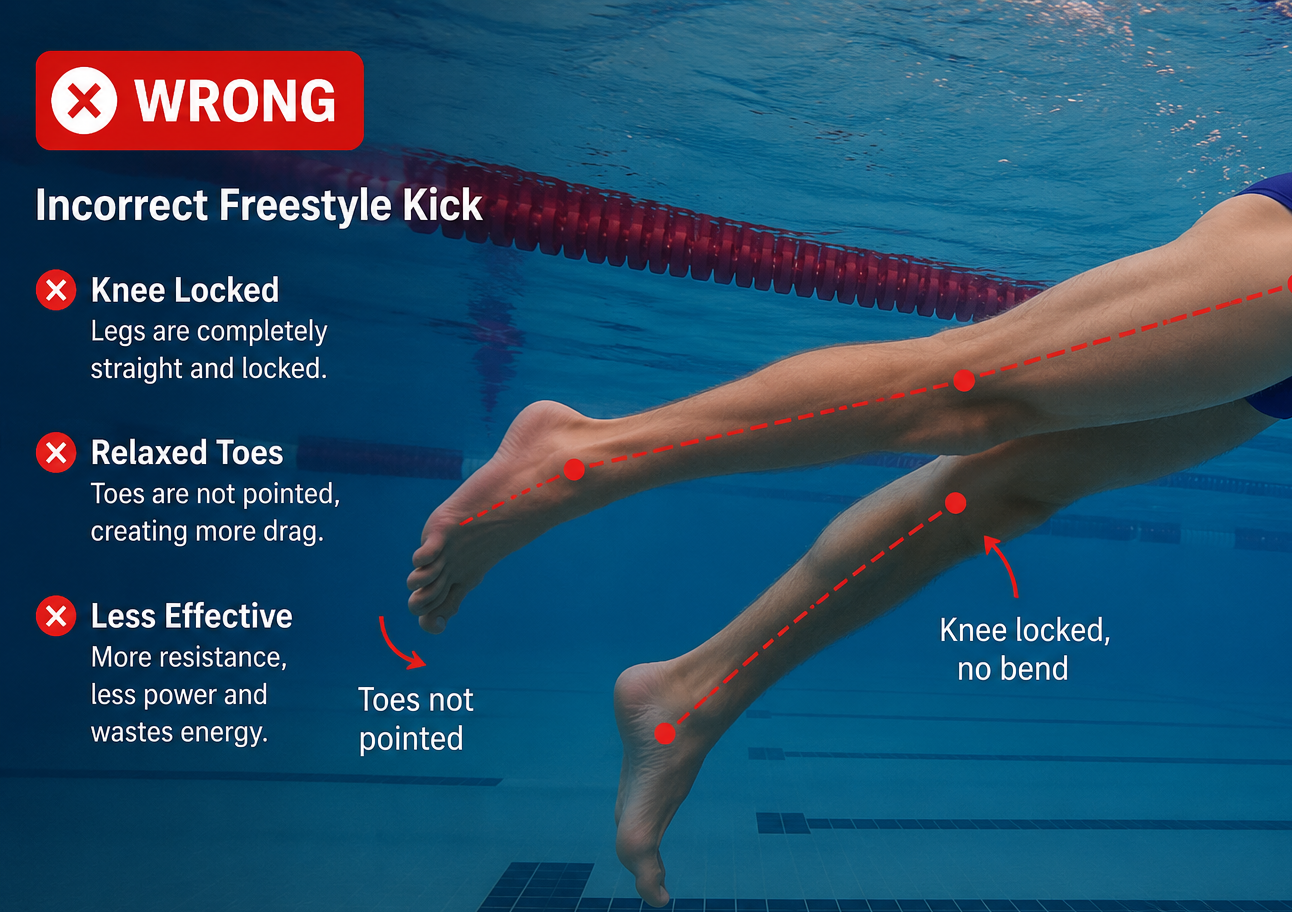
Your legs should stay long and relaxed, not stiff.
The Opposite Mistake: Too Much Knee Bend
The other extreme is kicking mainly from the knees, almost as if you’re riding a bicycle underwater.
This causes the feet to push water downward instead of backward, creating extra drag. The thighs also separate more than necessary, increasing resistance and slowing the swimmer down.
If your knees are coming far forward during every kick, you’re probably bending them too much.
Where Should the Kick Come From?
A proper flutter kick starts from the hips. The entire leg moves together in a smooth, wave-like motion.
As the leg travels up and down, the knee naturally bends a little. You don’t need to consciously bend it, it should happen automatically because the body is relaxed.
Think of your leg as a flexible whip, not a rigid stick.
How Much Knee Bend Is Ideal?
There isn’t a fixed angle that works for every swimmer. The amount of knee bend changes slightly depending on speed, body position, and individual flexibility.
In general:
- The knee should bend naturally, not forcefully.
- The bend should be small enough that the kick still feels driven from the hips.
- Your feet should stay close to the surface instead of dropping deep underwater.
If your kick creates lots of bubbles behind your feet without your knees moving excessively, you’re likely on the right track.
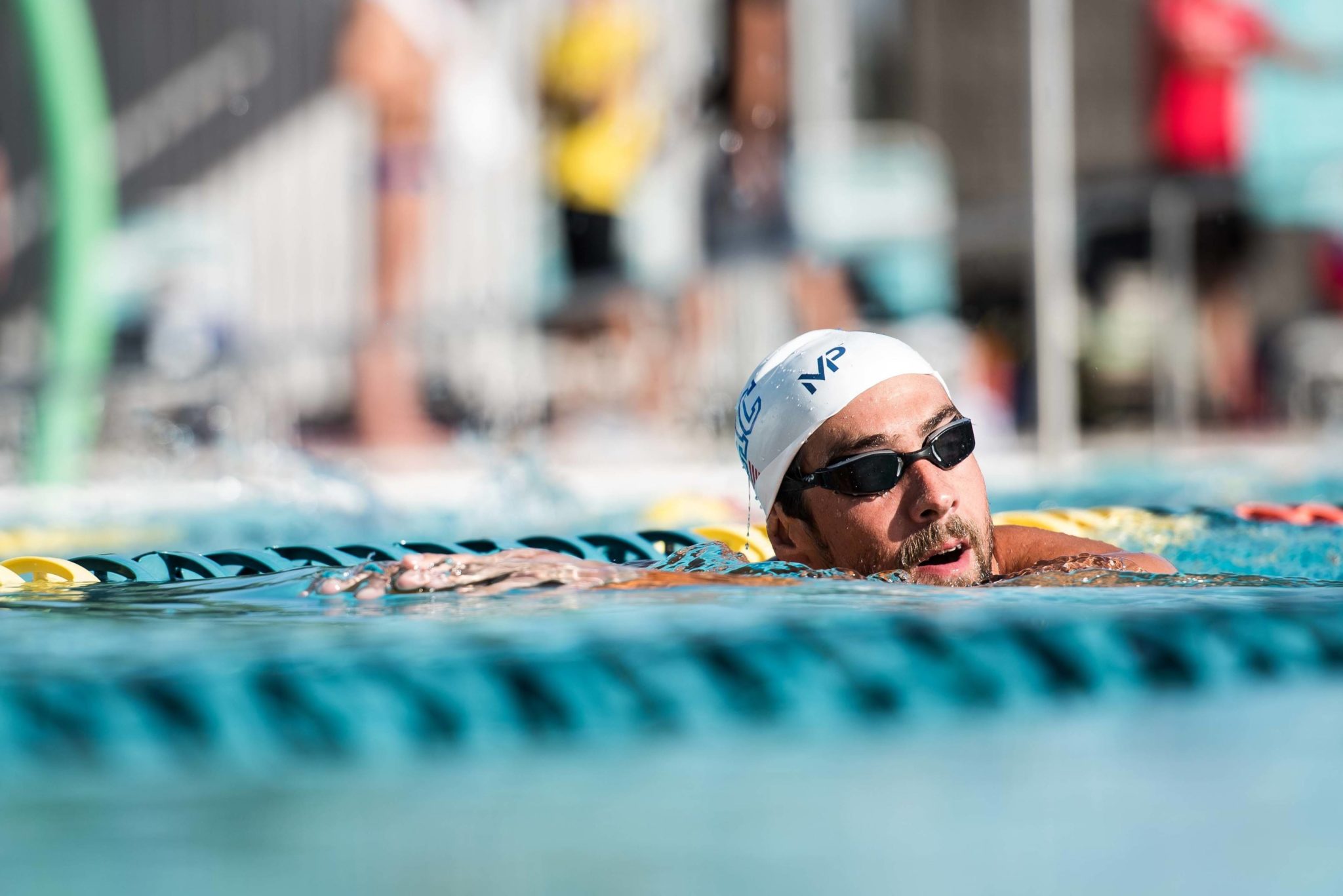
Take a close look at the Rio 2016 4×100m Freestyle Relay – Underwater Camera video included in this article. You’ll see that every elite swimmer maintains a slight knee bend while kicking rather than keeping the legs completely locked straight
The Role of Ankle Flexibility
Many swimmers think their knees are the problem when the real issue is their ankles.
Flexible ankles allow the feet to point backward and create more propulsion with less effort. Swimmers with stiff ankles often compensate by bending their knees more, making the kick less efficient.
Improving ankle mobility can often improve your kick without changing anything else.
The ideal freestyle kick is not perfectly straight, and it’s not heavily bent at the knees. It begins at the hips, with the knees remaining relaxed enough to bend naturally as part of the movement.
Instead of trying to force your legs into one position, focus on staying streamlined, relaxed, and allowing the kick to flow from your hips. A small, natural knee bend is not a flaw. it’s actually a sign of an efficient and effective swimming kick.

Try kicking a ball with your knee locked. Then try again leading with your knee, then following through with your foot. Flutter kick works the same way—the knee leads and the foot follows through (in both directions). The knee and the foot should move up and down the same amount relative to the neutral position, and not very much. A common mistake is only kicking from the knees down, which means the knee bends, but doesn’t move. Vertical kicking is a great way to see and modify exactly what’s happening with the size and shape of the kick.
For anyone confused it’s pretty much the exact same as walking but with pointed toes.
A better way to think about it is to lift the leg from the hip and hamstring (straight) and then let it relax down. That’s when the knee slightly bends. That’s also why side kicking is a great drill; it works the back sweep muscles that you need to lift the leg. If ankles are not fully flexible, the tops of the feet actually move water in the wrong direction, so improving that is critical…or do not kick at all, especially down.
What about the core? Not mentioned.
Engaging the core is super important, but it does not determine the shape of the kick.
I was also told to never breathe out of turns or breathe every stroke
Breathing off walls will legitimately hurt your times in sprint events. Most kids aren’t doing distance events when they’re first starting out, which is why not breathing off of walls is stressed so much as a fundamental.
Down the road, training an athlete who doesn’t breathe enough to breathe more is WAY easier than training an athlete who breathes too much to breathe less.
Almost everything we were taught was wrong.