Underwater footage – the problem
I think we can all agree that underwater swimming footage is cool and useful. It gives swimmers, coaches, and spectators a better view into how the swimmer is moving through the water that a normal pool deck view can’t really provide. The angle of view from the pool deck, plus all the refraction and bubbles from the water, make it difficult to see what’s going on. What happens underwater is really how we generate force and, well, swim fast.
For big meets like World Champs and the Olympics, we’ve solved this problem by having massive trolley setups that can move the entire length of the pool, and even rotate on an axis to get different angles.
These trolleys are great for TV broadcasts, but aren’t realistic for your average team or swimmer. Teams don’t have $100k to casually throw at a full setup, and most pools don’t even have the space or shape for a trolley to work. So instead, we resort to GoPros or cheap aquarium cameras that reduce price and setup time at the cost of functionality.
The functional hit we take with these cameras is pretty significant. They only give you a single fixed perspective, and you’re in frame for maybe three or four seconds max per length. Any adjustments require someone (either a swimmer or a coach) to physically move the camera and set it up in another position. Since nobody wants to be doing that mid practice, the view you start with is typically the only one you get for the whole session. We end up swimming for the camera, rather than having actual, candid footage of what we look like in practice.
Ideally, cameras should be empowering our training, instead of us having to modify practice to get meaningful value from them. So we need a way to gather footage efficiently without totally throwing a wrench in the flow of practice.
How do we solve this?
The underwater trolley is a good “ideal” system that solves the problem of keeping a swimmer in frame and having continuous footage over a long period of time. If you could set up something like a trolley instantly, and for cheap, in any pool, I’m sure most teams would love that (I certainly would). But we already established this isn’t feasible for your average club or college team. Instead we need something that’s scalable and cost-effective while also giving footage that’s somewhat comparable to what’s provided by a trolley.
I like to think of the current systems available with this graph below. On one axis you have the cost and complexity of the system you’re using. On the other axis you have the observability of the swimmer you’re filming.
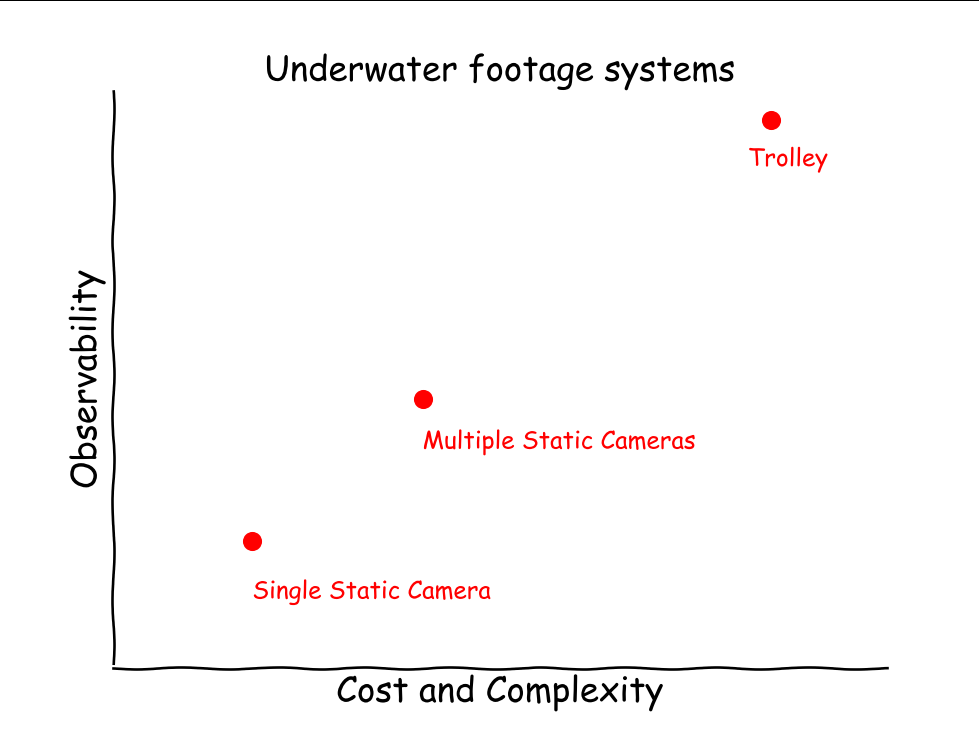
The static cameras are the economic solution: low cost with the drawback of only being able to see the swimmer for a short amount of time. You can scale them up to a point of having about 3 or 4 in your pool to get more angles and footage time, but that takes extra setup and requires you to constantly switch feeds. Conversely, the trolley setup is the ultimate high end solution: perfect footage all the time, but you need operators, installation time, and most importantly, money.
We weren’t really satisfied with any of these options, which is why we made Qwatercam.
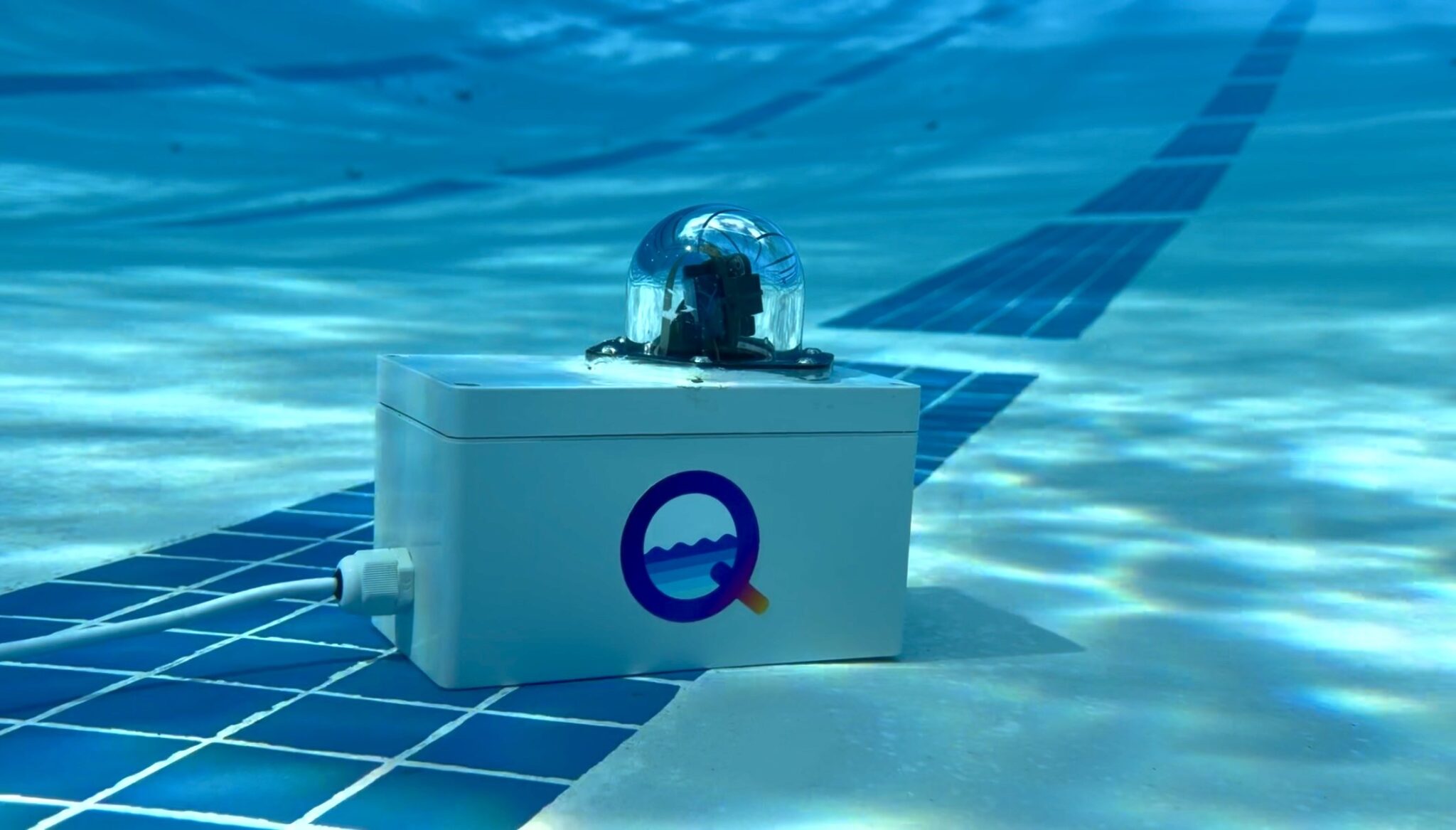
A Qwatercam unit, underwater
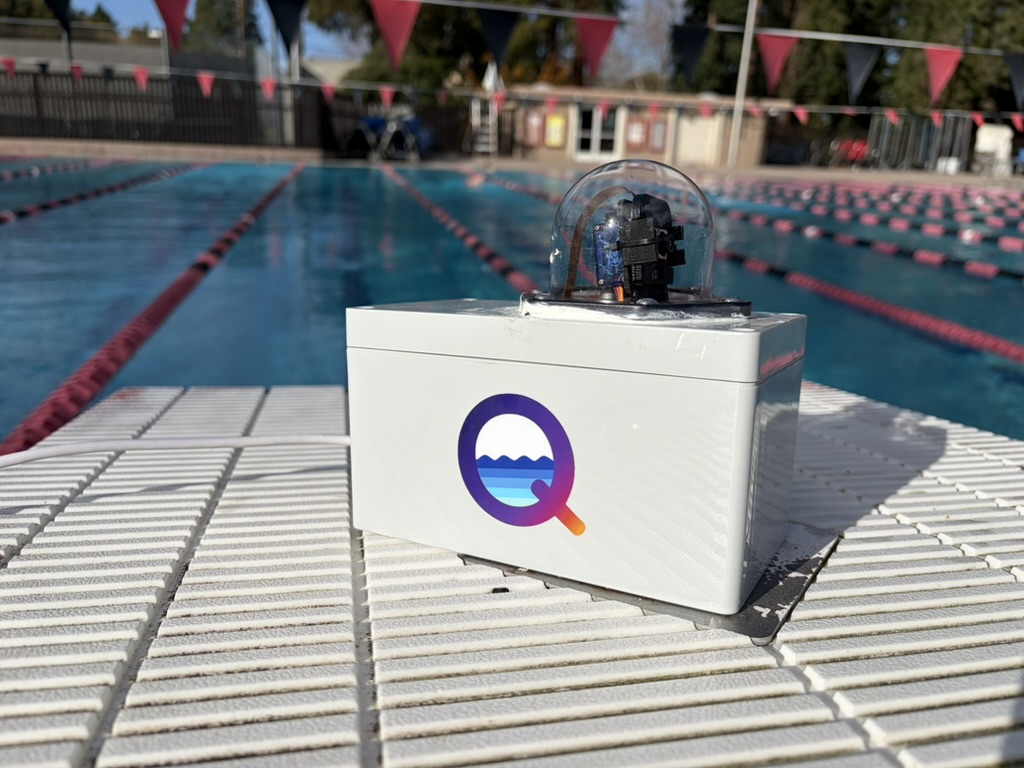
Qwatercam is a self tracking underwater swim camera built for short course pools. Its design is simple: you plug it in and place it on the bottom of the pool, roughly near the middle. Then, onboard AI vision models automatically detect swimmers, and internal servos rotate the camera to track any swimmer selected by the coach.
Here’s a demo of the footage that Qwatercam gets:
On the graph we saw earlier, this is where Qwatercam is:
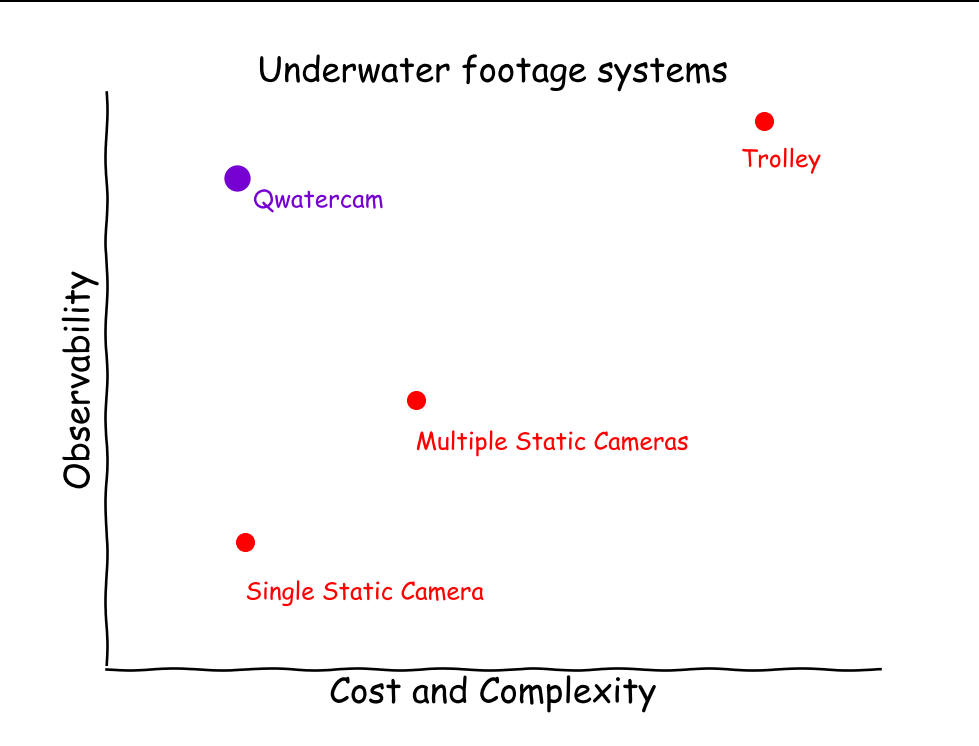
We get a massive increase in stroke observability, while still maintaining (or lowering!) the cost of current static camera systems.
Let’s explore the features that make Qwatercam special.
Video feed
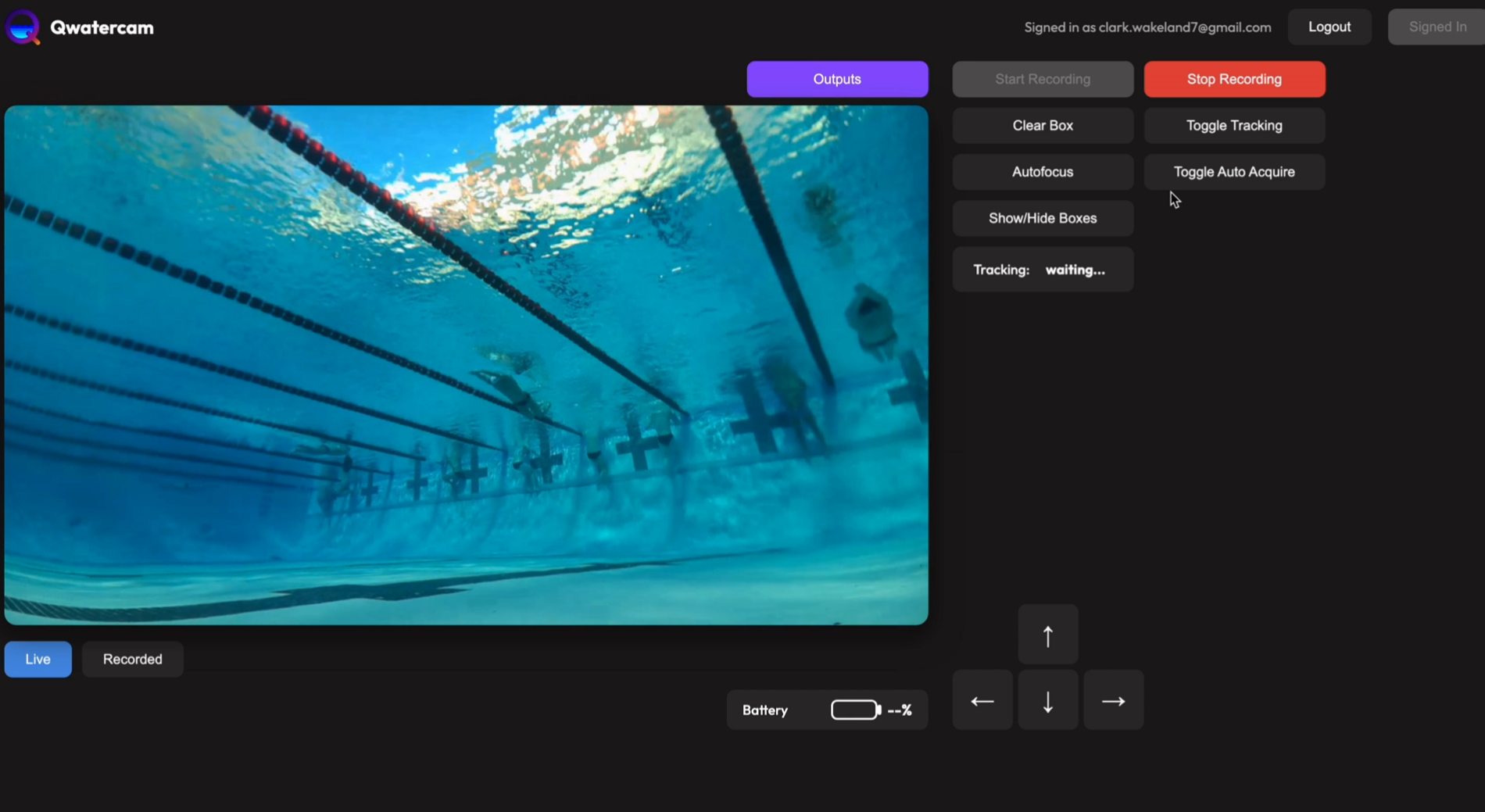
You interact with Qwatercam through a desktop app. You can select either live video (~200 ms delay) or playback video, where you can view and scrub through the past five minutes of footage. Live and Playback footage always stream at 1080p, 30 FPS.
You can start and stop recording anytime you want. There’s no limit to how long your recordings can be, and once you stop recording, the video is saved locally to your device.
Camera movement and Tracking
Qwatercam has two movement modes: Manual and Tracking.
Manual is just what it sounds like: you can pan and tilt the camera using the arrow keys in the bottom right of the app, or connect any standard gamepad (like an Xbox controller) to your computer and control it from there.
Manual control alone would be enough to set us apart from currently available systems. But with Qwatercam, we went one step further, and implemented Tracking. Once you press “Toggle Tracking”, Qwatercam will begin detecting swimmers in frame. Then, clicking on *any* swimmer in your video feed will cause Qwatercam to start tracking them.
You can even turn on bounding box viewing to see what Qwatercam is detecting in real time.
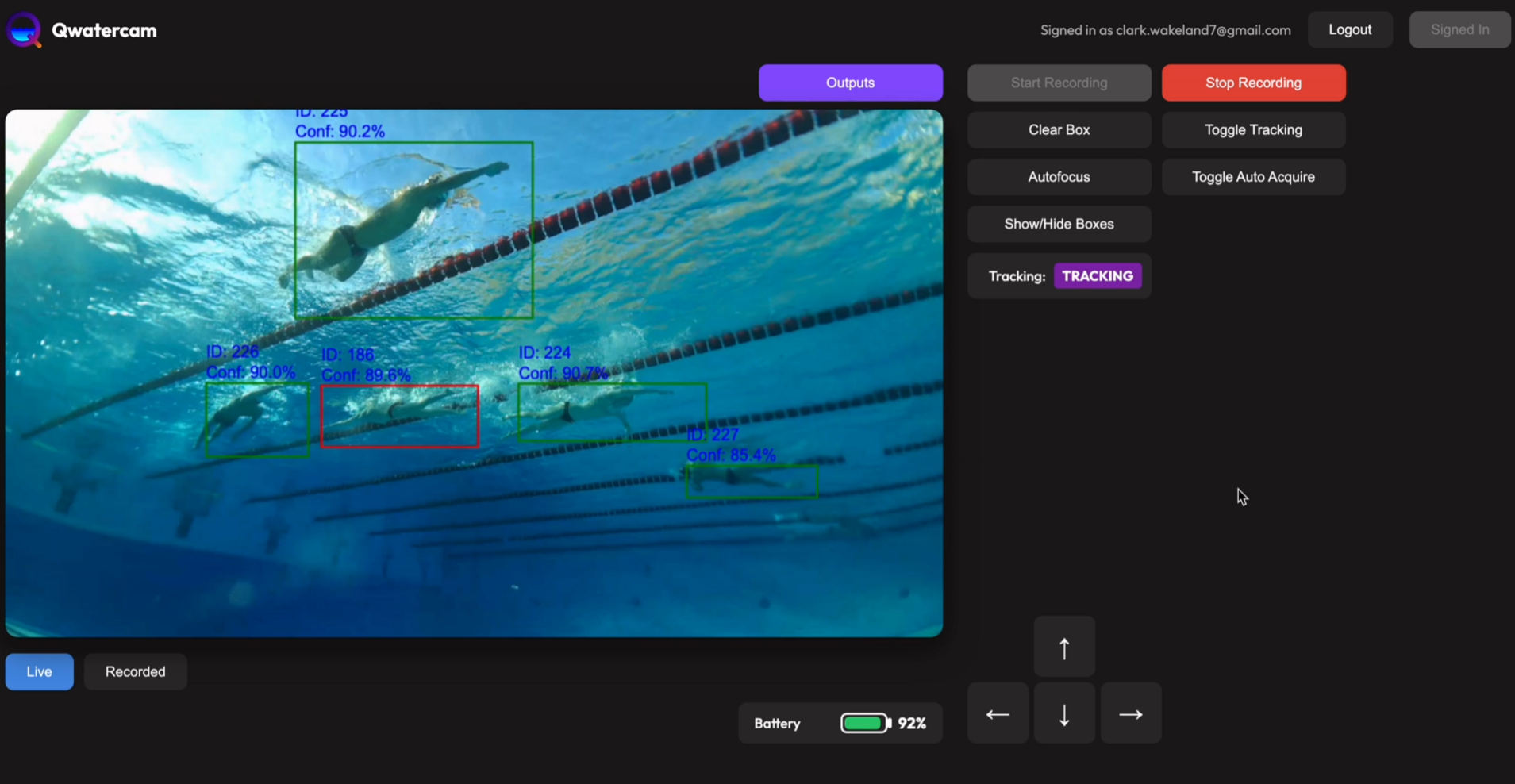
Even with multiple swimmers in frame, Qwatercam can identify and track your chosen swimmer, regardless of orientation changes or brief obstructions by another swimmer.
High(er) Quality Video
Ever notice how most swimming videos look cloudy, blurry, and blocky? There are a lot of reasons for this, but the biggest one is that most video formats don’t have the bitrate to support the fine detail in the water like ripples and bubbles. Qwatercam solves this by streaming video at 15 Mbps, which is *three times* more than most standard 5 Mbps 1080p videos.
If you don’t know what that last paragraph means, just know that Qwatercam videos are always crisp, clear, and high quality.
Cost and Pilot Program
If what you’ve read so far has resonated with you, and you’re frustrated with the limitations of current underwater camera systems, we’ve got great news: Qwatercam is open for pilots! Qwatercam units normally start at $2,500, but as part of the pilot, you get a $1000 discount on a unit (so $1500 total cost), lifetime support from Qwatercam engineering, and early access to new, in development features. There is no subscription required to use Qwatercam, and the physical unit is yours, forever. You can apply for the pilot program by filling out the form at the bottom of our website, qwatercam.com, and sending us a short message.
We welcome feedback, and the more teams that use Qwatercam, the more we can train our models to better detect and track swimmers. Qwatercam is built by swimmers, for the swimming community, so you can always be assured that the product will be developed with that intention in mind.
If you have any thoughts you’d like to share with us, feel free to email [email protected], fill out the form at the bottom of qwatercam.com, or just leave a comment on this article.
Hope to see you soon!
– Clark – Founder, Qwatercam
Qwatercam, a SwimSwam partner.
