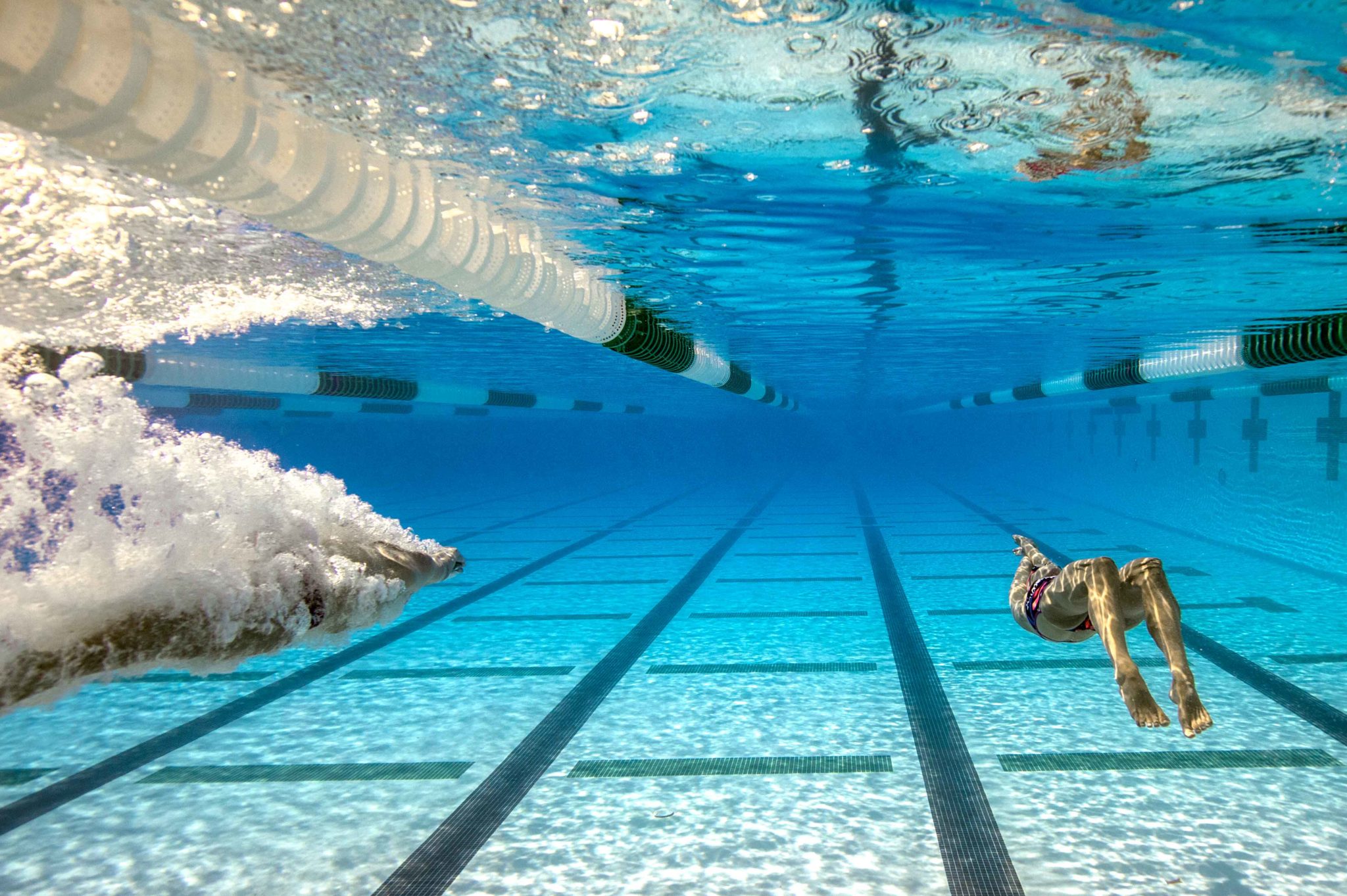
Fast underwaters are one of the essentials for swimmers looking to kick butt on race day.
But the fifth stroke is also the hardest to master.
Compared to the other strokes, dolphin kicking forces swimmers to try and solve several problems at the same time:
- You’re not breathing.
- You’re generating propulsion with some of the largest muscles in the body.
- And you have to coordinate and time a complex movement from the trunk to your toes.
Longer, more dolphiny breakouts come with some costs.
Better understanding them will allow you to train the dolphin kick like a pro and deploy it more smartly on race day.
Breathing constraints
Let’s start with the most obvious trade-off that we are making when we dip, dive, and push-off under the surface to dolphin kick—holding our breath!
Every extra kick we take means further delaying sucking down our next breath. Oxygen availability goes down, CO2 creeps up, and that not-fun discomfort/panic rises in our throats.
As oxygen availability is limited, swimmers are forced to turn to their anaerobic system to keep producing energy.
A study by (Venckunas & Achramavicius, 2024) looked at what happens when swimmers extended their underwaters beyond their usual breakout distance during a below-threshold 200m freestyle.
Instead of their usual 4-5m breakouts, swimmers were instructed to kick out to 12.5m off every wall. Blood lactate shot up with the longer kick-outs:
- Regular underwaters: 3.3 mmol/L.
- Long underwaters: 7.9 mmol/L.
Extending their underwaters pushed swimmers deeper into anaerobic territory.
Fewer breaths, more reliance on anaerobic energy to keep them swimming fast.
Metabolic constraints
Dolphin kicking is also straight-up metabolically expensive, even when we aren’t pushing beyond our usual kick-out distance.
Unlike full-stroke swimming, where energy is spread between the arms and legs, underwater kicking relies heavily on some of the largest muscle groups in the body to generate propulsion.
And they work hard.
- The trunk initiates the movement, creating significant oscillation and bracing the spine
- The hips drive hard in both directions, creating a powerful body wave
- The quadriceps, hamstrings, calves, and even your shins all fire intensely to turn it into propulsion
And all of this stuff happens as the lower body is snapping back and forth aggressively.
Compared to the freestyle kick, dolphin kicking uses way larger amplitude and increased energy cost. And it’s even more expensive than full-stroke swimming.
A study published earlier this year (Segovia-SanBenito et al., 2026) compared what happened when swimmers did 25s fast of:
- Underwater dolphin kick
- Full-stroke swimming
- Using a normal kickout (average of 7.1m) and then swimming the rest of the length
Things like oxygen saturation, perceived effort, and heart rate were relatively the same across the board. But lactate was where things got a little wild.
Dolphin kicking produced lactate values that were almost 50% higher than surface swimming… even though perceived exertion and oxygen saturation were almost the same.
Swimmers were paying a big energy bill but not necessarily feeling the metabolic cost.
This is important to remember because swimmers are dolphin kicking repeatedly, turn after turn, when racing. Swimmers need to train this skill hard and prepare to sustain the metabolic demands of the skill on race day.
Technical constraints
And then comes the trickiest part… mastering the movement of the kick itself.
Dolphin kicking is a really complex movement when you begin to break down all of the stuff that goes into it.
Swimmers need to be able to:
- Create a powerful body wave with their hips/trunk
- Use phase timing that keep vortices from shedding or breaking
- Rotate the hips externally and internally to properly place the feet during each phase and transition
- Drive with the hips and avoid the knee-led kicking motion that destroys the body wave and increases drag
- Inwardly turn the feet to maximize the “whip” at the end of the feet
- Aim for a quicker upkick phase to maximize time in propulsion and recapture vortices
- Clean up transitions to eliminate excess frontal drag
Technique errors can quickly compound into reduced efficiency (and remember—it’s already metabolically thirsty!) and speeds.
Dolphin kicking looks easy and smooth when it’s done at a high level because these swimmers have mastered technique and timing.
They’ve put in the reps. Hit their kick counts. Worked on the skill consistently. And refined the details.
Why It’s Worth the Work
Despite the challenges that come along with the underwater dolphin kick, there is a pay-off for the swimmer who rises to the difficulty of the task.
Underwaters can make up to 60% of your race in a short course pool. (A smidge longer in short course yards.)
And swimmers can travel faster underwater than at the surface.
Leading to faster results on race day.
So, be the swimmer who can manage the breathing demands, tolerate the metabolic cost, and master technique.
Happy kicking!
ABOUT THE AUTHOR
Olivier Poirier-Leroy is a former national-level swimmer, 2x Olympic Trials qualifier, and author of several books for swimmers, including The Dolphin Kick Manual: The Swimmer’s Ultimate Guide to a Fast Underwater Dolphin Kick.
 The book is a beastly 240+ pages of actionable insights and research into elite dolphin kicking technique and performance. It details everything from mastering undulation to vortex recapturing to structuring a dryland program for dolphin kicking success.
The Dolphin Kick Manual combines evidence-based insights with a collection of 20 ready-to-go sets and a 6-week Action Plan to help swimmers set a course for dolphin kicking success.
Train smarter and kick faster.
👉👉👉 Learn more about The Dolphin Kick Manual
